
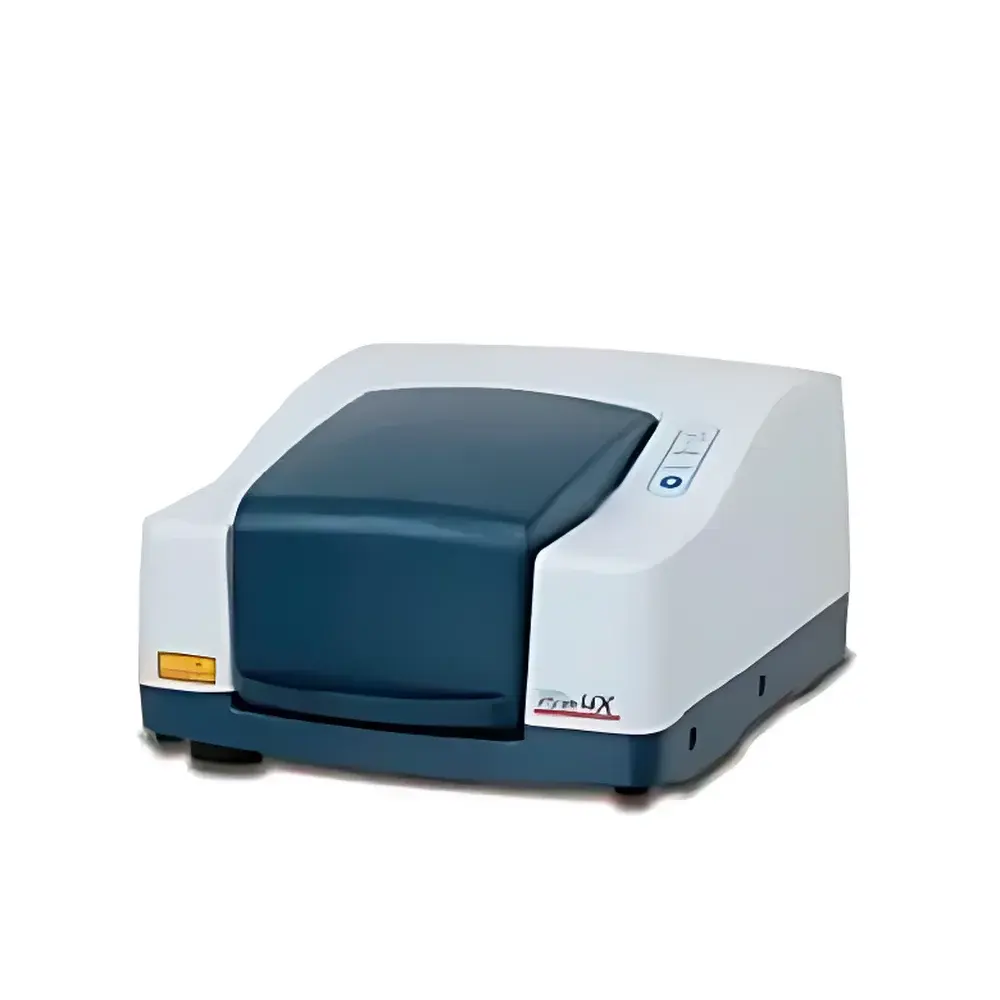
JASCO FT/IR-4X Fourier Transform Infrared Spectrometer
| Brand | JASCO |
|---|---|
| Origin | Japan |
| Instrument Type | Laboratory FTIR Spectrometer |
| Wavenumber Range | 11,500–50 cm⁻¹ |
| Spectral Resolution | 0.4 cm⁻¹ |
| Signal-to-Noise Ratio (S/N) | 35,000:1 |
| Dimensions | 386 mm (W) × 479 mm (D) × 290 mm (H) |
| Interferometer | Sealed, Thermally & Hygroscopically Stabilized Michelson |
| Scan Speed | Up to 80 spectra/sec |
| Detector Compatibility | MCT, InGaAs, DTGS |
| Sample Compartment Width | 200 mm |
| Software | Spectrum Manager Ver. 2.5 with Auto-Diagnostic & Guided Workflow |
Overview
The JASCO FT/IR-4X is a compact, research-grade Fourier Transform Infrared (FTIR) spectrometer engineered for high-fidelity molecular vibrational spectroscopy in academic, pharmaceutical, and industrial R&D laboratories. Based on the interferometric principle—where infrared radiation is split, phase-modulated via a moving mirror in a Michelson interferometer, and recombined to generate an interferogram subsequently Fourier-transformed into a spectrum—the FT/IR-4X delivers quantitative, reproducible spectral data across an extended wavenumber range of 11,500–50 cm⁻¹. Its optical architecture integrates a permanently sealed, maintenance-free interferometer equipped with integrated temperature and humidity sensors to sustain optimal internal dryness—critical for long-term alignment stability and baseline integrity. Designed as a direct evolution of JASCO’s legacy FT/IR-4000 series, the FT/IR-4X achieves a 40% reduction in footprint while retaining full compatibility with standard 200-mm-wide sample compartments and industry-standard optical interfaces.
Key Features
- Compact laboratory platform: 386 mm (W) × 479 mm (D) × 290 mm (H), reducing spatial demand without compromising optical path length or signal fidelity.
- High-performance sealed interferometer: Mechanically robust, thermally compensated, and hygroscopically monitored to eliminate drift and minimize recalibration frequency.
- Ultra-high signal-to-noise ratio: 35,000:1 (at 4 cm⁻¹ resolution, 1 min scan, DTGS detector), enabling detection of trace components and low-absorbance transitions.
- High-speed acquisition capability: Supports up to 80 interferograms per second, facilitating time-resolved studies of kinetic processes, reaction monitoring, and rapid quality screening.
- Sub-0.4 cm⁻¹ nominal resolution: Achievable with apodization and zero-filling, supporting fine-structure analysis in gas-phase spectra and narrow-band absorptions.
- Low-power operation: 30% reduction in energy consumption versus prior-generation benchtop FTIR systems, aligning with institutional sustainability objectives.
Sample Compatibility & Compliance
The FT/IR-4X accommodates a broad range of sample forms—including transmission cells (KBr, CaF₂, ZnSe), ATR accessories (diamond, Ge, ZnSe crystals), reflectance modules (specular, diffuse), and gas cells—via its standardized 200-mm-wide sample compartment. It supports automated accessory recognition for seamless switching between measurement modes. The system is compatible with third-party microscopes (e.g., JASCO FT/IR-4X-MICRO) and multi-channel imaging stages. From a regulatory standpoint, the instrument architecture and Spectrum Manager software support audit-trail-enabled workflows compliant with GLP and GMP environments. Data files conform to JCAMP-DX v5.01 and ASTM E1421 standards; optional 21 CFR Part 11 compliance packages are available for electronic signature and user-access control implementation.
Software & Data Management
Spectrum Manager Ver. 2.5 provides a unified, scriptable environment for instrument control, spectral acquisition, processing (baseline correction, smoothing, derivative calculation, peak integration), and multivariate analysis (PCA, PLS). Upon startup, the software initiates a full hardware self-diagnostic routine—verifying laser alignment, mirror velocity accuracy, detector response, and environmental sensor readings—and reports status in real time. Its guided workflow interface walks users through parameter selection (apodization, zero-filling, coaddition count, resolution setting) based on application context (e.g., “Polymer identification”, “Residual solvent quantitation”, “In-situ catalysis”). All raw interferograms and processed spectra are stored with embedded metadata (date/time, operator ID, instrument serial, accessory ID, environmental logs), ensuring full traceability and FAIR (Findable, Accessible, Interoperable, Reusable) data principles.
Applications
- Pharmaceutical solid-state characterization: Polymorph identification, hydrate/solvate analysis, and excipient compatibility screening per USP and ICH Q5A guidelines.
- Materials science: Crosslink density estimation in elastomers, oxidation state mapping in battery cathodes, and surface functional group verification on nanomaterials.
- Environmental analysis: Quantification of atmospheric VOCs in headspace samples and microplastic identification in filtration residues.
- Academic research: Time-resolved IR studies of photoinduced electron transfer, enzyme kinetics under stopped-flow conditions, and in situ catalytic surface reactions.
- Quality assurance: Raw material verification against reference spectra libraries (e.g., SDBS, NIST IR Database) with automated match scoring and deviation reporting.
FAQ
What is the minimum resolvable wavenumber separation at 0.4 cm⁻¹ resolution?
At 0.4 cm⁻¹ nominal resolution, two adjacent absorption bands can be distinguished when their peak maxima differ by ≥0.4 cm⁻¹—subject to instrumental line shape (typically Lorentzian) and signal-to-noise constraints.
Can the FT/IR-4X operate in purge-free mode?
Yes—its sealed interferometer and desiccant-integrated optical housing enable stable operation without external dry-air or nitrogen purge, though purging is recommended for measurements below 600 cm⁻¹ to minimize atmospheric CO₂/H₂O interference.
Is Spectrum Manager Ver. 2.5 validated for regulated environments?
The base software meets ALCOA+ data integrity principles; full 21 CFR Part 11 validation requires installation of the optional Compliance Pack, including electronic signatures, role-based access control, and immutable audit trails.
Which detectors are supported natively without hardware modification?
DTGS (room-temperature), MCT (liquid-N₂-cooled), and InGaAs (extended NIR) detectors are fully supported via auto-sensed detector interface and calibrated gain switching.
How does the FT/IR-4X maintain wavelength accuracy over time?
A stabilized He–Ne laser serves as the internal wavelength reference; mirror displacement is continuously tracked via laser fringe counting, ensuring long-term wavenumber accuracy within ±0.01 cm⁻¹ (calibrated against NIST-traceable polystyrene film).
Related Products






