
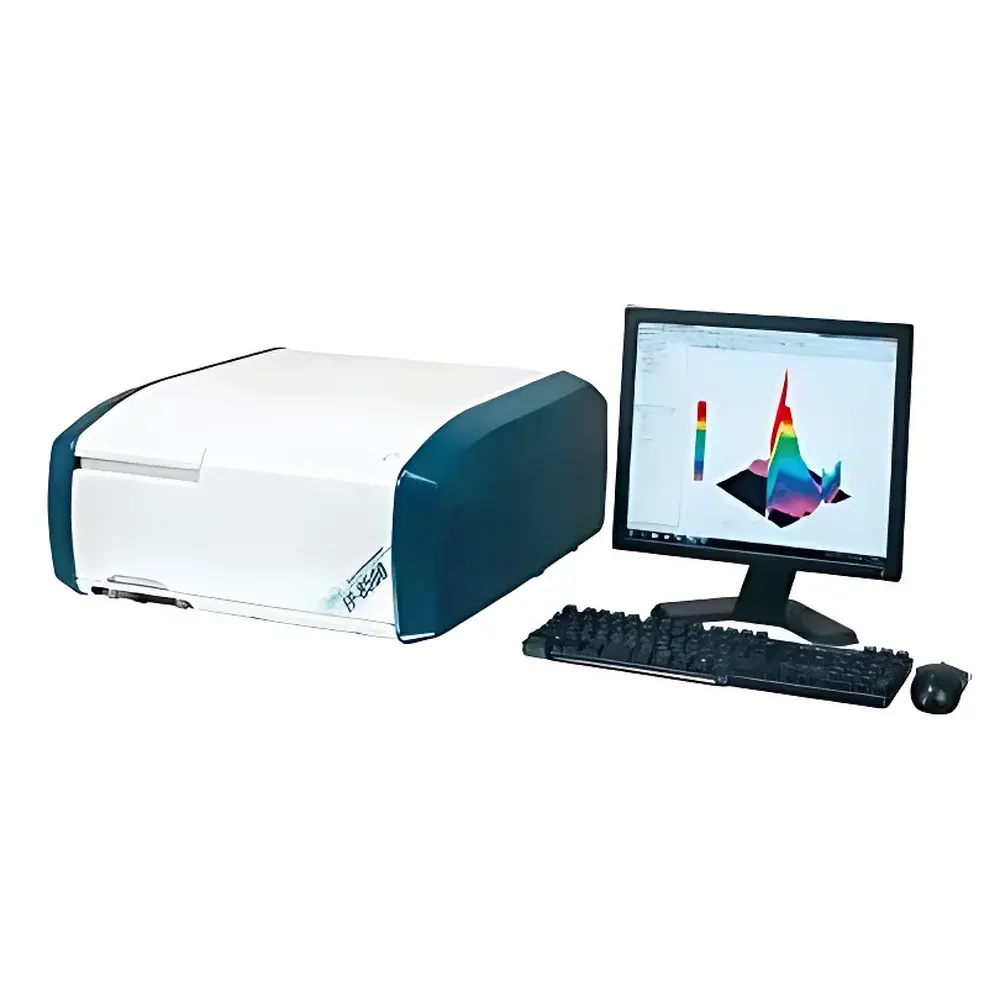
JASCO FP-8000 Series Molecular Fluorescence Spectrometer
| Brand | JASCO |
|---|---|
| Origin | Japan |
| Model | FP-8000 Series |
| Wavelength Range | 200–750 nm (up to 900 nm or 1010 nm depending on model) |
| Excitation Source | 150 W Xenon Arc Lamp |
| Spectral Bandwidth (Slit) | 1–20 nm |
| Resolution | 1.0 nm |
| Wavelength Accuracy | ±1.0 nm |
| Sensitivity (S/N) | >500 (RMS, specified at water Raman peak) |
| Scan Speed | Up to 60,000 nm/min |
| Dynamic Range | >6.5 decades |
| Detection Capability | Phosphorescence lifetime down to 1 ms |
| Dispersion Element | Grating + Order-sorting Filters |
| Accessories Interface | IQ-enabled automatic accessory recognition |
Overview
The JASCO FP-8000 Series Molecular Fluorescence Spectrometer is a high-performance benchtop instrument engineered for quantitative and qualitative fluorescence and phosphorescence analysis across academic research laboratories, pharmaceutical development groups, and advanced materials characterization facilities. Based on double-monochromator optical architecture with optimized stray-light rejection, the system employs a 150 W xenon arc lamp as its excitation source and delivers precise, reproducible spectral data across an extended wavelength range—spanning 200–750 nm (with optional extension to 900 nm on FP-8200/FP-8300 models and up to 1010 nm on the FP-8600). Its fundamental measurement principle relies on photomultiplier tube (PMT)-based detection of emitted photons following monochromatic excitation, enabling both steady-state and time-resolved luminescence measurements. The FP-8000 platform is designed to meet the stringent demands of modern spectroscopic workflows requiring high signal-to-noise ratio, rapid spectral acquisition, and robust thermal and mechanical stability.
Key Features
- High sensitivity performance with S/N > 500 (RMS, measured at the water Raman peak under standard conditions), achieved through low-noise PMT detection and optimized optical throughput.
- Ultra-fast scanning capability up to 60,000 nm/min, significantly reducing acquisition time for kinetic studies and high-throughput screening applications.
- Variable spectral bandwidth control (1–20 nm) via motorized slits, supporting both high-resolution spectral deconvolution and high-intensity signal collection.
- Automatic higher-order diffraction cutoff filters integrated into the emission monochromator path, eliminating manual filter changes and ensuring spectral purity without operator intervention.
- IQ-enabled accessory recognition system that automatically detects and configures connected modules—including temperature-controlled cuvette holders, integrating spheres, and fluorescence anisotropy kits—minimizing setup errors and enhancing protocol reproducibility.
- Extended phosphorescence measurement capability with microsecond-to-millisecond lifetime resolution, enabled by gated detection modes and synchronized delay electronics.
- Double-grating monochromators with precision stepper-motor drive ensure long-term wavelength stability and repeatability, critical for regulatory-compliant data generation.
Sample Compatibility & Compliance
The FP-8000 Series accommodates standard 10 mm square quartz cuvettes, microvolume cells (down to 50 µL), solid-sample holders, and fiber-optic probes for non-invasive or remote measurements. Optional accessories include Peltier-controlled temperature units (–10 °C to +105 °C), integrating spheres for absolute quantum yield determination (compliant with ASTM E2758), and titration/stopped-flow modules for reaction kinetics. The system supports GLP/GMP-aligned operation when used with Spectra Manager™ II software configured for 21 CFR Part 11 compliance—including electronic signatures, audit trails, and user-access controls. All optical components are certified to ISO 9001 manufacturing standards, and wavelength calibration traceability follows NIST-traceable reference materials.
Software & Data Management
Controlled exclusively via Spectra Manager™ II—a modular, Windows-based application—the FP-8000 enables full instrument automation, multi-dimensional data acquisition (e.g., excitation-emission matrices), and advanced post-processing including spectral subtraction, peak deconvolution, and lifetime decay fitting. Raw data are stored in vendor-neutral ASCII formats (.txt, .csv) alongside proprietary .spm files containing metadata such as instrument configuration, calibration history, and environmental logs. Batch processing, report templating, and export to third-party platforms (OriginLab, MATLAB, Python via CSV) are natively supported. Audit trail functionality records all parameter modifications, data exports, and user logins—essential for FDA inspections and internal quality audits.
Applications
- Quantitative analysis of fluorophores in biopharmaceutical formulations (e.g., tryptophan quantification in monoclonal antibodies).
- Characterization of quantum dots, perovskite nanocrystals, and organic light-emitting materials (OLEDs) via excitation-emission mapping and quantum yield assessment.
- Protein folding/unfolding studies using intrinsic fluorescence and anisotropy decay analysis.
- Environmental monitoring of polycyclic aromatic hydrocarbons (PAHs) in aqueous extracts.
- Phosphorescent oxygen sensing in polymer films and biological tissues.
- Method development and validation per ICH Q2(R2) guidelines for analytical procedures in regulated environments.
FAQ
What is the maximum emission wavelength range available on the FP-8000 Series?
The FP-8200 and FP-8300 support emission up to 900 nm; the FP-8500 extends to 850 nm; and the FP-8600 achieves full coverage to 1010 nm.
Does the system support time-resolved fluorescence measurements?
Yes—the FP-8000 Series supports gated detection for phosphorescence lifetimes ≥1 ms; for sub-millisecond resolution, external TCSPC hardware integration is recommended.
Is Spectra Manager™ II compliant with 21 CFR Part 11?
Yes, when deployed with appropriate server configuration, user role assignment, and digital signature modules, it satisfies electronic record and signature requirements for regulated labs.
Can the instrument perform absolute quantum yield measurements?
Yes—with the optional integrating sphere accessory and calibrated reference standards, the system complies with ASTM E2758 for absolute photoluminescence quantum yield determination.
What maintenance is required for optimal long-term performance?
Annual wavelength and intensity calibration using NIST-traceable standards is recommended; xenon lamp replacement every 1,000–1,500 hours; and periodic cleaning of optical surfaces per JASCO’s Maintenance Protocol Rev. 4.2.







