
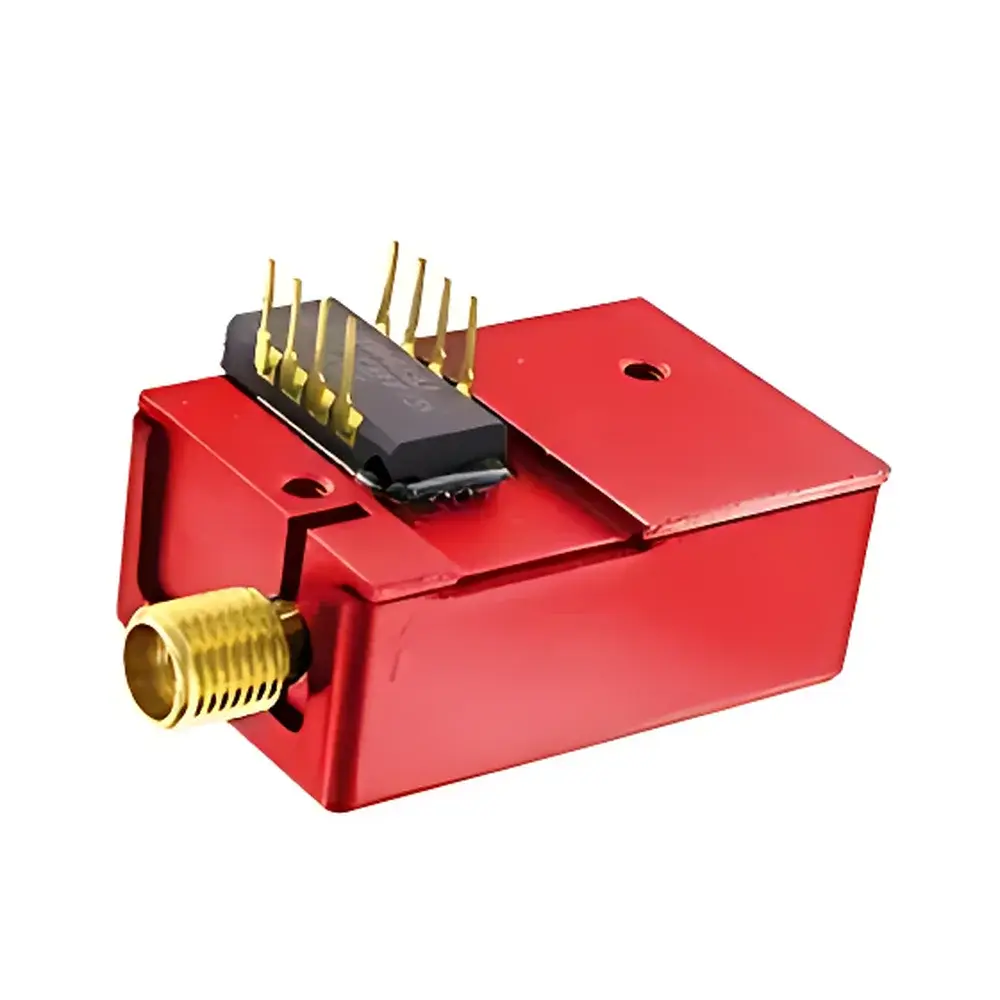
HORIBA JY VS20 Customizable Miniature Grating Spectrometer
| Brand | HORIBA |
|---|---|
| Origin | France |
| Model | VS20 |
| Optical Configuration | Czerny–Turner with concave holographic grating |
| Spectral Range | 200–1700 nm |
| Spectral Resolution | 6.5 nm (FWHM, typical) |
| Dispersion | 90 nm/mm |
| F/# | 2.7 |
| Wavelength Accuracy | < ±0.5 nm |
| Stray Light | < 0.25% @ 260 nm |
| Thermal Drift | < 0.03 nm/°C |
| Dimensions | 15 × 22 × 35 mm |
| Detector Compatibility | CMOS, CCD, InGaAs (e.g., Hamamatsu S837X, S390X, S1011X |
| Application Modes | Transmission & Reflection Spectroscopy |
| Compliance | RoHS-compliant optical housing, ISO 9001 manufacturing environment |
Overview
The HORIBA JY VS20 is a compact, high-stability miniature grating spectrometer engineered for integration into portable, handheld, and OEM analytical platforms. Based on a simplified Czerny–Turner optical layout featuring a single 20 mm focal length concave holographic grating, the VS20 eliminates intermediate mirrors and collimating optics—reducing alignment sensitivity and enhancing mechanical robustness. Its core design principle centers on optical simplicity without compromising spectral fidelity: the monolithic grating serves simultaneously as collimator, disperser, and focusing element, enabling exceptional thermal and vibrational stability (< 0.03 nm/°C wavelength shift). With full spectral coverage from deep UV (200 nm) to short-wave near-infrared (1700 nm), the VS20 supports multi-range configurations—including UV-Vis (200–750 nm), Vis-NIR (550–1015 nm), and SWIR (800–1700 nm)—all configurable via interchangeable grating options and detector modules. Its f/2.7 aperture ensures high light throughput, critical for low-intensity or rapid-acquisition applications such as real-time process monitoring or battery-powered field instrumentation.
Key Features
- Ultra-compact footprint: 15 × 22 × 35 mm — among the smallest commercially available full-range spectrometers
- Optically stable monolithic design: No moving parts or adjustable optics; optimized for shock and thermal resilience
- Low stray light performance: < 0.25% at 260 nm, < 0.1% at 400 nm, and < 0.2% at 600 nm — essential for high-dynamic-range absorbance and fluorescence measurements
- High spectral reproducibility: Wavelength accuracy better than ±0.5 nm across the entire range, verified per NIST-traceable calibration protocols
- Modular detector interface: Supports industry-standard linear array detectors including silicon-based CMOS/CCD (e.g., Hamamatsu S837X series) and extended-InGaAs sensors (e.g., G9211-256, SU256-LSB)
- OEM-ready architecture: Designed for high-volume integration with standardized electrical interfaces (LVDS or USB 2.0), minimal thermal management requirements, and scalable assembly
Sample Compatibility & Compliance
The VS20 is compatible with standard fiber-optic coupling (SMA 905), enabling seamless interfacing with transmission cuvettes, integrating spheres, reflection probes, and flow cells. It meets key regulatory expectations for analytical instrumentation used in regulated environments: its optical housing complies with RoHS directives, and final assembly occurs in HORIBA’s ISO 9001-certified facility in Longjumeau, France. While the VS20 itself is not a standalone GLP/GMP instrument, its spectral stability, traceable calibration, and deterministic optical response support validation workflows aligned with ASTM E275, ISO 17025, and USP guidelines for spectrophotometric system suitability. When integrated into validated systems (e.g., inline water quality monitors or pharmaceutical colorimeters), it contributes to audit-ready data integrity under FDA 21 CFR Part 11-compliant software architectures.
Software & Data Management
The VS20 operates via HORIBA’s SDK (Software Development Kit), providing low-level register access, exposure control, dark current subtraction, and pixel binning configuration. It integrates natively with third-party platforms including LabVIEW, Python (via PyVISA or custom ctypes wrappers), and MATLAB. Raw spectra are output in 16-bit integer format with optional on-board dark correction and nonlinearity compensation. Time-series acquisition supports frame rates up to 1 kHz (dependent on detector and interface), with metadata tagging (timestamp, integration time, temperature) embedded in each spectrum header. For regulated use, the SDK supports external logging hooks to enable full audit trails, electronic signatures, and version-controlled firmware updates—prerequisites for deployment in GxP environments.
Applications
- Field-deployable water quality analyzers measuring nitrate, dissolved organic carbon (DOC), and turbidity via UV-Vis absorption
- Portable bioreactor monitoring for real-time NADH/NADPH or biomass estimation in fermentation processes
- OEM integration into HPLC detectors for dual-wavelength peak tracking and purity assessment
- In-line colorimetric control in paint, textile, and display manufacturing
- LED spectral power distribution (SPD) characterization and binning in production test fixtures
- Rapid screening of food adulterants (e.g., melamine, Sudan dyes) using reflectance NIR fingerprinting
- Wafer-level photoluminescence (PL) mapping in semiconductor fab metrology tools
FAQ
Can the VS20 be calibrated for absolute irradiance measurement?
Yes—when paired with an NIST-traceable calibration source (e.g., tungsten-halogen lamp with known spectral radiance), the VS20 supports relative and absolute responsivity calibration. HORIBA provides factory calibration certificates; end-users may perform re-calibration using standard procedures outlined in ASTM E308.
Is thermal stabilization required for laboratory-grade repeatability?
No active cooling is needed. The intrinsic thermal drift (< 0.03 nm/°C) allows stable operation over ambient ranges of 15–35°C without recalibration. For sub-nm stability over wider temperature spans, optional thermistor feedback and software-based wavelength correction are supported via the SDK.
What is the minimum integration time and how does it affect SNR?
Minimum integration time is 1 ms (detector-dependent). Signal-to-noise ratio scales with √t, so longer exposures improve detection limits—particularly in UV and SWIR bands where quantum efficiency declines. On-chip binning and external averaging further enhance SNR without sacrificing frame rate.
Are custom grating options available for narrowband applications?
Yes—HORIBA offers application-specific grating variants (e.g., 1200 g/mm for enhanced UV resolution or blazed 300 g/mm for SWIR throughput), subject to MOQ and lead time. All custom configurations retain identical mechanical and electrical interfaces.





