
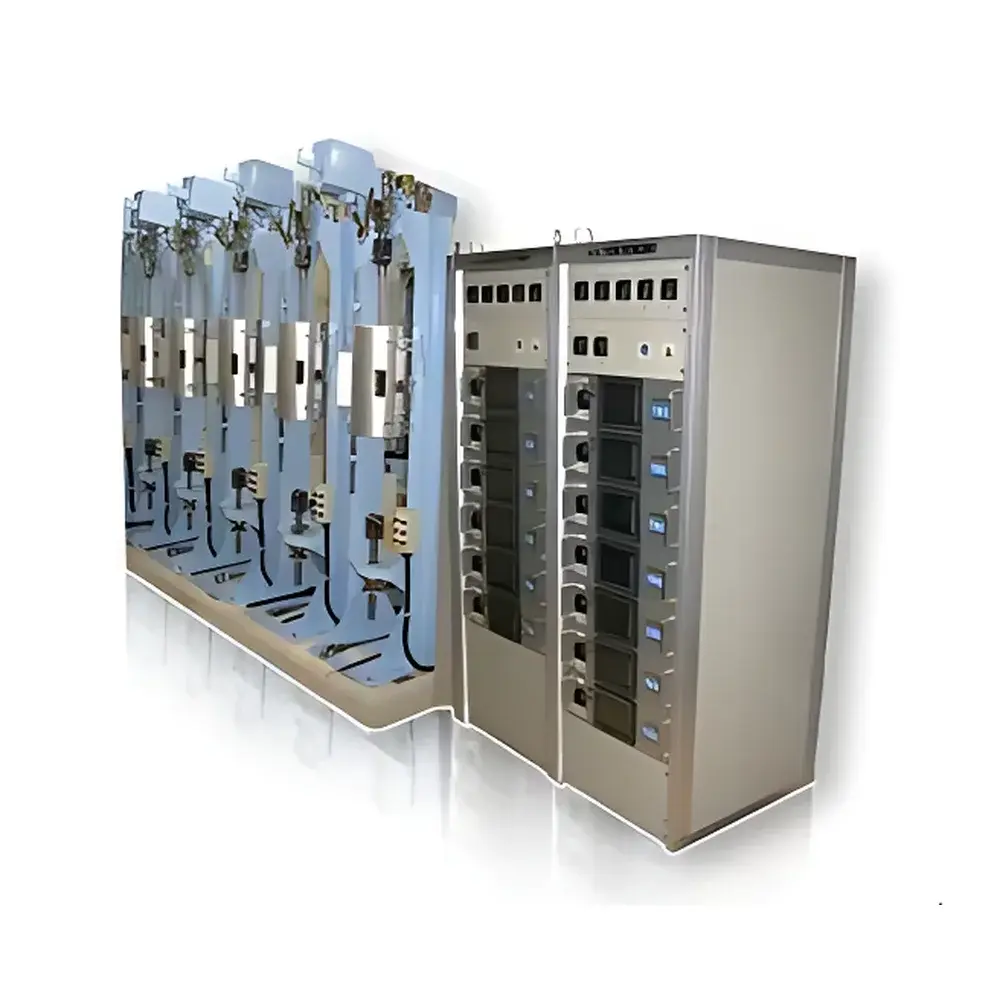
High-Performance High-Temperature Creep Testing Machine TKS Model HT-CRE-30
| Key | Origin: Japan |
|---|---|
| Manufacturer Type | Authorized Distributor |
| Origin Category | Imported |
| Model | HT-CRE-30 |
| Quotation | Upon Request |
| Max Test Load | 5–30 kN |
| Temp Range (Standard) | 300–900 °C |
| Max Temp | 1000 °C |
| Optional | High-Temp Creep Extensometer |
Overview
The TKS HT-CRE-30 High-Performance High-Temperature Creep Testing Machine is an engineered solution for time-dependent mechanical characterization of structural materials under sustained uniaxial loading at elevated temperatures. Based on the fundamental principles of high-temperature creep mechanics—governed by thermally activated dislocation motion, grain boundary sliding, and diffusional processes—the system enables precise quantification of strain accumulation (creep strain), minimum creep rate, time to rupture, and tertiary acceleration behavior. Designed for long-duration testing up to 10,000 hours, it supports ASTM E139, ISO 204, and ASTM E292 standard test protocols. Its rigid load frame, low-drift electro-mechanical actuation system, and integrated thermal management architecture ensure dimensional stability and force fidelity across extended thermal cycles.
Key Features
- Modular load train with calibrated servo-controlled loading system delivering stable axial forces from 5 kN to 30 kN (±0.5% full scale accuracy), traceable to JCSS-certified standards;
- High-stability three-zone furnace assembly featuring SiC heating elements and multi-point PID feedback control, enabling uniform temperature distribution (±2 °C) within ±15 mm of the gauge section across the 300–1000 °C operating range;
- Dual-sensor thermal monitoring: embedded Type K thermocouples at specimen mid-span and furnace wall, plus optional optical pyrometry for non-contact surface temperature validation;
- Integrated high-temperature extensometry option (HT-CRE-EXT): air-cooled ceramic guide rods, sapphire-tipped levers, and LVDT-based displacement transduction rated for continuous operation at 1000 °C with resolution ≤0.1 µm;
- Real-time data acquisition at 10 Hz sampling rate, synchronized across load, temperature, axial displacement, and environmental chamber parameters;
- Robust mechanical design compliant with ISO 12100 safety principles, including redundant over-temperature cutoffs, emergency load dump solenoid, and interlocked access doors.
Sample Compatibility & Compliance
The HT-CRE-30 accommodates standard creep specimens per ASTM E8M/E8, ISO 6892-2, and GB/T 2039 formats—including round bar (φ3–10 mm), flat dog-bone, and notched configurations—with custom grips available for nickel-based superalloys, austenitic stainless steels, ferritic/martensitic steels, and ceramic matrix composites. All hardware contacting the specimen at elevated temperature is fabricated from recrystallized alumina or molybdenum alloys to prevent contamination and oxidation-induced measurement drift. The system meets requirements for GLP-compliant material qualification and supports audit-ready documentation per FDA 21 CFR Part 11 when paired with TKS CreepSuite™ software (see Software & Data Management).
Software & Data Management
TKS CreepSuite™ v4.2 provides deterministic real-time control, automated test sequencing, and standardized reporting templates aligned with ISO/IEC 17025 laboratory accreditation criteria. The software enforces electronic signatures, full audit trails (user actions, parameter changes, calibration events), and encrypted data storage with SHA-256 hashing. Raw time-series datasets are exported in HDF5 format with embedded metadata (test standard, specimen ID, operator, calibration certificates). Batch analysis modules support Larson-Miller parameter calculation, Monkman-Grant correlation, and Norton-Bailey power-law fitting with uncertainty propagation per GUM (JCGM 100:2018). Export options include PDF reports compliant with EN 10002-5 and Excel-compatible CSV for integration into enterprise LIMS platforms.
Applications
- Life assessment of turbine rotor discs, blades, and casings in fossil-fueled and combined-cycle power plants;
- Creep-fatigue interaction studies for pressure vessel components in Generation III+ nuclear reactors (e.g., SA-508 Cl.4a, Alloy 617);
- Qualification of additively manufactured Ni-superalloys (e.g., IN738LC, CM247LC) under simulated service thermal-mechanical cycling;
- Development and validation of constitutive models for ASME Section III Division 5 high-temperature design codes;
- Long-term reliability screening of brazed joints and thermal barrier coating systems used in gas turbine hot-section components.
FAQ
What standards does the HT-CRE-30 support for creep testing?
ASTM E139, ASTM E292, ISO 204, ISO 6892-2, and JIS Z 2271 are fully implemented in test method libraries and reporting templates.
Can the system perform creep tests under inert or controlled atmospheres?
Yes—optional quartz or alumina tube furnaces with flanged vacuum/gas ports support argon, helium, or forming gas environments down to 1×10⁻³ mbar base pressure.
Is high-temperature extensometry included as standard equipment?
No—the HT-CRE-EXT high-temperature extensometer is an optional add-on; standard displacement measurement uses furnace-mounted linear variable differential transformers (LVDTs) with water-cooled housings.
How is force calibration maintained during extended high-temperature operation?
Load cells are mounted outside the furnace zone and thermally isolated; periodic in-situ verification is performed using NIST-traceable dead-weight calibrators prior to each test series.
Does the system support remote monitoring and diagnostics?
Yes—via secure TLS 1.2-enabled web interface with role-based access control, live dashboard views, and SNMP-based alerting for temperature deviation, load instability, or communication timeout events.



