
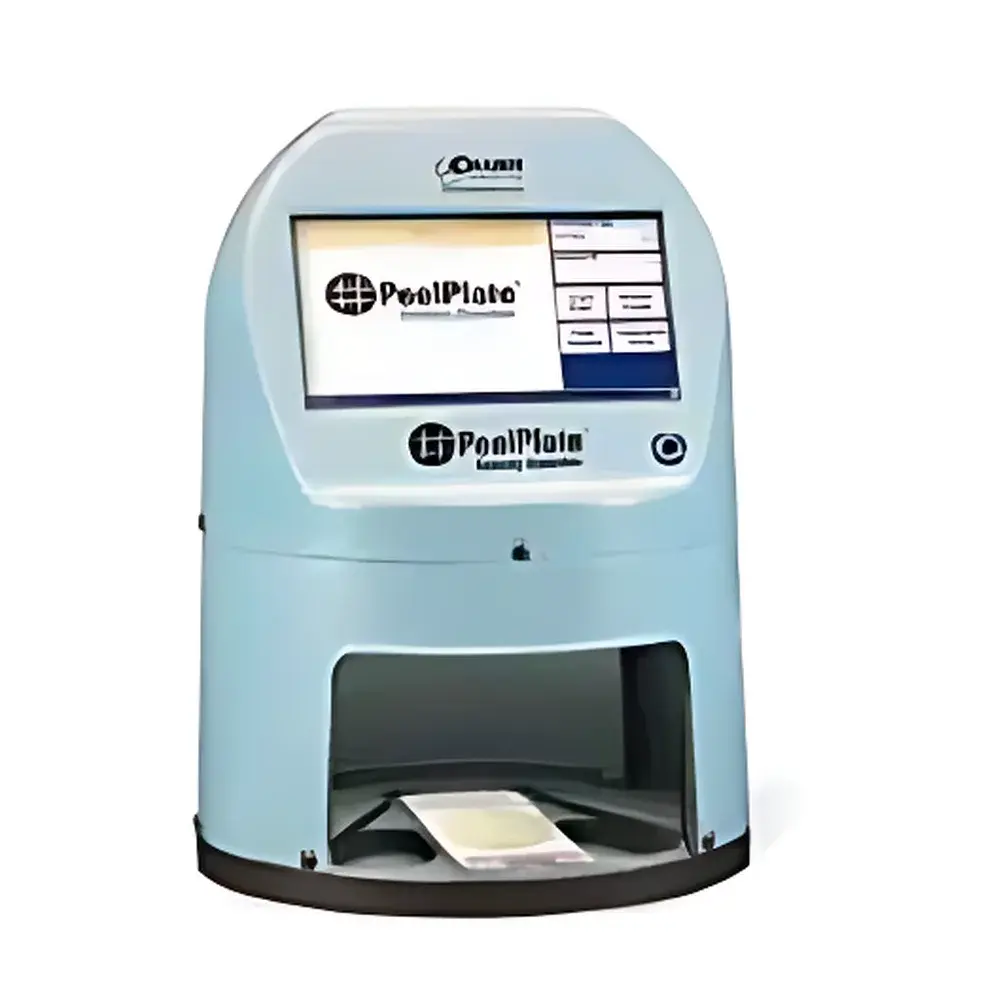
Charm Peel Plate Colony Counter
| Brand | Charm |
|---|---|
| Origin | USA |
| Manufacturer Type | Authorized Distributor |
| Product Category | Imported Instrument |
| Model | Charm Peel Plate Colony Counter |
| Price Range | USD 7,000 – 14,000 (FOB) |
| Instrument Type | Semi-Automatic Microbial Enumeration System |
| Detection Throughput | Up to 96 Peel Plate™ assays per hour (based on standard workflow) |
| Compatible Assay Formats | Total Aerobic Count, *E. coli*, Coliforms, Yeast & Mold, Enterobacteriaceae |
| Integrated Camera Resolution | ≥5 MP |
| Display | 6.75-inch diagonal touchscreen LCD |
| Dimensions (W × H × D) | 32.0 × 22.86 × 16.764 cm |
| Weight | 4.54 kg (10 lbs) |
| Power Supply | 100–240 V AC, 50/60 Hz |
| Onboard Storage Capacity | 66,000 assay records |
| Data Export Formats | JPEG (raw & processed images), CSV (quantitative results), SQL-compatible database output via Ethernet |
| Input Devices | Wireless keyboard/mouse, optional barcode scanner |
| Calibration Check | Configurable frequency — at startup, after user-defined count intervals, or on-demand |
| User Roles | Dual-tier (Operator + Administrator) with role-based access control (RBAC) |
| Compliance | Designed for GLP-compliant environments |
Overview
The Charm Peel Plate Colony Counter is a dedicated, self-contained semi-automatic imaging system engineered for rapid, objective enumeration of microbial colonies grown on proprietary Peel Plate™ chromogenic detection films. Unlike conventional manual counting or generic digital colony counters, this instrument is purpose-built to interpret the optical contrast, morphology, and spatial distribution characteristics unique to Charm’s standardized, single-use, dry-film microbiological assays. It operates on the principle of high-contrast digital image acquisition followed by deterministic algorithmic segmentation and classification—leveraging pre-validated thresholds for colorimetric response, colony size range (≥0.1 mm diameter), and edge definition to distinguish true positive colonies from background artifacts or film imperfections. The system eliminates subjective visual interpretation while maintaining full traceability of raw image data, processing parameters, and final counts—making it suitable for routine quality control in food safety laboratories, pharmaceutical manufacturing QC units, and contract testing facilities operating under ISO/IEC 17025 or cGMP frameworks.
Key Features
- Integrated 5-megapixel industrial-grade camera with fixed-focus optics optimized for uniform illumination and minimal distortion across the entire Peel Plate™ surface (90 mm × 90 mm active area)
- Onboard embedded computer running real-time Linux-based firmware—no external PC required for operation, data capture, or basic reporting
- Dual-user authentication architecture: Operator-level access permits assay execution and result review; Administrator-level access enables user management, plate-type configuration, calibration scheduling, and secure data archiving
- Configurable calibration verification: Automatic optical and algorithmic validation triggered at power-on, after every N counts (N = 1–999, user-defined), or manually initiated—ensuring consistent performance across shifts and operators
- Comprehensive data provenance: Each assay generates three immutable JPEG files—original image, thresholded binary mask, and annotated overlay—and one timestamped CSV record containing colony count, average size (µm²), and confidence score
- Network-ready Ethernet interface supporting direct integration into LIMS or SQL-based laboratory databases without middleware; optional barcode scanning streamlines sample ID assignment and chain-of-custody tracking
Sample Compatibility & Compliance
The Charm Peel Plate Colony Counter is validated exclusively for use with Charm Sciences’ family of AOAC-PTM- and ISO 16140-verified Peel Plate™ formats—including Total Aerobic Count (TAC), *Escherichia coli*/*Coliform* dual-detection, Yeast & Mold (Y&M), and Enterobacteriaceae-specific assays. It does not support agar-based Petri dishes, membrane filters, or non-Charm proprietary films. Its design aligns with regulatory expectations for automated microbial enumeration systems: built-in audit trail functionality logs all user actions, parameter changes, and calibration events with timestamps and operator IDs; data export protocols preserve original image metadata (EXIF) and enforce write-once-read-many (WORM) storage logic for critical records. While not certified as “21 CFR Part 11 compliant” out-of-the-box, the system provides the foundational technical controls—electronic signatures, role-based permissions, and tamper-evident logging—required for validation against Part 11 Annex A during site-specific IQ/OQ/PQ protocols.
Software & Data Management
Firmware v3.2+ includes an intuitive touch-driven interface with multilingual support (English, Spanish, French, Mandarin). All image processing occurs locally using deterministic algorithms—not AI or machine learning—to ensure reproducibility and eliminate model drift concerns. Raw images are stored in lossless JPEG format with embedded ICC profiles; quantitative outputs include total colony count, mean colony area (µm²), coefficient of variation (%CV) per plate, and pass/fail status relative to user-set thresholds. Data export options include USB mass storage dump, network file transfer (SFTP), or direct insertion into ODBC-compliant relational databases. Administrators may define custom report templates (PDF/CSV) with configurable fields: sample ID, analyst name, date/time, plate lot number, and environmental conditions (if integrated with external sensors).
Applications
This system serves as a core enumeration tool in regulated environments where speed, repeatability, and documentation rigor are mandatory. Typical use cases include: shelf-life challenge studies for ready-to-eat foods; environmental monitoring programs in sterile pharmaceutical production suites; raw material release testing per USP <61>/<62>; and supplier qualification audits requiring auditable, operator-independent colony counts. Its portability (10-lb footprint) and battery-free operation make it deployable in mobile labs, cold-chain inspection points, or field-deployed food safety response units—without compromising analytical traceability.
FAQ
Is the Charm Peel Plate Colony Counter compatible with non-Charm detection media?
No. It is calibrated and validated solely for Charm Peel Plate™ films. Use with other substrates voids accuracy guarantees and regulatory acceptability.
Can I validate this system per ISO/IEC 17025 or FDA requirements?
Yes. The instrument provides all necessary raw data, metadata, and audit logs required for method validation and equipment qualification under ISO/IEC 17025:2017 Clause 6.4 and FDA guidance on computerized systems.
How often must calibration be performed?
Calibration checks are fully configurable—users may set automatic verification at startup, after each assay, or after any integer number of counts (1–999); no scheduled recalibration is required unless hardware maintenance is performed.
Does the system support electronic signatures for GLP compliance?
It supports role-based login and action logging with timestamps and user IDs—serving as the technical foundation for electronic signature implementation during local validation; signature policy enforcement remains the responsibility of the laboratory’s QMS.
What happens if a Peel Plate™ shows condensation or uneven development?
The software flags low-contrast or saturated regions during preprocessing and prompts the operator to either re-scan or manually override; such events are logged with severity tags and preserved in the audit trail.




