
Custom-Built Walk-In Environmental Chamber for Temperature and Humidity Control
| Brand | OEM / Third-Party Manufacturer |
|---|---|
| Origin | Imported |
| Manufacturer Type | Authorized Distributor |
| Temperature Range | −40 °C to +130 °C |
| Humidity Range | 20 %RH to 98 %RH |
| Temperature Uniformity | ±2 °C |
| Humidity Uniformity | ±3.0 %RH (steady-state) |
| Temperature Fluctuation | ±0.5 °C |
| Humidity Fluctuation | ±2.5 %RH (steady-state) |
| Heating Rate | ~2.5 °C/min (air, no-load, non-linear) |
| Cooling Rate | ~1 °C/min (air, no-load, non-linear) |
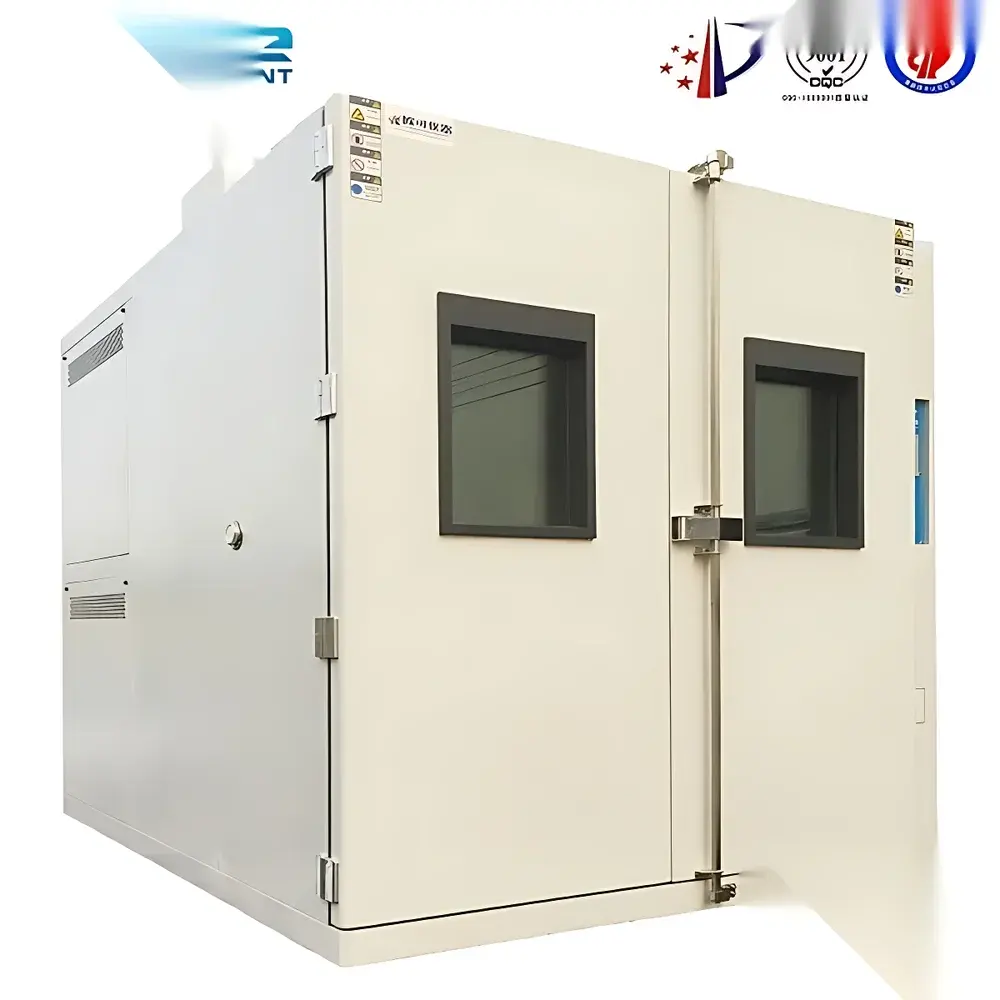
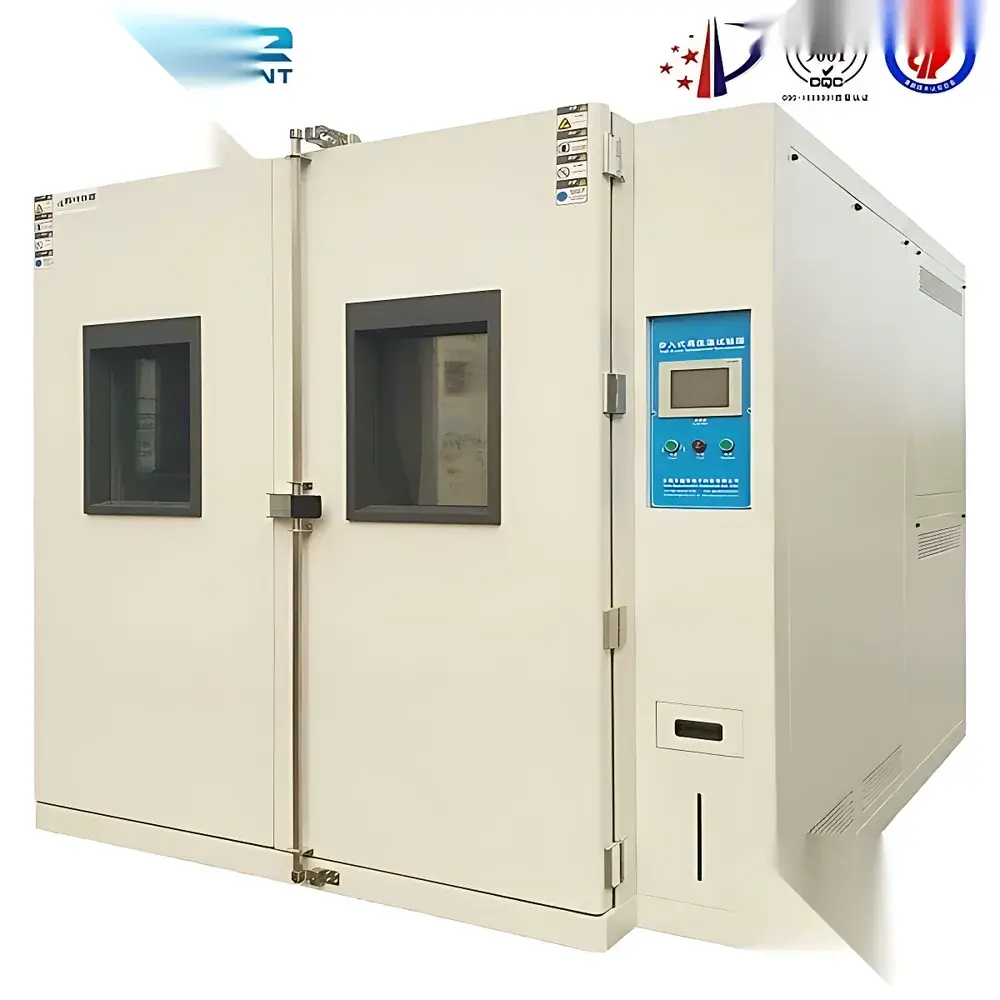
| Internal Dimensions (W×D×H) | 3000 × 1000 × 2000 mm |
| External Dimensions (W×D×H) | 3800 × 1300 × 2450 mm |
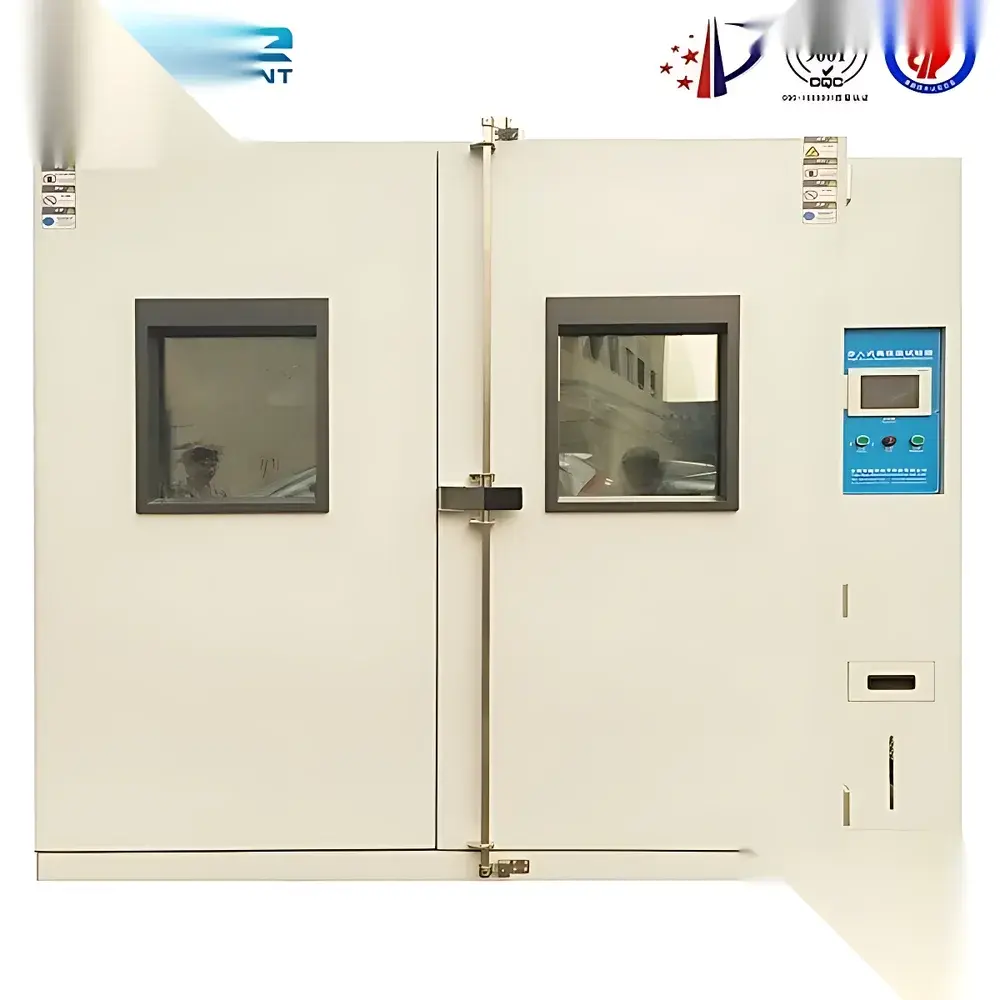
| Door | Single outward-opening, 1000 × 1900 mm |
| Observation Windows | Front (300 × 450 mm), Left Side (500 × 450 mm) |
| Refrigeration | Mechanical compression refrigeration with water-cooling |
| Power Supply | 380 V ±10 %, 50/60 Hz |
| Total Power Consumption | ~30 kVA |
| Heat Load Capacity | 8.5 kW |
| Compliance | GB10589, GB10592, GB10586, GB11158, GB2423.1–GB2423.4, GB2423.22, GB/T5170.2, GB/T5170.5 |
Overview
The Custom-Built Walk-In Environmental Chamber for Temperature and Humidity Control is an engineered solution designed for rigorous environmental simulation in industrial R&D, quality assurance, and product validation laboratories. Based on the principles of forced-air convection, precision dew-point control, and dual-stage mechanical refrigeration with integrated water-cooling, this chamber delivers stable, repeatable thermal and hygrometric conditions across a wide operational envelope. Unlike standardized benchtop chambers, this system is fully customized to meet client-specific spatial, load, and regulatory requirements—including structural integration into existing facility infrastructure, specialized access configurations, and extended operational duty cycles. The chamber operates under ISO/IEC 17025-aligned environmental test conditions, with all performance metrics validated per national standards (GB series) and traceable to primary metrological references. Its architecture supports both steady-state conditioning and dynamic cycling protocols, making it suitable for compliance testing against IEC, MIL-STD, and automotive OEM specifications where long-duration exposure at extreme conditions is required.
Key Features
- Structurally reinforced steel frame with six adjustable mushroom-head leveling feet and heavy-duty swivel casters for controlled mobility and load distribution—designed to support ≥1,500 kg static load with ≤0.1 mm deflection under full operational stress.
- Double-wall insulated enclosure using high-density polyurethane foam (≥120 mm thickness, λ ≤ 0.022 W/m·K) with vapor barrier lamination to minimize thermal bridging and condensation risk.
- Water-cooled refrigeration system utilizing R404A/R23 cascade compressors, enabling rapid cooling down to −40 °C without reliance on ambient air exchange—critical for high-heat-load applications (e.g., powered electronics or battery packs).
- High-accuracy Pt100 temperature sensors and capacitive humidity transducers mounted at the supply air outlet and geometric center point, with real-time compensation for airflow dynamics and sensor drift.
- Full-panel PLC-based controller with 10.4″ color touchscreen interface, supporting up to 99 programmable test profiles, ramp/soak sequences, and user-defined alarm thresholds with event logging.
- Integrated safety architecture including over-temperature cutoff, high-pressure refrigerant shutdown, door interlock, emergency stop circuit, and automatic condensate pump monitoring.
Sample Compatibility & Compliance
This chamber accommodates large-format samples—including automotive ECUs, aerospace avionics enclosures, medical device sterilization trays, and industrial control cabinets—without compromising uniformity or control fidelity. Its internal volume (6 m³ net) permits simultaneous conditioning of multiple units under identical boundary conditions. All performance verification follows GB/T5170.2 (temperature) and GB/T5170.5 (humidity) test methods, with measurement uncertainty budgets documented per ISO/IEC 17025 Annex A. The system meets functional equivalency to ASTM E145 Class II, IEC 60068-2-1 (cold), IEC 60068-2-2 (dry heat), and IEC 60068-2-30 (damp heat cyclic) when operated within specified ambient and utility constraints (cooling water: 10–30 °C, 0.1–0.3 MPa). Optional calibration certificates are available from CNAS-accredited third-party labs upon request.
Software & Data Management
The embedded controller logs time-stamped temperature/humidity data at 1-second intervals, storing ≥30 days locally with automatic rollover. Data export is supported via USB 2.0 or Ethernet (Modbus TCP/IP) to external SCADA or LIMS platforms. Audit trail functionality complies with GLP and GMP requirements: all parameter changes, profile uploads, and manual overrides are timestamped, user-ID tagged, and immutable once recorded. Optional software packages enable remote monitoring via secure HTTPS, automated report generation (PDF/CSV), and integration with enterprise MES systems using OPC UA protocol stacks. Full 21 CFR Part 11 compliance—including electronic signatures, role-based access control, and data integrity validation—is achievable through validated firmware upgrades.
Applications
- Accelerated life testing of lithium-ion battery modules under combined thermal-hygrometric stress (−20 °C/95 %RH to 60 °C/30 %RH cycling).
- Pre-conditioning of optical components prior to interferometric inspection to eliminate moisture-induced refractive index drift.
- Validation of packaging material permeability (e.g., blister foil, polymer films) under accelerated aging per ISO 11607.
- Functional burn-in of industrial IoT gateways operating at elevated ambient temperatures (85 °C/85 %RH).
- Environmental screening of military-grade connectors per MIL-STD-810H Method 502.7 (low temperature) and Method 507.6 (humidity).
FAQ
What is the standard lead time for custom configuration and factory acceptance testing (FAT)?
Typical lead time is 12–16 weeks from final drawing approval, inclusive of FAT conducted per agreed-upon test plan and witnessed by client-appointed engineers.
Can the chamber be integrated with existing building management systems (BMS)?
Yes—BACnet MS/TP, Modbus RTU, or LonWorks interfaces are available as factory-installed options; integration documentation and commissioning support are included.
Is on-site installation and commissioning provided?
Comprehensive turnkey services—including foundation verification, utility connection, leak testing, calibration, and operator training—are offered globally through certified field service engineers.
How is temperature and humidity uniformity verified during qualification?
Per GB/T5170.2 and GB/T5170.5, nine-point mapping is performed at chamber center plane using NIST-traceable sensors; results are reported with expanded uncertainty (k=2) and spatial deviation histograms.
What maintenance schedule is recommended for sustained performance?
Quarterly refrigerant pressure checks, biannual condenser coil cleaning, annual sensor recalibration, and five-year compressor oil analysis are advised per manufacturer’s technical bulletin TB-ENV-2023.



