
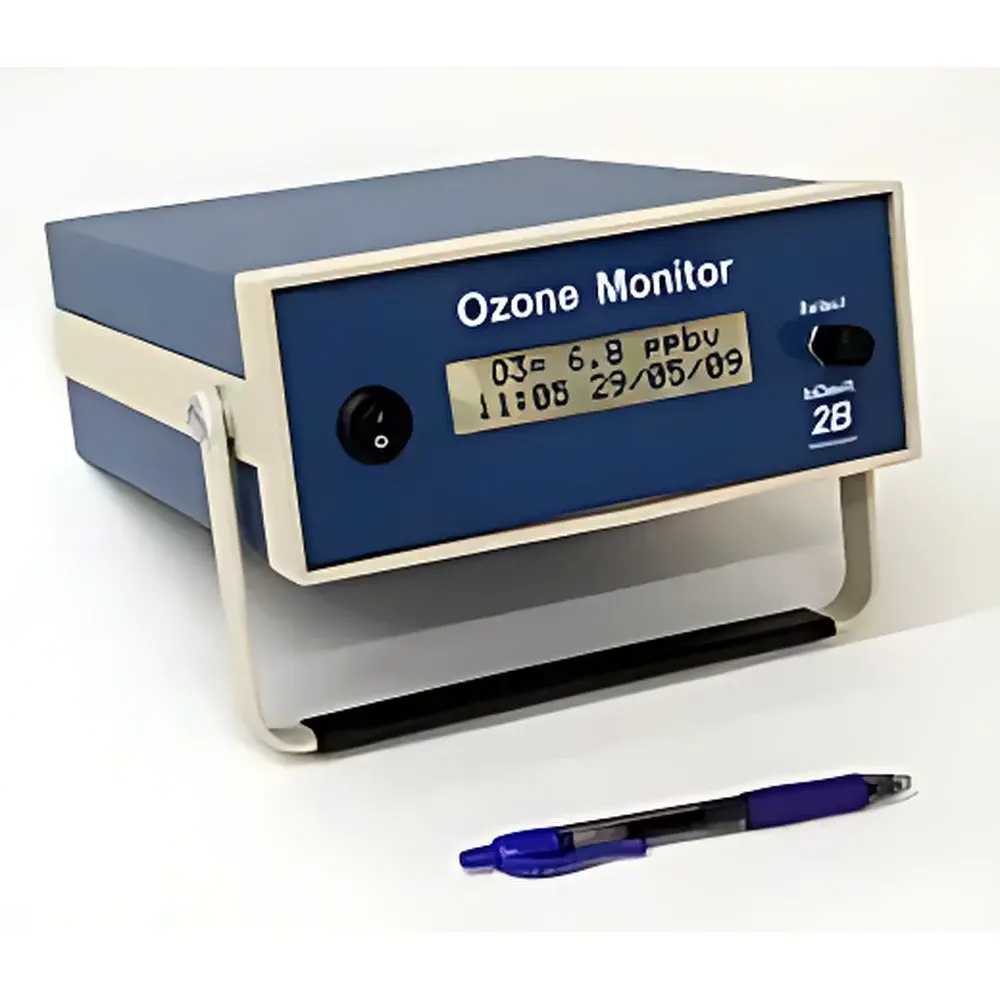
2B Technologies Model 202 Ozone Analyzer
| Brand | 2B Technologies |
|---|---|
| Origin | USA |
| Model | 202 |
| Measurement Principle | UV Absorption at 254 nm |
| Linear Range | 1.5 ppbv to 250 ppmv |
| Precision | ±1.5 ppb or ±2% of reading (whichever is greater) |
| Accuracy | ±1.5 ppb or ±2% of reading (whichever is greater) |
| Detection Limit | 3 ppb |
| Measurement Interval | 10 s (user-selectable averaging: 10 s, 1 min, 5 min, 1 hr) |
| Response Time | 20 s for 100% step change (2-point) |
| Sample Flow Rate | ~1 L/min (nominal), ≥0.6 L/min (minimum required) |
| Baseline Drift | <2 ppb/day, <5 ppb/year |
| Sensitivity Drift | <1 ppb/day, <3 ppb/year |
| Temperature & Pressure Compensation | Yes |
| Operating Temperature | 0–50 °C (–20–50 °C with optional low-temperature modification kit) |
| Operating Altitude | 0–30 km (30–1000 mbar) |
| Data Storage Capacity | 14,336 records (e.g., 1.4 days at 10-s average |
| Output Interfaces | RS-232 serial, 0–2.5 V analog, built-in LCD display |
| Dimensions | 9 × 21 × 29 cm |
| Weight | 2.1 kg (host only |
| Compliance | U.S. EPA Federal Equivalent Method (FEM) EQOA-0410-190 |
| Calibration | NIST-traceable |
Overview
The 2B Technologies Model 202 Ozone Analyzer is a compact, field-deployable instrument engineered for high-fidelity, real-time measurement of ambient ozone (O3) concentrations using dual-beam ultraviolet absorption spectroscopy at 254 nm. Based on the well-established Beer–Lambert law, the system quantifies ozone by measuring the differential attenuation of UV light through a sample cell versus a reference path, minimizing drift and enhancing long-term stability. Certified as a Federal Equivalent Method (FEM) by the U.S. Environmental Protection Agency under EQOA-0410-190, the Model 202 meets stringent regulatory performance criteria for ambient air monitoring networks. Its design prioritizes operational robustness across diverse deployment scenarios — from ground-based urban sensor arrays and mobile platforms (vehicles, drones, kites) to high-altitude balloon-borne vertical profiling up to 30 km. The analyzer operates with minimal power consumption (<3 W typical), enabling extended unattended operation in remote or off-grid locations.
Key Features
- U.S. EPA FEM-certified ozone measurement platform compliant with EQOA-0410-190
- NIST-traceable factory calibration with documented uncertainty budget
- Dual-beam UV photometer architecture for inherent compensation of lamp intensity drift and optical contamination
- Onboard temperature and pressure compensation ensuring accuracy across altitudes from sea level to 30 km (30–1000 mbar)
- Configurable data averaging intervals (10 s, 1 min, 5 min, 1 hr) supporting both high-temporal-resolution research and long-term trend analysis
- Low-power electronics optimized for battery- or solar-powered deployments (typical current draw: <1 A at 3 V DC)
- Integrated LCD display with real-time concentration readout and diagnostic status indicators
- RS-232 serial interface and 0–2.5 V analog output for seamless integration into SCADA systems, data loggers, or custom telemetry hardware
Sample Compatibility & Compliance
The Model 202 is designed exclusively for gaseous-phase ozone detection in ambient air, stratospheric air samples, and controlled laboratory environments. It does not require chemical scrubbers or catalytic converters, eliminating interference from common atmospheric constituents including NO2, SO2, and hydrocarbons at typical ambient mixing ratios. The analyzer complies with ISO 13964:1998 (Ambient air — Determination of ozone — UV photometric method) and supports adherence to U.S. EPA 40 CFR Part 53 requirements for reference and equivalent methods. All calibration procedures follow ASTM D5012–21 guidelines for ozone generator validation and field calibration verification. For regulated applications requiring auditability, the instrument’s internal clock, non-volatile memory, and timestamped data logging support GLP/GMP-aligned documentation practices. While not inherently 21 CFR Part 11 compliant, its data export structure (ASCII CSV via RS-232) enables integration with validated third-party data management systems that provide electronic signature and audit trail functionality.
Software & Data Management
Data acquisition and configuration are managed via the included 2B Technologies Ozone Software Suite (Windows-compatible), which enables real-time visualization, remote parameter adjustment, firmware updates, and automated calibration sequence execution. Raw measurements are stored in non-volatile memory with full time stamping (year/month/day/hour/minute/second). Internal storage holds up to 14,336 records — sufficient for 1.4 months of 5-minute averaged data or 34 hours of 10-second resolution output. Export formats include plain-text CSV files compatible with MATLAB, Python (pandas), R, and commercial environmental data platforms such as EQuIS and AirNow. Optional GPS modules (sold separately) embed geospatial metadata directly into each record, critical for mobile mapping and vertical profile reconstruction. No proprietary database or cloud dependency is required; all data remain under user control at the instrument or host PC level.
Applications
- Ambient air quality monitoring networks (urban, rural, background sites) in compliance with national air quality standards
- Vertical ozone profiling using radiosondes, UAVs, tethered balloons, and light aircraft platforms
- Mobile monitoring campaigns assessing spatial heterogeneity of ozone exposure in transportation corridors and near industrial zones
- Epidemiological studies correlating real-time ozone exposure metrics with respiratory health outcomes
- Material degradation testing and biological response assays (e.g., plant foliar injury, microbial viability) under controlled ozone dosing
- Calibration transfer and intercomparison studies between reference-grade analyzers and lower-cost sensor networks
- Long-term trend analysis in remote or polar regions where power and maintenance access are constrained
FAQ
Is the Model 202 suitable for indoor or workplace ozone monitoring?
Yes — it operates reliably across the full specified temperature range (0–50 °C) and can be deployed in occupational settings. However, users must ensure sample flow remains ≥0.6 L/min and avoid condensation-prone environments without optional heating accessories.
Does the instrument require periodic zero/span calibration in the field?
While factory-calibrated and stable, best practice recommends quarterly zero checks using an ozone scrubber (e.g., activated charcoal) and annual span verification against a NIST-traceable ozone generator per ASTM D5012–21.
Can the Model 202 be integrated into an existing environmental data acquisition system?
Yes — via RS-232 ASCII protocol (default 9600 baud, 8N1) or 0–2.5 V analog output. Communication commands and data packet structure are fully documented in the publicly available User Manual.
What is the recommended maintenance schedule?
Optical windows should be inspected quarterly; cleaning with spectroscopic-grade methanol is advised if particulate accumulation is observed. The internal desiccant cartridge requires replacement every 6–12 months depending on humidity exposure.
Is low-temperature operation supported out-of-the-box?
No — operation below 0 °C requires the optional Low-Temperature Modification Kit, which includes a heated sample cell, thermoelectric cooler, and rotary vane pump to maintain laminar flow under freezing conditions.







