
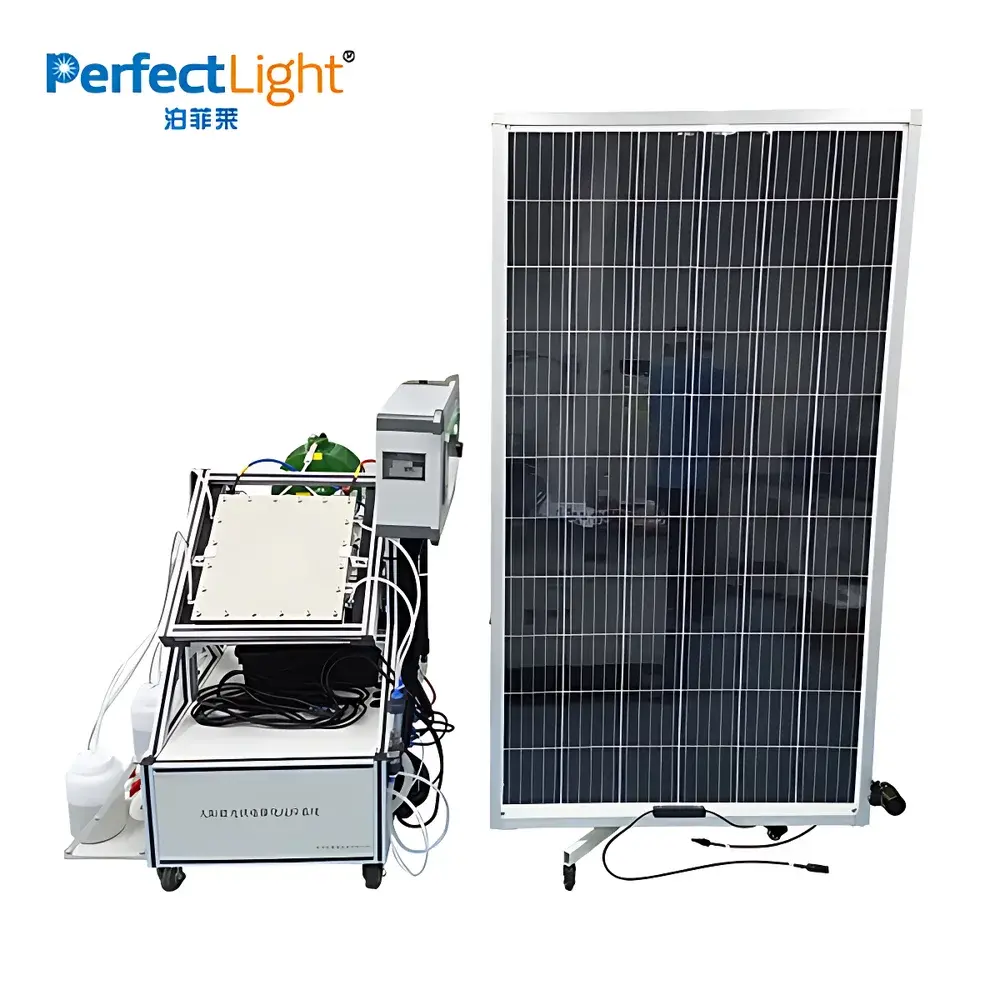
PufeiLai PLR-PVERS Series Solar Photovoltaic-Photoelectrochemical (PEC) and Electrocatalytic Reaction System
| Brand | PufeiLai (PerfectLight) |
|---|---|
| Origin | Beijing, China |
| Manufacturer Type | Authorized Distributor |
| Product Origin | Domestic (China) |
| Model | PLR-PVERS Series |
| Pricing | Available Upon Request |
Overview
The PufeiLai PLR-PVERS Series Solar Photovoltaic-Photoelectrochemical (PEC) and Electrocatalytic Reaction System is an integrated, field-deployable platform engineered for scalable solar-to-hydrogen (STH) and solar-to-chemical (STC) conversion research. It combines photovoltaic (PV) energy harvesting with either electrocatalytic or photoelectrochemical water splitting—enabling direct coupling of solar electricity generation and catalytic fuel synthesis under ambient or controlled outdoor conditions. The system operates on the principle of decoupled solar energy conversion: high-efficiency silicon-based PV panels convert incident sunlight into electrical power, which is then delivered to a modular catalytic reactor for proton exchange membrane (PEM)-based or alkaline/acidic electrolysis—or, in photoelectrochemical mode, to a light-transparent reactor where semiconductor photoanodes/cathodes drive simultaneous water oxidation and reduction under illumination. Designed in alignment with the “Hydrogen Farm Project” (HFP) framework proposed by Academician Can Li’s group at Dalian Institute of Chemical Physics (DICP), CAS, the PLR-PVERS platform supports STC > 1.9% and STH > 1.8% performance validation under real-world irradiance conditions (AM1.5G, 1000 W/m²). Its architecture emphasizes reproducibility, operational safety, and scalability—from lab-scale feasibility studies to pilot-level hydrogen production demonstration.
Key Features
- Real-time Solar Irradiance Tracking: Integrated pyranometer continuously monitors incident solar irradiance; automated tilt adjustment (0–90° in 10° increments) optimizes PV panel orientation for maximum photon capture and power output.
- Modular Plate-Type Reactor Design: Flat-plate electrode configuration (up to 25 cm × 25 cm active area) increases electroactive surface area per unit volume versus conventional cylindrical electrolyzers—enhancing mass transport, reducing concentration overpotential, and improving Faradaic efficiency.
- Configurable Reactor Modes: Dual-path architecture supports both pure electrocatalysis (non-illuminated PEM or liquid-electrolyte cells) and photoelectrocatalysis (with quartz or UV-grade fused silica optical windows, up to 625 cm² illuminated area).
- Multi-parameter In-line Monitoring: Simultaneous real-time acquisition of irradiance (W/m²), cell voltage (0–12 V), current (0–80 A), H₂ volumetric flow rate (L/h), solution pH, temperature (10–60 °C), and electrolyte flow rate (0.1–1 L/min).
- Graded Fluidic Management: Dual-pump system: low-noise micro-peristaltic pump ensures uniform electrolyte circulation across electrode surfaces; dedicated diaphragm gas pump enables rapid H₂/O₂ phase separation and collection—minimizing bubble accumulation and interfacial resistance.
- Field-Ready Mechanical Integration: Rigid aluminum support frame (900 × 700 × 970 mm, ~50 kg total), weather-resistant cabling, quick-disconnect gas/liquid ports, and footprint ≤1 m² facilitate outdoor deployment and long-term unattended operation.
Sample Compatibility & Compliance
The PLR-PVERS system accommodates a broad range of electrode materials—including Ni mesh, Ni foam, Ti-fiber felt, RuO₂/IrO₂-coated anodes, and custom photoelectrodes (e.g., BiVO₄, Fe₂O₃, or perovskite-based thin films). It supports acidic (0.5 M H₂SO₄), neutral (phosphate buffer), and alkaline (1 M KOH) electrolytes. All wetted components comply with ASTM G199-19 (corrosion resistance of materials in aqueous electrolytes) and ISO 2719:2016 (flammability classification for hydrogen-handling systems). Gas collection meets ISO 8573-1 Class 2 purity standards for compressed hydrogen. The control interface supports audit-ready data logging aligned with GLP principles; optional firmware upgrade enables 21 CFR Part 11-compliant electronic signatures and user-access tiering.
Software & Data Management
A Windows-based supervisory control software provides synchronized visualization of all sensor channels, programmable setpoint control (e.g., constant-current or constant-voltage modes), and automated event-triggered data export (CSV/Excel). Raw time-series data are timestamped with UTC synchronization and stored locally with configurable retention policies. Exported datasets include calibrated irradiance-corrected STH/STC calculations, polarization curves, and Tafel analysis outputs. Remote monitoring via Ethernet/WiFi is supported; API access enables integration with third-party LIMS or SCADA platforms. Firmware updates follow IEC 62443-3-3 security guidelines for industrial control systems.
Applications
- Validation of solar-driven hydrogen production pathways under realistic insolation profiles (e.g., diurnal cycle, seasonal variation)
- Electrocatalyst screening and stability testing (chronoamperometry, accelerated degradation protocols)
- Photoelectrode performance benchmarking under simulated or natural sunlight (including spectral mismatch correction)
- Process optimization of coupled PV-PEC systems for methanol or ammonia synthesis feedstock generation
- Educational deployment in university renewable energy labs for hands-on solar fuel engineering curricula
- Pilot-scale demonstration of distributed green hydrogen production for off-grid applications
FAQ
What is the maximum hydrogen production capacity of the PLR-PVERS system?
The system achieves ≥10 L/h H₂ output under standard test conditions (STC: 1000 W/m², 25 °C, 1 atm) using optimized Ni-based electrodes and 1 M KOH electrolyte.
Can the reactor operate at elevated temperatures?
Yes—standard operation is rated for 10–60 °C; high-temperature variants (up to 80 °C) are available upon request with upgraded seals and thermal management modules.
Is the system compatible with third-party PV panels?
Yes—the DC input accepts 0–12 V / 0–80 A; external PV arrays can be connected directly to the power conditioning module with appropriate MPPT integration.
How is gas purity ensured during continuous operation?
Integrated gas-liquid separators, stainless-steel gas lines, and optional palladium membrane purifiers reduce O₂ crossover and moisture content to <10 ppm H₂O and <50 ppm O₂.
Does the system support automated long-term durability testing?
Yes—software-defined test sequences (e.g., 1000-h chronoamperometric stress tests with periodic impedance spectroscopy) are fully scriptable and logged with full metadata traceability.



