
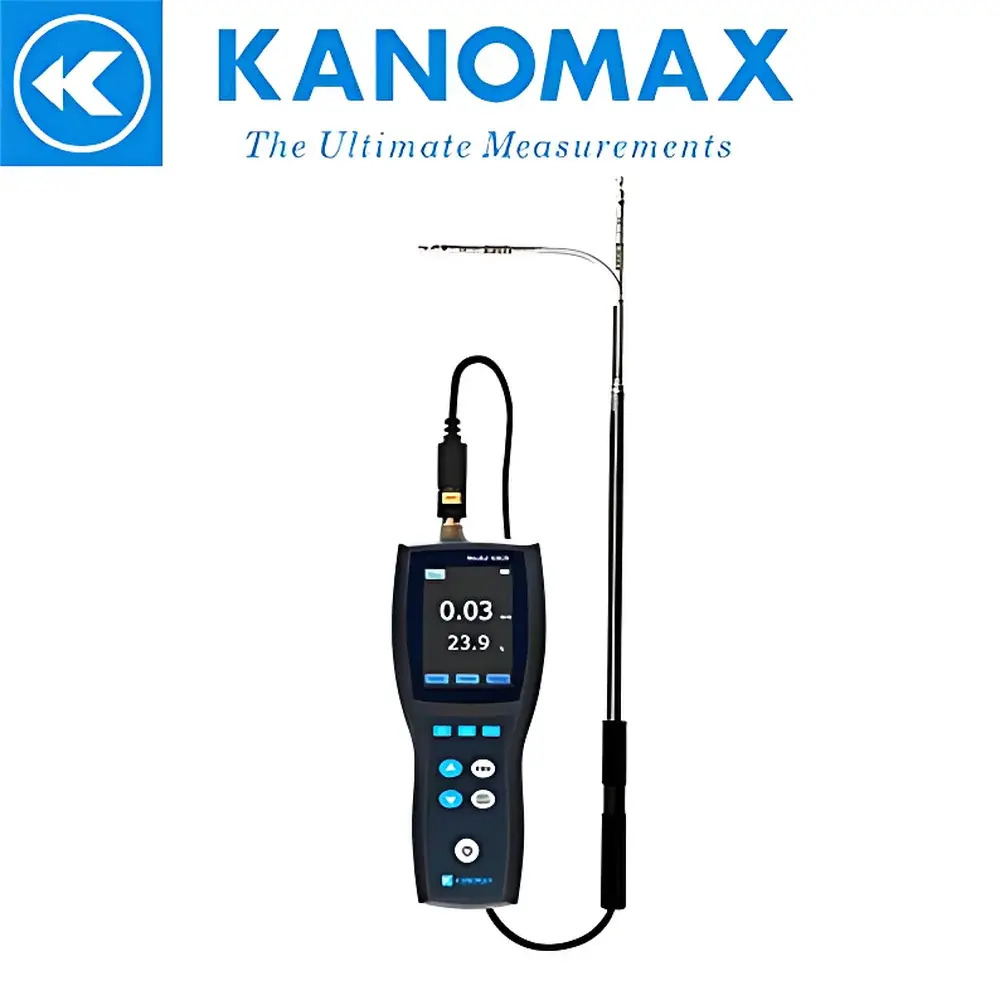
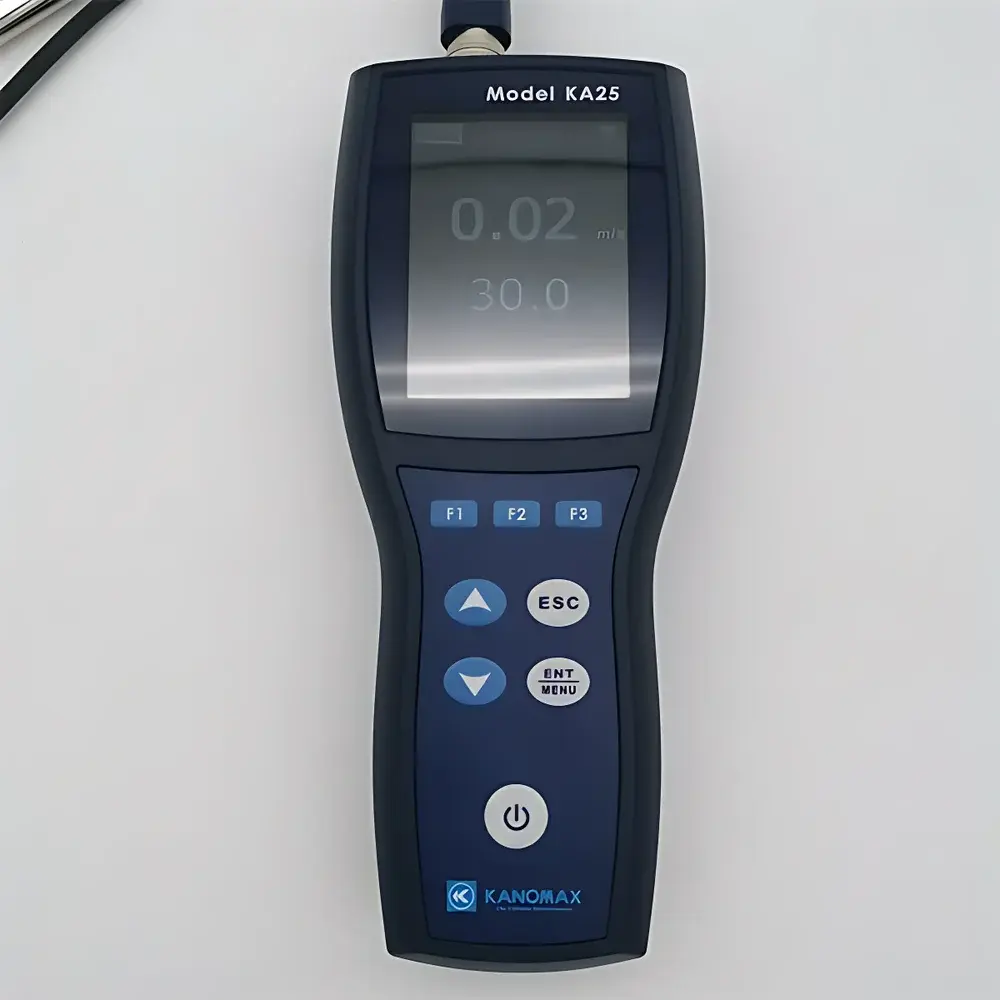
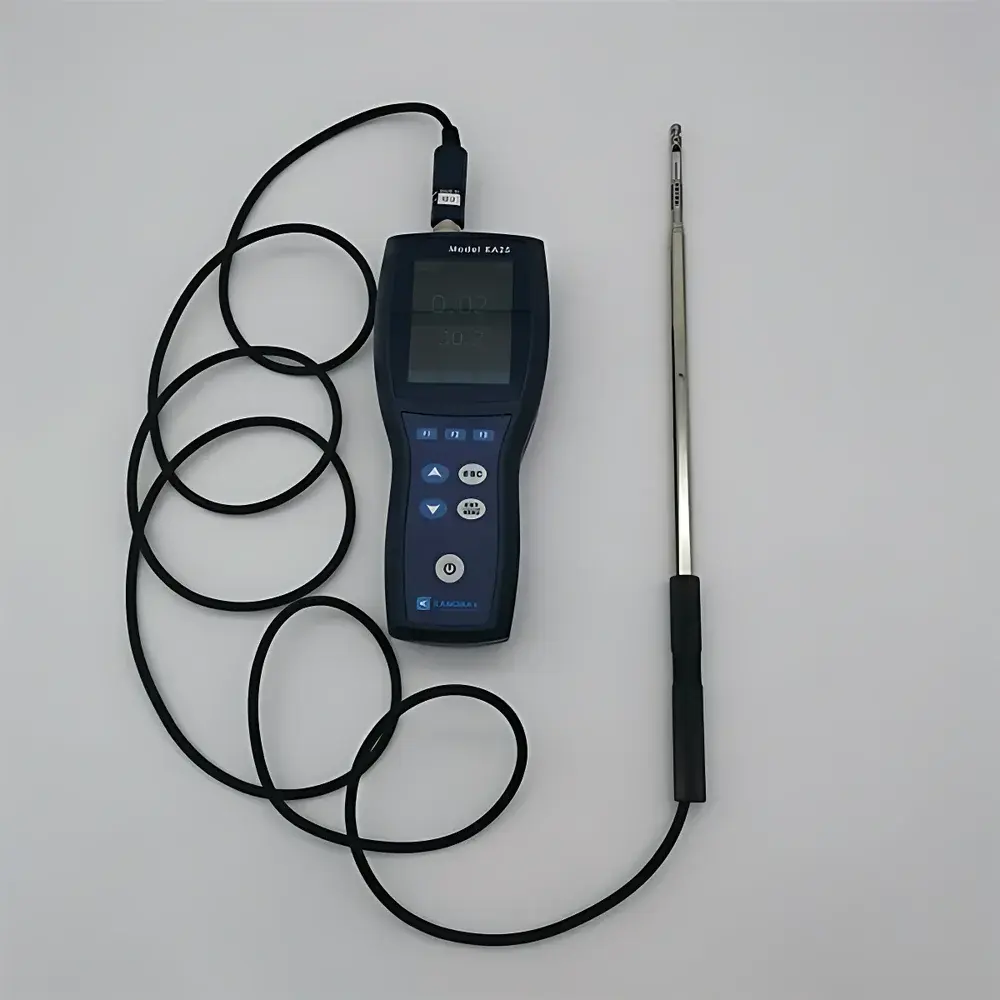
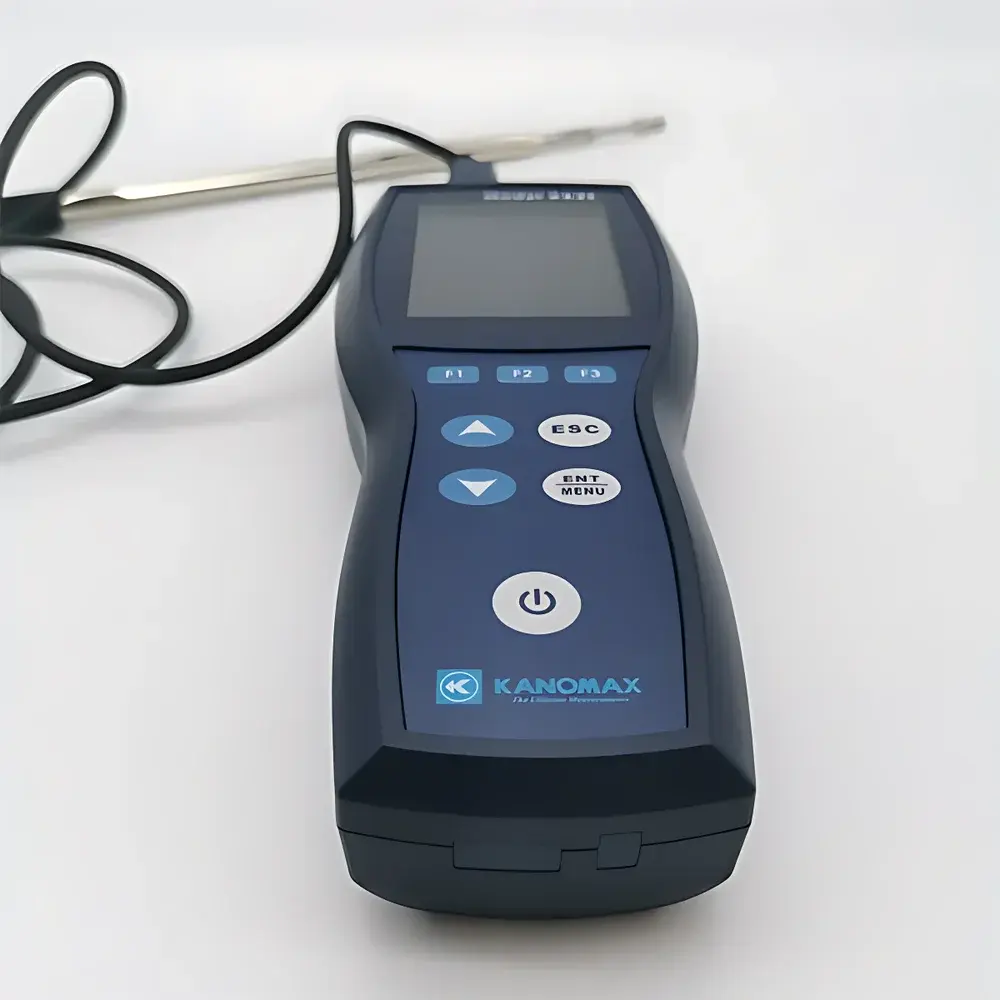
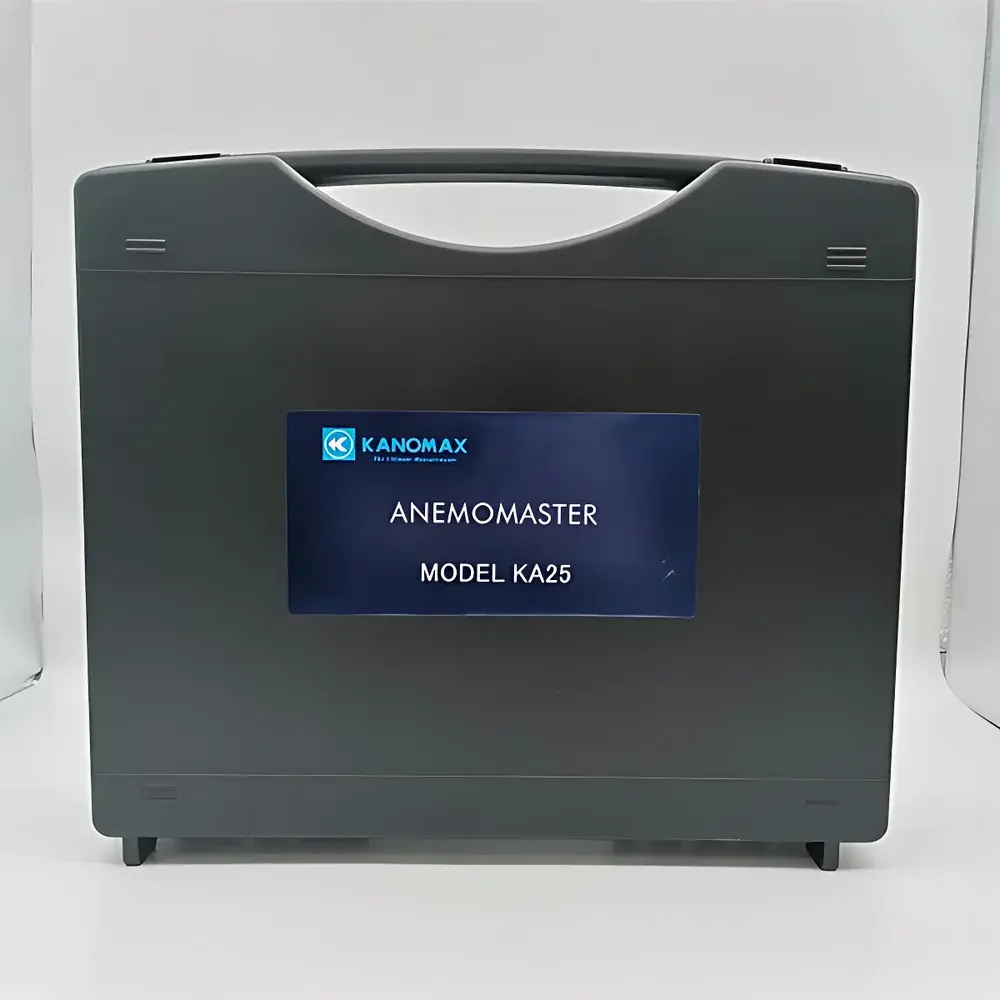
KANOMAX KA25 Portable Thermal Anemometer
| Brand | KANOMAX |
|---|---|
| Origin | Japan |
| Instrument Type | Thermal Anemometer |
| Measurement Range | 0.01–20.0 m/s |
| Resolution | 0.01 m/s |
| Accuracy | ±(3% of reading + 0.03 m/s) |
| Temperature Range | −20 to +70 °C |
| Temperature Accuracy | ±0.5 °C (at v > 0.5 m/s) |
| Temperature Resolution | 0.1 °C |
| Response Time (Wind Speed) | ~1 s (90% response at 1 m/s) |
| Response Time (Temperature) | ~30 s (90% response at 1 m/s) |
| Air Volume Calculation | Supported (rectangular & circular ducts, cross-section input 0.1–255.0 cm) |
| Display | 3-level backlight LCD |
| Power | 4 × AA alkaline batteries |
| Battery Life | ~15 h (1 m/s, 20 °C) |
| Body Dimensions | 200 × 85 × 40 mm |
| Probe Dimensions | Ø6 mm (sensor) / Ø14 mm (handle) × 294–1060 mm (telescoping & flexible) |
| Cable Length | 2000 mm |
| Operating Environment (Body) | 5–40 °C |
| Storage Temperature | −20 to +60 °C |
| Weight | ~220 g (without batteries) |
Overview
The KANOMAX KA25 Portable Thermal Anemometer is a precision-engineered handheld instrument designed for reliable, real-time measurement of air velocity and ambient temperature in HVAC commissioning, indoor air quality (IAQ) assessments, cleanroom validation, and industrial ventilation audits. Utilizing constant-temperature anemometry (CTA), the KA25 employs a heated platinum resistance sensor whose thermal dissipation correlates directly with local airflow velocity—enabling high-sensitivity detection down to 0.01 m/s. Unlike cup or vane anemometers, its thermal principle ensures minimal flow disturbance and consistent performance across low-velocity laminar and turbulent regimes. The device integrates dual-parameter acquisition (velocity + temperature) and supports on-device air volume computation for rectangular and circular ducts—eliminating post-processing delays during field surveys. Its robust mechanical design—including a telescoping, bendable probe with interchangeable sensor heads—facilitates access to confined grilles, diffusers, and ductwork without compromising measurement integrity.
Key Features
- Thermal sensing architecture compliant with ISO 7726:1998 (Ergonomics of the thermal environment — Instruments for measuring physical quantities)
- Adjustable time constant (1 s / 5 s / 10 s / 20 s) to optimize dynamic response for transient airflow conditions or stable averaging
- Real-time statistical functions: simultaneous display of minimum, maximum, and arithmetic mean values over user-defined intervals
- On-screen data hold with manual freeze capability for documentation under challenging access conditions
- Three-level adjustable backlight LCD for legibility in low-light mechanical rooms, ceiling plenums, or outdoor shading
- Telescoping and articulating probe (Ø6 mm active sensor, Ø14 mm ergonomic handle) extends from 294 mm to 1060 mm and accommodates angular alignment in duct corners or behind filters
- Auto power-off with configurable idle timeout (3 / 5 / 10 minutes) to conserve battery life during multi-point surveys
- Battery status indicator and integrated low-power management ensure uninterrupted operation for up to 15 hours (typical use case: 1 m/s, 20 °C, alkaline cells)
Sample Compatibility & Compliance
The KA25 is calibrated for clean, dry air (non-condensing, particle-free, non-corrosive). It is not rated for use in explosive atmospheres (ATEX/IECEx), high-humidity (>95% RH), or environments containing oil mist, solvent vapors, or particulate loading exceeding ISO 14644 Class 8. For regulatory alignment, its measurement methodology supports traceability to NIST-traceable thermal anemometer standards. While the instrument itself does not carry CE marking for medical devices, its output data may be incorporated into GLP-compliant HVAC validation protocols when used alongside documented calibration certificates (recommended annually per ISO/IEC 17025-accredited labs). Temperature compensation is applied automatically during velocity calculation, ensuring stability across its full operating range (−20 to +70 °C at probe; 5 to +40 °C at body).
Software & Data Management
The KA25 operates as a standalone field instrument with no proprietary software dependency. All measurements—including timestamped min/avg/max records, duct geometry inputs, and computed volumetric flow (m³/h)—are retained in volatile memory until manually cleared. No USB or Bluetooth interface is included; data export requires manual transcription or photographic documentation. This architecture enhances reliability in electromagnetically noisy industrial settings and avoids firmware update dependencies. For laboratories requiring audit trails, users may integrate KA25 readings into validated electronic lab notebooks (ELNs) or LIMS platforms via structured CSV entry. The device meets the functional requirements of ASTM D1896-22 (Standard Guide for Air Velocity Measurements in Ventilation Systems) and supports preliminary compliance checks against ASHRAE Standard 111 (Methods of Testing for Rating Air Terminal Units).
Applications
- HVAC system balancing and airflow verification across supply/return/exhaust ducts
- Local exhaust ventilation (LEV) hood face velocity surveys per OSHA Technical Manual Section III: Chapter 5
- Cleanroom ISO 14644-3 air change rate estimation using multi-point traverse methods
- Building envelope leakage screening via depressurization-induced airflow quantification
- Educational laboratory demonstrations of convective heat transfer and boundary layer development
- Industrial process cooling airflow monitoring in electronics manufacturing and food processing lines
FAQ
What calibration standards does the KA25 reference?
The KA25 is factory-calibrated against KANOMAX’s internal thermal wind tunnel standard, traceable to JCSS (Japan Calibration Service System) accredited references. Users should obtain annual recalibration from an ISO/IEC 17025-accredited provider for regulated applications.
Can the KA25 measure airflow in wet or dusty environments?
No. The thermal sensor is susceptible to contamination and condensation-induced drift. It must be used only in clean, non-corrosive, non-saturated airstreams. A protective hydrophobic filter cap (optional accessory) may extend usability in mildly humid indoor spaces.
Is duct shape input mandatory for air volume calculation?
Yes. Accurate volumetric flow (m³/h) requires user entry of duct geometry (rectangular width × height or circular diameter) and unit selection (cm). The device does not auto-detect shape or size.
How does the time constant setting affect measurement uncertainty?
A shorter time constant (e.g., 1 s) increases responsiveness to rapid fluctuations but amplifies noise sensitivity. A longer setting (e.g., 20 s) improves signal averaging at the expense of temporal resolution—ideal for steady-state duct traverses.
Does the KA25 support data logging to external storage?
No. It lacks internal memory expansion or wired/wireless data streaming capability. Field notes or digital photography remain the primary documentation methods.







