
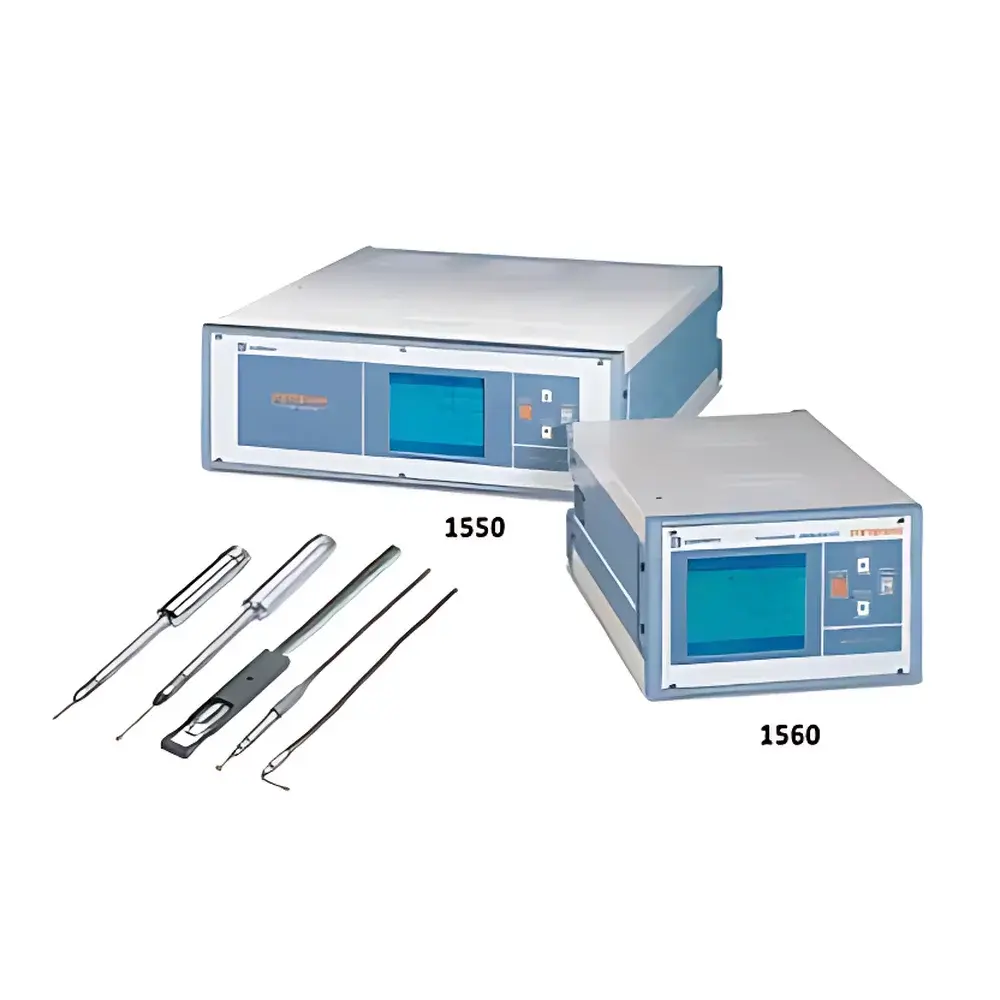
KANOMAX 6242/6243 Multi-Point Environmental Monitoring System
| Brand | KANOMAX |
|---|---|
| Origin | Japan |
| Model | 6242 / 6243 |
| Instrument Type | Thermal Anemometer |
| Measurement Range | 0.01–50.0 m/s |
| Accuracy | ±0.5% FS |
| Resolution | ±2% of reading |
| Operating Temperature | −20 to +70 °C |
| Operating Humidity | 2.0–98.0% RH |
| Base Unit Configurations | Model 1550 (up to 16 modules per unit, max 320 channels via cascading), Model 1560 (up to 6 modules per unit) |
| Probe & Module Flexibility | Interchangeable sensor modules and probes for simultaneous measurement of air velocity, temperature, relative humidity, and differential/static pressure |
Overview
The KANOMAX 6242/6243 Multi-Point Environmental Monitoring System is a modular, high-channel-count instrumentation platform engineered for precision environmental parameter acquisition in controlled environments, HVAC commissioning, cleanroom validation, and industrial airflow characterization. Built upon KANOMAX’s thermal anemometry core technology, the system employs constant-temperature anemometer (CTA) principles—where a heated sensing element’s cooling rate correlates linearly with local air velocity—to deliver stable, low-noise velocity measurements across a wide dynamic range (0.01–50.0 m/s). Unlike single-point handheld devices, the 6242/6243 architecture decouples data acquisition from sensing: a centralized base unit (Model 1550 or 1560) hosts interchangeable sensor modules, each supporting one or more calibrated probes. This distributed topology enables synchronized, time-aligned acquisition across dozens to hundreds of spatially distributed points—critical for ISO 14644-3 airflow uniformity mapping, ASHRAE 110 tracer gas testing, or GMP-compliant environmental monitoring in pharmaceutical manufacturing suites.
Key Features
- Modular scalability: Model 1550 base unit supports up to 16 sensor modules; five 1550 units can be cascaded to form a 320-channel system—ideal for large-scale facility qualification.
- Multi-parameter synchronization: Simultaneous real-time acquisition of air velocity, temperature (±0.3 °C typical), relative humidity (±2.0% RH typical), and pressure (differential or static, depending on module configuration).
- Thermal anemometer probe options: Includes omnidirectional hot-wire probes (e.g., 6242-P1), vane-type probes for turbulent or low-velocity ducts, and micro-probes for confined geometries—all factory-calibrated traceable to JIS Z 8000 and NIST standards.
- Rugged industrial design: Enclosure rated IP54; operating ambient range −20 to +70 °C and 2.0–98.0% RH ensures reliability in harsh production or outdoor test environments.
- High-fidelity signal conditioning: Each module features 24-bit ADC, programmable sampling rates (1–10 Hz default, configurable), and onboard memory buffering to prevent data loss during transient network interruptions.
Sample Compatibility & Compliance
The system accommodates diverse probe types—including stainless-steel sheathed hot-wire sensors for corrosive airstreams, low-inertia probes for rapid transients, and thermistor-hygrometer combinations for psychrometric analysis. All modules comply with IEC 61000-4 electromagnetic immunity standards and meet CE marking requirements for EMC and safety. For regulated industries, the platform supports audit-ready operation: raw data files include embedded timestamps (NTP-synchronized), sensor ID, calibration expiration dates, and operator metadata—enabling full traceability per FDA 21 CFR Part 11 and EU Annex 11 guidelines when used with validated software configurations. Calibration certificates are issued per ISO/IEC 17025-accredited procedures, with uncertainty budgets documented for each probe type.
Software & Data Management
KANOMAX’s proprietary WinDAQ Pro+ software provides comprehensive control, visualization, and post-processing capabilities. It supports real-time channel grouping, custom calculation fields (e.g., volumetric flow rate, turbulence intensity, air change rate), and automated report generation in PDF or Excel formats compliant with ISO 14644-1 and ISO 14644-3 annexes. Data export includes CSV with header metadata, compatible with MATLAB, Python (Pandas), or LIMS integration via OPC UA or Modbus TCP. The software implements role-based user access control, electronic signatures, and immutable audit trails—including all parameter changes, calibration uploads, and export actions—satisfying GLP/GMP documentation integrity requirements.
Applications
- Cleanroom airflow mapping per ISO 14644-3: Uniformity, directionality, and recovery testing using multi-point velocity grids.
- HVAC system balancing and commissioning: Simultaneous duct traverse measurements with integrated temperature and RH correction.
- Pharmaceutical isolator and RABS qualification: Monitoring laminar airflow stability and particle dispersion correlation.
- Automotive cabin airflow development: Characterizing ventilation performance under thermal load cycling.
- Academic aerodynamics research: Boundary layer profiling and wake structure analysis in wind tunnels or open-jet facilities.
FAQ
What is the maximum number of measurement points supported by a single 6242/6243 system?
A single Model 1550 base unit supports up to 16 modules; up to five 1550 units may be cascaded to achieve 320 total channels.
Can the system measure absolute pressure or only differential pressure?
Both configurations are available: dedicated differential pressure modules (e.g., 6243-DP) and absolute pressure modules (e.g., 6243-AP) are offered as optional sensor cartridges.
Is probe calibration traceable to national standards?
Yes—each probe is individually calibrated against KANOMAX’s primary wind tunnel standard, accredited to ISO/IEC 17025, with traceability to NMIJ (National Metrology Institute of Japan) and NIST.
Does the software support automated pass/fail evaluation against predefined limits?
Yes—WinDAQ Pro+ allows user-defined acceptance criteria per channel or group, with color-coded real-time status indicators and auto-generated compliance summaries.
How is data integrity ensured during extended unattended logging?
Onboard module memory buffers data continuously; the base unit performs cyclic redundancy checks (CRC) on all transmitted frames and logs checksum mismatches with timestamped event records.
Related Products







