
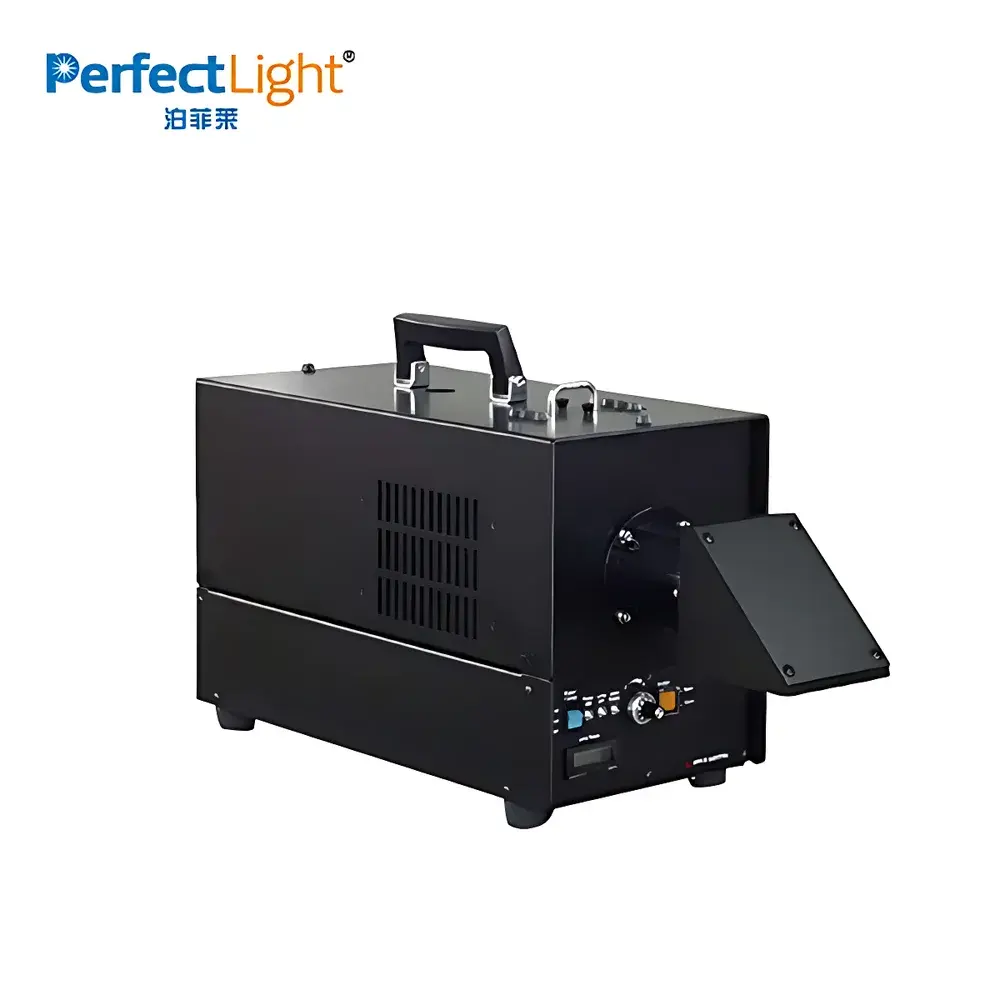
PerfecLight XES-40S3-TT-200 AAA-Class Solar Simulator
| Brand | PerfecLight |
|---|---|
| Origin | Beijing, China |
| Light Source Type | Xenon Arc Lamp |
| Illumination Mode | External Irradiation |
| Radiation Area | 40 × 40 mm² |
| Spectral Match | AM1.5G (Class A) |
| Temporal Instability | <1% (Class A) |
| Spatial Uniformity | ±2% (Class A) |
| Initial Irradiance | 1.0 sun |
| Adjustable Irradiance Range | 70–130% |
| Lamp Lifetime | 2000 h (1000 h warranty) |
| Collimation Angle | ±4° |
| Shutter Timing Range | 0.1 s – 9990 h |
| Output Orientation | Vertical Down/Up, Horizontal Left/Right, 45° Mirror-Reflected |
| Input Voltage | AC 100–220 V ±10%, 50/60 Hz |
| Operating Environment | 5–35 °C, 20–85% RH |
Overview
The PerfecLight XES-40S3-TT-200 is a high-precision, laboratory-grade AAA-class solar simulator engineered for photovoltaic characterization, photoelectrochemical (PEC) research, and quantum yield quantification under standardized terrestrial sunlight conditions. It employs a stabilized, pulsed or continuous-wave xenon arc lamp as its primary radiation source, optically conditioned through a multi-element collimating lens system and spectral filtering optics to achieve rigorous compliance with IEC 60904-9 Ed. 3 (2020), ASTM E927-22, and JIS C 8912:2021—collectively defining the AAA classification for spectral match (Class A), spatial uniformity (Class A), and temporal stability (Class A). The simulator delivers a calibrated 1.0-sun irradiance (100 mW/cm²) at the sample plane with a collimation angle of ±4°, enabling accurate angular response evaluation of devices such as perovskite solar cells, dye-sensitized cells (DSSCs), and tandem architectures. Its compact 40 × 40 mm² radiation field is optimized for small-area device testing while maintaining metrological traceability to NIST-traceable reference cells.
Key Features
- Dual independent shutter timer system with programmable delay, exposure duration, and repeat cycles—enabling precise kinetic studies in photocatalytic hydrogen evolution or transient photocurrent measurements.
- Integrated lamp hour counter and thermal cutoff protection circuitry, ensuring operational safety and facilitating predictive maintenance scheduling aligned with ISO/IEC 17025 calibration interval recommendations.
- Remote optical shutter control via TTL-compatible digital I/O interface (BNC), compatible with automated test benches and synchronization to potentiostats, lock-in amplifiers, or data acquisition systems.
- Modular optical output configuration: vertical downward/upward, horizontal left/right, and 45° mirror-reflected beam paths—supporting custom reactor integration including top-irradiated PEC cells and side-illuminated gas-phase photoreactors.
- Continuously adjustable irradiance from 70% to 130% of 1.0 sun via precision iris diaphragm and neutral density filter staging—eliminating the need for external attenuators during light-intensity-dependent quantum efficiency mapping.
Sample Compatibility & Compliance
The XES-40S3-TT-200 is validated for use with standard silicon reference cells (e.g., KG5-filtered KG5-Si, certified per IEC 60904-2), thermopile detectors, and spectroradiometers traceable to national metrology institutes. Its AM1.5G spectral output (300–1200 nm) meets Class A spectral mismatch criteria (<12.5% deviation from reference spectrum in each of six defined wavelength bands). Spatial uniformity is verified using a 2D CCD-based irradiance mapping system across the full 40 × 40 mm² field, with ±2% variation confirmed at 100 measurement points. Temporal stability is monitored in real time via a fast-response photodiode array sampling at 100 Hz over ≥6 hours, satisfying <1% RMS fluctuation requirements. The system supports GLP-compliant documentation workflows, including electronic logbook entries for lamp usage, calibration dates, and irradiance verification reports.
Software & Data Management
Control is executed via PerfecLight’s proprietary LabSim v3.2 software (Windows 10/11), providing GUI-driven shutter sequencing, irradiance profiling, and synchronized logging of environmental parameters (chamber temperature, ambient humidity). All operational events—including shutter actuation timestamps, lamp runtime accumulation, and manual irradiance adjustments—are recorded with ISO 17025-aligned audit trail functionality. Export formats include CSV, HDF5, and MATLAB-compatible .mat files. For integration into LIMS or enterprise QA systems, the simulator supports Modbus TCP and SCPI command sets, enabling remote orchestration within automated photovoltaic test lines compliant with IEC 61215-2 MQT 03 and USP analytical instrument qualification protocols.
Applications
- Quantum yield determination in photocatalytic water splitting (H₂/O₂ evolution) and CO₂ reduction, per ISO 25097:2022 guidelines.
- Incident photon-to-current efficiency (IPCE) and external quantum efficiency (EQE) mapping of thin-film and emerging photovoltaics.
- Stability assessment of perovskite solar cells under controlled illumination stress (ISOS-L-1 protocol).
- Photoelectrochemical impedance spectroscopy (PEIS) and Mott–Schottky analysis of semiconductor photoanodes/cathodes.
- Kinetic modeling of VOC degradation (formaldehyde, NOₓ, SOₓ) and aqueous pollutant decomposition (azo dyes, phenolic compounds) under simulated solar flux.
FAQ
What standards does the XES-40S3-TT-200 comply with for AAA classification?
It meets all three Class A criteria defined in IEC 60904-9 Ed. 3 (2020): spectral match (AM1.5G), spatial non-uniformity (±2%), and temporal instability (<1% RMS over 6 hours).
Can the simulator be used for accelerated aging tests?
Yes—its stable 1.0-sun output and programmable shutter timing support ISOS-L-1 and IEC 61215-2 MQT 03 light soaking protocols when integrated with environmental chambers.
Is spectral recalibration required after lamp replacement?
Yes. Each new xenon lamp must be spectrally characterized using a calibrated spectroradiometer; PerfecLight provides factory calibration certificates and recommends annual third-party verification per ISO/IEC 17025.
Does the system support spectral filtering for UV-only or VIS-only irradiation?
Yes—optional bandpass filters (e.g., UG11 for UV-A, BG40 for visible cutoff) and dichroic mirrors can be mounted in the beam path to isolate specific spectral regions for mechanistic photochemical studies.
What is the recommended maintenance schedule for the xenon lamp?
Lamp runtime should be logged continuously; replacement is advised at 2000 h or earlier if spectral drift exceeds ±5% in the 350–400 nm range, as verified by periodic spectroradiometric validation.





