
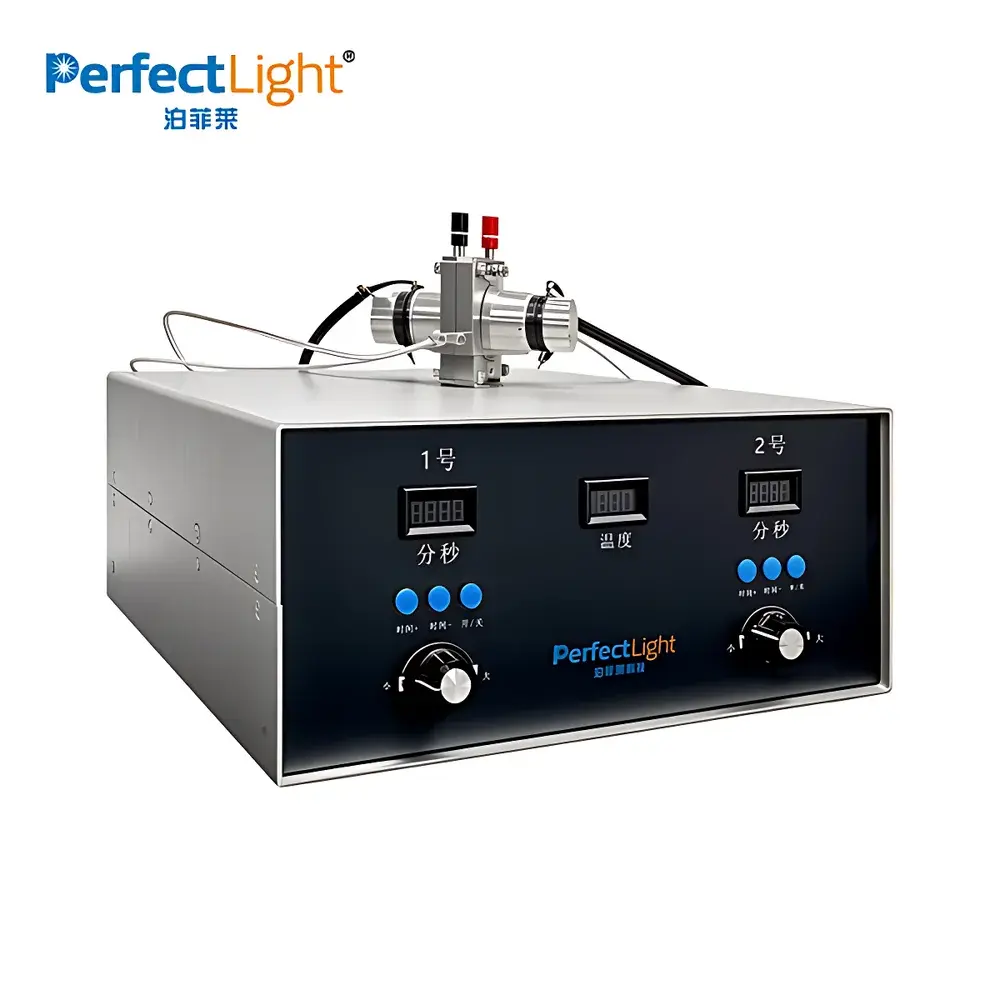
PufeiLai ULTRA-SONIC COUPLED DUAL-CHAMBER ELECTROLYSIS CELL
| Brand | PufeiLai (PerfectLight) |
|---|---|
| Origin | Beijing, China |
| Manufacturer Type | Authorized Distributor |
| Country of Origin | China |
| Model | ULTRA-SONIC COUPLED DUAL-CHAMBER ELECTROLYSIS CELL |
| Price | Upon Request |
| Ultrasonic Frequency | 40 kHz |
| Ultrasonic Power Range | 0–60 W per channel (dual independent channels) |
| Temperature Monitoring Range | 0–80 °C |
| Timer Range | 0–99 min |
| Chamber Configuration | Dual-compartment, dual-electrode |
| Electrode Active Area (Standard) | 2 × 2 cm² |
| Housing Material | 2 mm anodized aluminum |
| Dimensions (W × D × H) | 155 × 365 × 330 mm |
| Operating Environment | Non-condensing, ambient pressure, ≤60 °C |
| Ultrasonic Transducer Mounting | Threaded stud + structural epoxy bonding |
| Fluidic Interface | Dual inlet/dual outlet (optional) |
| Optical Compatibility | Single-chamber replaceable with quartz window + metal body for sonophotoelectrocatalysis |
Overview
The PufeiLai ULTRA-SONIC COUPLED DUAL-CHAMBER ELECTROLYSIS CELL is a purpose-engineered electrochemical reactor platform designed to integrate high-frequency ultrasonic energy (40 kHz) with controlled galvanostatic/potentiostatic electrolysis in a physically isolated dual-compartment configuration. It operates on the principle of acoustic cavitation-enhanced mass transport and interfacial activation—where ultrasonic irradiation generates transient microbubbles that collapse near electrode surfaces, inducing localized microturbulence, enhanced ion diffusion, reduced concentration polarization, and improved charge-transfer kinetics. This synergistic coupling enables rigorous investigation of sonoelectrocatalytic mechanisms under reproducible, non-thermal conditions—particularly critical for reactions involving gas evolution (e.g., water splitting), multi-electron transfer (e.g., CO₂ reduction), or surface-sensitive synthesis pathways. The system maintains strict physical separation between anolyte and catholyte compartments via a proton-exchange or ceramic frit membrane interface, supporting both symmetric and asymmetric electrolyte configurations.
Key Features
- Dual independent ultrasonic channels: Each channel delivers 0–60 W RMS power at 40 kHz, with fully decoupled amplitude control and real-time monitoring—enabling asymmetric sonication across electrodes or chambers.
- Hermetic dual-seal architecture: Two concentric silicone gasket layers ensure leak-tight operation under continuous electrolytic gas evolution, validated for >72 h static liquid retention at ambient pressure.
- Integrated temperature sensing: A calibrated Pt100 RTD probe embedded in the cell base provides ±0.3 °C accuracy across 0–80 °C, feeding data to external potentiostats or programmable logic controllers for thermal feedback loops.
- Modular electrode interface: Standard active area of 2 × 2 cm² accommodates mesh, foil, or gas-diffusion electrodes; custom geometries (up to 5 × 5 cm²) are supported via machined electrode holders with uniform current distribution.
- Robust mechanical integration: Ultrasonic transducers mount via M6 threaded studs and aerospace-grade epoxy adhesive—ensuring >10⁶ cycles of mechanical stability without delamination or resonance drift.
- Optical upgrade path: One chamber can be substituted with a fused-silica window (≥85% transmission @ 200–2500 nm) and stainless-steel housing, enabling concurrent UV-Vis illumination for sonophotoelectrocatalytic studies compliant with ASTM E2938 protocols.
Sample Compatibility & Compliance
The cell accommodates aqueous, non-aqueous, and ionic liquid electrolytes—including 0.1–1.0 M KOH, KHCO₃, LiTFSI/DOL, and EMIM-BF₄ systems. Electrode materials include Pt, NiFe LDH, Cu foam, carbon paper, and photoanodes such as BiVO₄ or TiO₂. All wetted components comply with ISO 8502-3 for surface cleanliness prior to assembly. The dual-chamber design supports standard membrane types (Nafion 117, Fumasep FAA-3, Celgard 2500) and satisfies ASTM D1149 requirements for elastomer compatibility. For GLP-compliant operation, the system interfaces with third-party potentiostats featuring 21 CFR Part 11 audit trails and electronic signature support.
Software & Data Management
While the unit itself is hardware-controlled (no embedded firmware), it integrates seamlessly with commercial electrochemical workstations (e.g., BioLogic SP-300, Gamry Interface 5000E) via analog trigger I/O and RS-232/USB TTL signals. Ultrasonic timing and power setpoints synchronize with electrochemical pulse sequences using external TTL gating. Temperature and timer outputs are accessible as 0–5 V analog signals for logging in LabVIEW, Python (PyVISA), or MATLAB environments. Raw data files retain timestamped metadata including chamber ID, transducer channel assignment, and calibration coefficients—supporting FAIR (Findable, Accessible, Interoperable, Reusable) data principles per OECD Guidelines for Good Electrochemical Practice.
Applications
- Sonoelectrocatalytic water splitting: Quantification of Faradaic efficiency for O₂/H₂ evolution under controlled cavitation intensity and bubble dynamics.
- CO₂ electroreduction under ultrasound: Suppression of C₂+ product crossover via intensified local pH gradients and accelerated *CO dimerization kinetics.
- Electrosynthetic amide coupling: Ultrasound-enabled deagglomeration of heterogeneous catalysts during constant-potential amine oxidation.
- Fuel cell catalyst durability testing: Accelerated degradation protocols combining cyclic voltammetry with pulsed sonication to simulate mechanical stress at triple-phase boundaries.
- Hybrid sonophotoelectrocatalysis: Simultaneous 365 nm LED irradiation and 40 kHz cavitation in quartz-window configuration for hole-scavenging enhancement in photoanode studies.
FAQ
Can this cell be operated under pressurized conditions?
No—it is engineered exclusively for ambient-pressure operation. Pressurization may compromise gasket integrity and transducer bonding reliability.
Is the ultrasonic output calibrated traceably to NIST standards?
Yes, each transducer is supplied with a factory calibration certificate referencing NIST-traceable hydrophone measurements at 40 kHz in degassed water.
What membrane types are recommended for CO₂ reduction studies?
Fumasep FAA-3 anion-exchange membranes are preferred for alkaline CO₂R due to low carbonate precipitation and high OH⁻ conductivity.
Does the system support flow-through electrolyte circulation?
Dual inlet/dual outlet manifolds are available as an optional accessory kit, compatible with peristaltic or syringe pumps operating at 0.1–5 mL/min flow rates.
How is electrical isolation maintained between ultrasonic drivers and electrochemical circuits?
All signal and power lines incorporate 3 kV AC galvanic isolation; grounding follows IEC 61000-6-3 EMC guidelines to prevent measurement noise coupling.



