
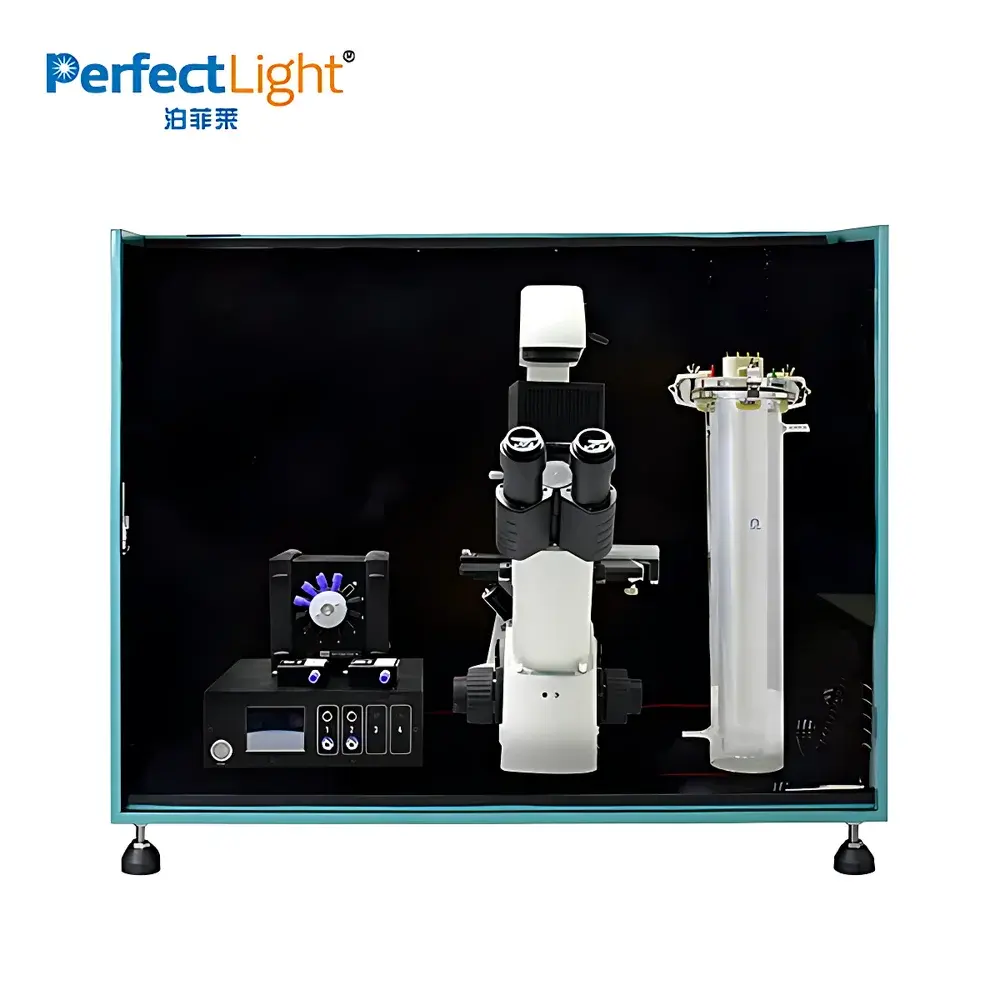
PerfecLight WLK-1000 Microfluidic Photochemical Reaction System
| Brand | PerfecLight |
|---|---|
| Origin | Beijing, China |
| Manufacturer Type | Authorized Distributor |
| Product Origin | Domestic (China) |
| Model | WLK-1000 |
| Pricing | Available Upon Request |
| Light Source Wavelength Range | 255–760 nm (Multi-wavelength Selectable) |
| Optical Power Output | 10–120 W (Adjustable) |
| Temperature Control Range | −20 to +80 °C (Precision Thermostatic Regulation) |
| Reaction Volume per Chip Unit | 5 µL / 10 µL |
| Liquid Flow Rate | 0.1–70 mL/min |
| Compatible Phases | Liquid–liquid (homogeneous & heterogeneous) |
| Chip Substrate Materials | Fused Silica, Borosilicate Glass, PDMS, Polymer |
| Footprint | 620 mm × 540 mm × 430 mm |
Overview
The PerfecLight WLK-1000 Microfluidic Photochemical Reaction System is an engineered platform for precise, reproducible, and scalable photochemical synthesis under continuous-flow conditions. It operates on the principle of controlled photon delivery to microconfined reaction volumes—leveraging laminar flow, high surface-to-volume ratios, and uniform irradiation geometry to achieve superior photonic efficiency and thermal management compared to batch reactors. Designed for laboratories engaged in photocatalysis, solar fuel research, pharmaceutical phototransformation, and mechanistic photochemical studies, the WLK-1000 enables systematic optimization of light intensity, residence time, wavelength selectivity, and interfacial mass transfer—all within a single integrated instrument. Its modular chip architecture supports rapid prototyping of reaction pathways without reconfiguration of optical or fluidic hardware.
Key Features
- Microscale reaction chambers (5 µL and 10 µL variants) enabling precise control over photon flux density and residence time distribution.
- Broad-spectrum tunable illumination (255–760 nm), compatible with UV-A, visible, and near-UV LED or lamp-based sources; power output continuously adjustable from 10 W to 120 W to match quantum yield requirements.
- Active temperature regulation across −20 °C to +80 °C, ensuring kinetic consistency during exothermic or cryogenic photochemical processes.
- Integrated fiber-optic UV-Vis spectrometer for real-time, in-line monitoring of reaction effluents—capturing spectral shifts indicative of intermediate formation, product accumulation, or photodegradation.
- Automated syringe pump-driven fluid handling with programmable valve sequencing, supporting multi-step reagent addition, phase switching, and gradient mixing protocols.
- Modular microfluidic chip library including cross-junction droplet generators, multi-cycle Tesla-valve mixing channels, flow-splitting/mixing manifolds, droplet counters based on cascaded accumulation logic, and passive serpentine mixers—each fabricated in optically transparent, chemically inert substrates (fused silica, borosilicate glass, or biocompatible PDMS).
Sample Compatibility & Compliance
The WLK-1000 accommodates both homogeneous liquid-phase reactions and heterogeneous liquid–liquid systems—including aqueous/organic biphasic catalysis, emulsion-based photooxidations, and micellar-confined transformations. Its chip materials comply with ISO 8573-1 (cleanliness of compressed air), ASTM D4176 (microcontamination control in lab-grade glassware), and USP for extractables profiling in polymer-based microdevices. All fluidic interfaces utilize PTFE or stainless-steel wetted parts rated for compatibility with common organic solvents (e.g., acetonitrile, THF, DMF), acids (up to 1 M HCl), and bases (up to 1 M NaOH). The system architecture supports GLP-compliant operation through audit-trail-enabled software logging (see Software section) and meets mechanical safety requirements per IEC 61010-1:2010 for laboratory equipment.
Software & Data Management
Control and data acquisition are managed via PerfecLight’s proprietary LabFlow™ software suite, compatible with Windows 10/11 (64-bit). The interface provides synchronized orchestration of light source parameters (wavelength selection, power ramping), thermal setpoints, flow rate profiles, and spectrometer acquisition timing. All operational events—including valve actuation timestamps, temperature deviations >±0.5 °C, and spectral baseline corrections—are logged with UTC-stamped metadata. Export formats include CSV, HDF5, and vendor-neutral JCAMP-DX for spectral datasets. The software complies with FDA 21 CFR Part 11 requirements for electronic records and signatures when configured with user-role authentication, session lockout, and immutable audit trails—making it suitable for regulated QC environments and method validation workflows.
Applications
- Optimization of photocatalytic C–H functionalization under visible-light irradiation using Ru/Ir complexes or organic dyes.
- High-throughput screening of photoredox reaction conditions for API intermediate synthesis (e.g., decarboxylative couplings, [2+2] cycloadditions).
- Quantitative study of quantum yields and action spectra in solar-simulated conditions (AM1.5G spectral filtering optional).
- Investigation of interfacial photochemistry at stabilized oil–water droplet interfaces, relevant to colloidal photocatalysis and microreactor intensification.
- Development of photopolymerization protocols with spatially resolved initiation kinetics using real-time absorbance tracking.
- Validation of continuous-flow scalability prior to pilot-scale photoreactor deployment (e.g., tubular or falling-film reactors).
FAQ
Can the WLK-1000 be used for gas–liquid photochemical reactions?
No—the current configuration supports only liquid-phase delivery. Gas introduction requires optional add-on modules (e.g., T-mixers with gas-permeable membranes or pressurized gas injection ports), available upon technical consultation.
Is chip cleaning and reuse supported?
Yes—glass and fused silica chips tolerate standard solvent rinsing (e.g., acetone, isopropanol, piranha solution for organics removal) and oxygen plasma treatment for hydrophilicity restoration. PDMS chips are single-use due to irreversible adsorption and swelling in certain solvents.
Does the system support wavelength-specific irradiation without external filters?
Yes—integrated monochromator-compatible light engines allow discrete bandpass selection within the 255–760 nm range; full spectral scans are possible via motorized grating positioning.
What level of spectral resolution does the built-in fiber-optic spectrometer provide?
The standard configuration offers 1.5 nm optical resolution (FWHM) across 200–850 nm, sufficient for tracking characteristic π→π* transitions and monitoring photoproduct growth kinetics.
Can third-party pumps or detectors be integrated?
Yes—the system provides TTL and RS-232 interfaces for synchronization with external HPLC pumps, electrochemical workstations, or mass spectrometers, subject to protocol alignment and driver compatibility verification.



