
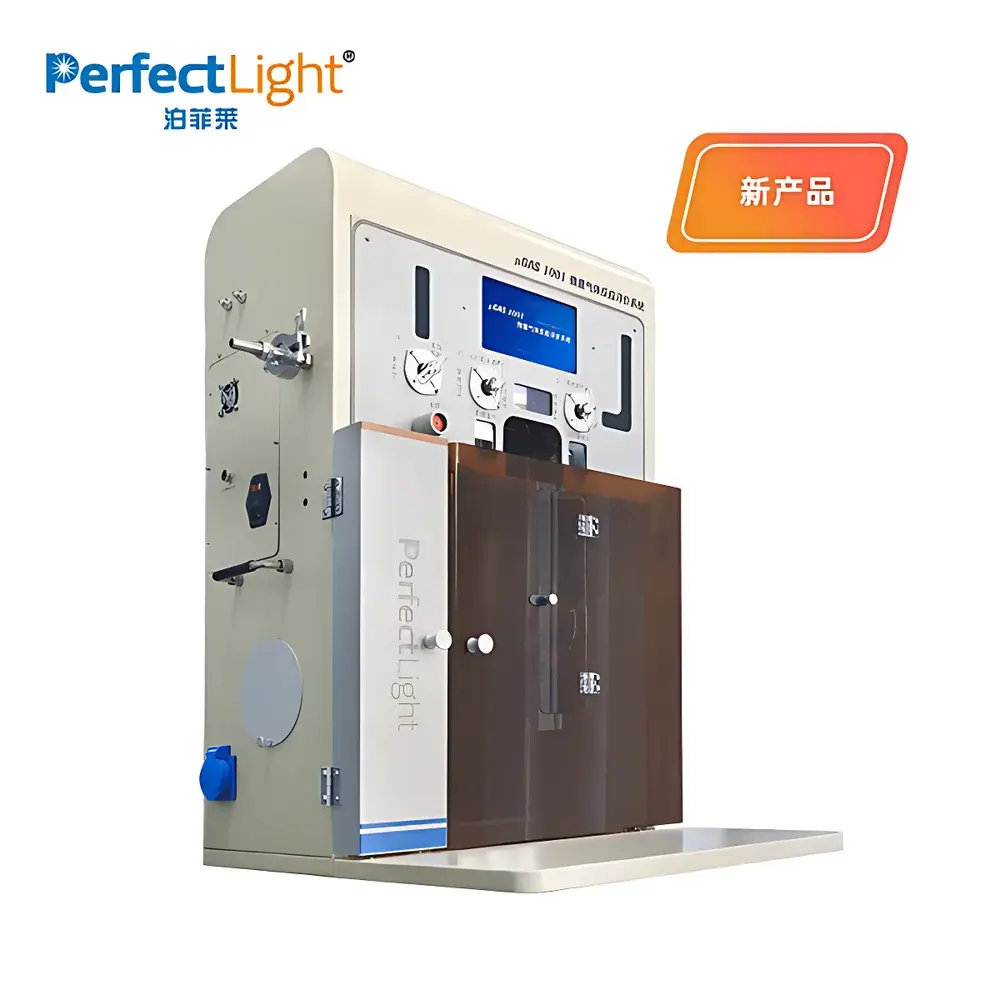
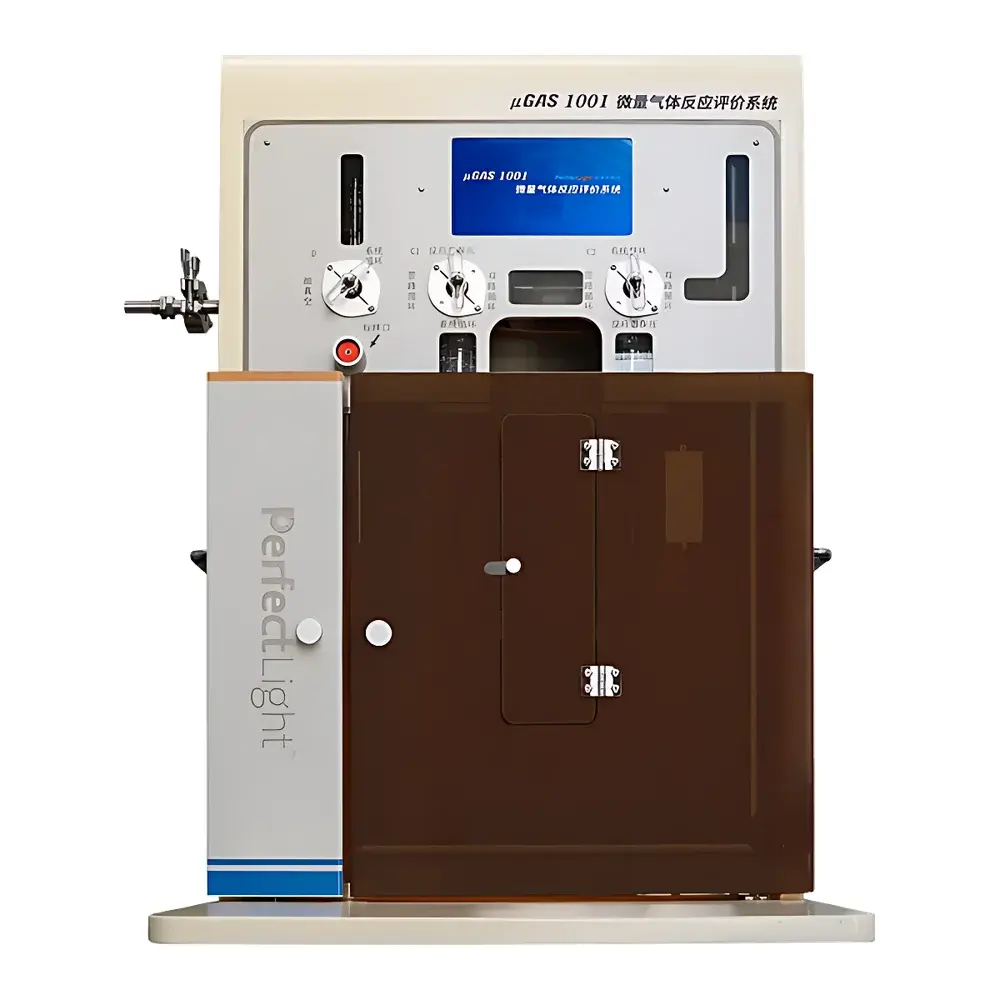
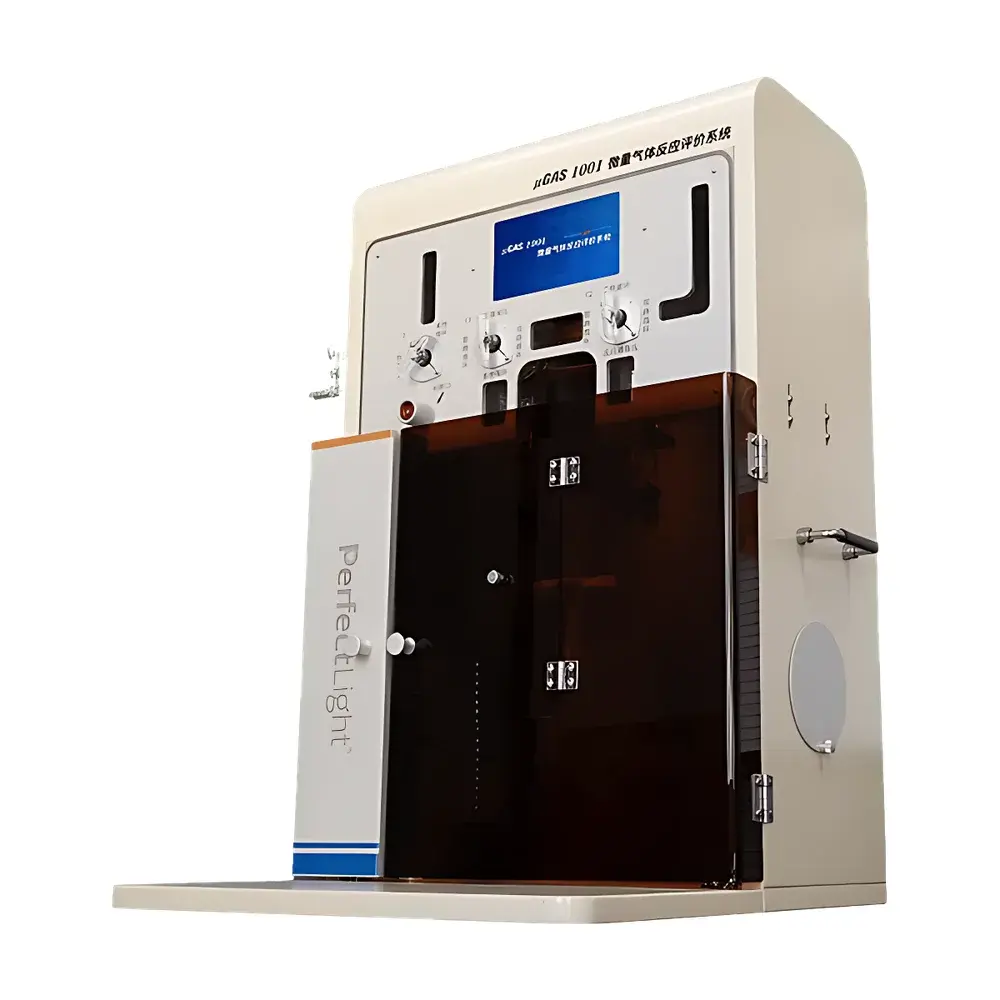
PerfectLight μGAS1001 Micro-Gas Reaction Evaluation System
| Brand | PerfectLight |
|---|---|
| Origin | Beijing, China |
| Manufacturer Type | Authorized Distributor |
| Product Category | Domestic |
| Model | μGAS1001 |
| Pressure Range | 0 kPa to ambient pressure (gauge) |
| Temperature Control Accuracy | ±0.01°C |
| System Total Volume | 440 mL |
| Reactor Volume | 210 mL (recommended working volume: 40–80 mL) |
| O₂ Leak Rate | ≤0.1 μmol/h |
| Quantitative Loop Options | 0.5, 1, 2, 3, 5 mL |
| Maximum Sampling Ratio | 1:88 |
| Vacuum Base Pressure | ≤0.5 kPa (absolute) |
| Tubing Material | High-borosilicate glass |
| Valve Technology | Patented all-glass, metal-free rotary valve island |
| Circulation Pump | Contactless magnetic-drive fan impeller pump (intrinsically safe for H₂ environments) |
| GC Interface | Fully automated, bidirectional TTL/RS-485 control of GC and vacuum pump |
Overview
The PerfectLight μGAS1001 Micro-Gas Reaction Evaluation System is a fully integrated, sealed-phase batch reactor platform engineered for quantitative kinetic assessment of low-yield heterogeneous catalytic reactions under controlled gaseous atmospheres. It operates on the principle of integral accumulation—where reaction products (e.g., H₂, O₂, CO, CH₄, C₂H₆) accumulate in a fixed-volume, high-integrity reactor over time—and employs an on-line, self-sampling methodology based on differential pressure-driven gas transfer into calibrated quantitative loops. Unlike flow-through or continuous-stirred-tank reactors, the μGAS1001 maintains strict mass balance within a closed loop, enabling precise determination of apparent quantum yield (AQY), turnover frequency (TOF), and gas evolution rates without product loss or dilution artifacts. Its design conforms to the metrological requirements of ISO 17025-accredited laboratories performing photocatalytic water splitting (ISO/CD 24592) and CO₂ reduction studies (ASTM E3176-22), particularly where sub-micromole-level detection sensitivity and long-term system integrity are critical.
Key Features
- Patented all-glass, metal-free valve island with Apiezon H vacuum grease—ensures chemical inertness, zero catalytic interference, and operational stability from –10°C to +200°C
- Dynamic leak rate ≤0.1 μmol/h (O₂-equivalent), validated per ASTM E493–21 for ultra-low-permeability systems—meets stringent AQY testing criteria for photocatalytic overall water splitting
- Modular quantitative loop selection (0.5–5 mL) enables tunable detection sensitivity; maximum sampling ratio of 1:88 ensures representative subsampling without system perturbation
- Contactless magnetic-drive circulation pump eliminates electrical ignition sources and electrochemical side reactions—certified intrinsically safe for H₂/O₂ mixtures per IEC 60079-0
- Integrated 7-inch industrial HMI with real-time logging of absolute pressure (±1 Pa), temperature (±0.01°C), humidity, and vacuum status—data stored in CSV/Excel-compatible format with timestamped audit trail
- On-board automatic dynamic leak test protocol—executed pre-run, mid-experiment, or on-demand without manual intervention
- Full GC and vacuum pump interoperability via TTL/RS-485—supports vendor-agnostic integration with Agilent, Shimadzu, Thermo Fisher, and custom-built GC systems
- Temperature-controlled circulation and injection lines (up to 200°C)—prevents condensation-induced chromatographic artifacts and ensures consistent vapor-phase composition
Sample Compatibility & Compliance
The μGAS1001 accommodates gas–solid, gas–liquid–solid, and photoelectrochemical configurations through customizable reactor geometries—including flat-plate, immersion-type, and three-electrode cell variants. It supports catalyst loadings from 1 mg to 100 mg and liquid volumes between 40–80 mL, with optional quartz-jacketed irradiation windows (250–800 nm). All wetted surfaces are constructed from high-borosilicate glass (DIN ISO 3585), exhibiting negligible adsorption for polar and nonpolar gases (tested per ISO 15195 for trace gas retention). The system complies with GLP data integrity requirements: all experimental parameters—including valve actuation timestamps, pressure transients, and thermal profiles—are digitally recorded with immutable metadata. Audit trails satisfy FDA 21 CFR Part 11 electronic record provisions when paired with validated third-party LIMS or ELN software.
Software & Data Management
The embedded controller firmware implements a deterministic real-time operating system (RTOS) with deterministic task scheduling for synchronized valve sequencing, pump modulation, and GC trigger signaling. Experimental methods—including ramp profiles, sampling intervals, background gas injection sequences, and leak-test protocols—are stored as reusable method files with version control. Raw sensor data (pressure, temperature, humidity) are logged at 1 Hz resolution and exported with embedded calibration coefficients. Integrated calculation modules compute instantaneous gas evolution rates (μmol·h⁻¹), cumulative yields (μmol), and normalized metrics (e.g., μmol·g⁻¹·h⁻¹, mol·photon⁻¹) directly from GC peak areas using user-defined calibration curves (R² > 0.999, linear range 0.1–100 μmol). Export formats include CSV, PDF reports with embedded chromatograms, and XML for LIMS ingestion.
Applications
- Quantitative apparent quantum yield (AQY) determination for overall water splitting (H₂ + O₂ co-evolution) under simulated solar illumination
- Time-resolved CO₂ photoreduction kinetics—monitoring multi-carbon product distribution (CO, CH₄, C₂H₄, C₂H₆) with high reproducibility (RSD < 3% across quadruplicate injections)
- Electrocatalytic and photoelectrocatalytic gas evolution studies under potentiostatic/galvanostatic control
- Thermocatalytic H₂ production from ammonia decomposition or formic acid dehydrogenation
- Stability benchmarking of MOFs, covalent organic frameworks (COFs), and single-atom catalysts under prolonged gaseous reaction conditions
- Method development for ISO/IEC 17025 accreditation of photocatalytic activity testing laboratories
FAQ
What is the minimum detectable gas quantity per analysis?
Detection limits depend on GC detector sensitivity and selected quantitative loop volume. With a 0.5 mL loop and standard TCD detection, the system reliably quantifies ≥0.2 μmol of H₂ or O₂ per injection.
Can the μGAS1001 be used for reactions requiring elevated pressure?
No—the system is rated for operation from full vacuum (≤0.5 kPa abs) up to ambient pressure only. It is not designed for pressurized (>101.3 kPa gauge) or supercritical applications.
Is the reactor compatible with corrosive gases such as HCl or NH₃?
Yes—high-borosilicate glass construction provides excellent resistance to most inorganic acids and bases below 150°C; extended exposure to HF, hot concentrated phosphoric acid, or strong alkalis above pH 13 is not recommended.
How is background gas introduced without air contamination?
Via the patented valve island’s dedicated background gas port, which injects carrier gas (e.g., Ar, N₂) under precise pressure regulation—eliminating syringe-based puncture and associated O₂/N₂ ingress.
Does the system support external light source synchronization?
Yes—TTL-triggered illumination start/stop signals can be input via the rear-panel I/O interface, enabling precise correlation between photon flux onset and gas accumulation kinetics.



