
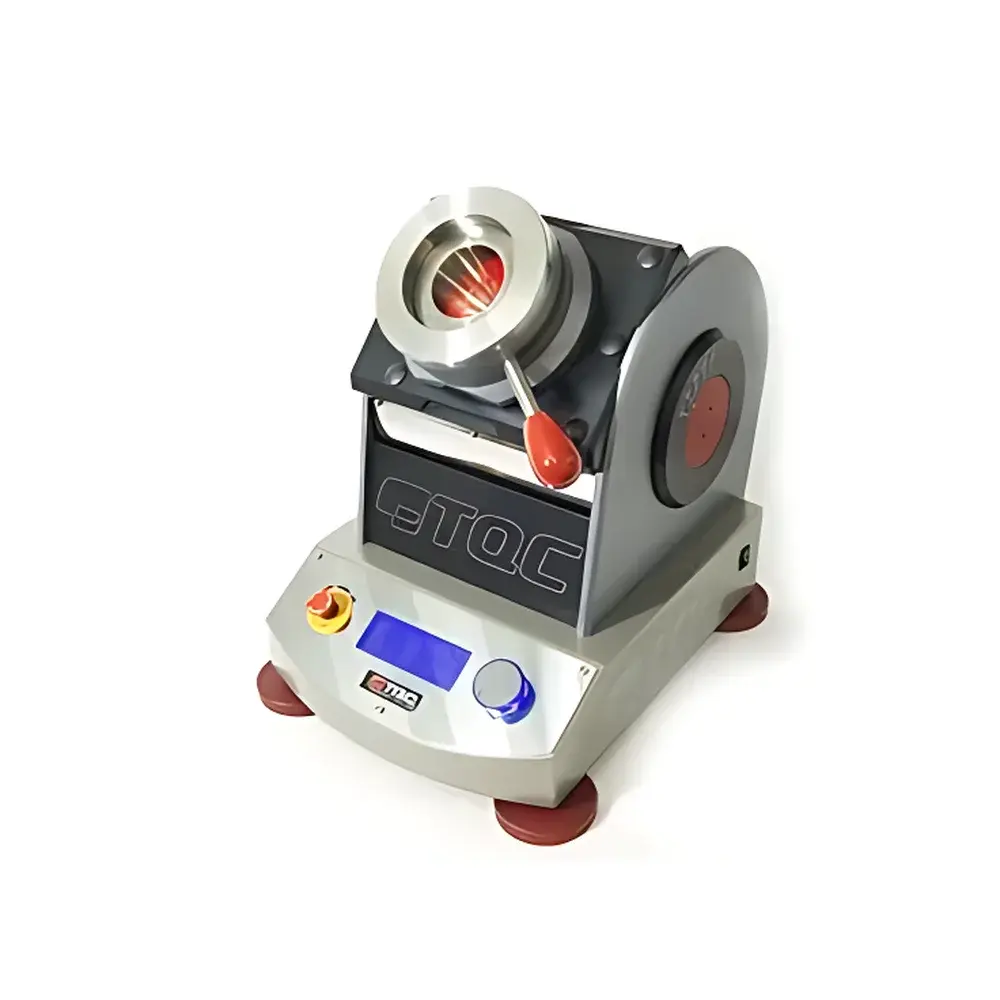
TQC Sheen SP4300/SP4305 Erichsen Cupping Tester
| Origin | Netherlands |
|---|---|
| Manufacturer Type | Authorized Distributor |
| Origin Category | Imported |
| Model | SP4300 / SP4305 |
| Quotation | Upon Request |
| Punching Speed Range | 0.01–0.70 mm/s |
| Maximum Stroke | 0–12 mm |
| Test Panel Width | 100 mm |
| Steel Panel Thickness | 0.8 mm |
| Aluminum Panel Thickness | 1.2 mm |
| Dimensions (D×W×H) | 450 × 350 × 600 mm |
| Net Weight | ~31 kg |
| Power Consumption | 80 W |
| Display Resolution | 193 × 64 pixels |
| Backlight | Blue LED |
| Stroke Accuracy | ±0.01 mm |
| Speed Accuracy | ±1% of set value |
| Safety Features | Emergency Stop Button, Audible Alarm |
| Control Interface | Rotary Push-button Navigation, Multilingual On-screen Menu |
| Integrated LED Illumination System | Adjustable Angle, Intensity, and Color Temperature for Optimized Contrast |
Overview
The TQC Sheen SP4300 and SP4305 Erichsen Cupping Testers are precision-engineered instruments designed to quantify the ductility and adhesion integrity of organic coatings applied to metallic substrates—primarily steel and aluminum sheets—under controlled biaxial deformation. Based on the Erichsen cupping principle defined in ISO 1520, the test applies a hemispherical punch vertically into a clamped, flat test panel until coating failure (cracking, flaking, or delamination) occurs. The depth of punch penetration at first observable failure—reported in millimeters—is the primary performance metric. Unlike manual cupping testers, which suffer from inconsistent stroke rates and operator-dependent repeatability, the SP4300/SP4305 employs a micro-stepping motor drive system delivering programmable, linear displacement with 0.01 mm resolution and speed stability within ±1% of setpoint across the full 0.01–0.70 mm/s range. This ensures strict compliance with ISO 1520’s requirement for constant, uninterrupted deformation rate (0.1–0.3 mm/s), particularly critical when evaluating high-strength or thick-gauge substrates where mechanical hysteresis and load relaxation significantly impact failure mode interpretation.
Key Features
- Micro-stepper motor-driven punch actuation enabling precise, repeatable, and traceable displacement control from 0.01 to 0.70 mm/s
- High-resolution stroke encoder with ±0.01 mm positional accuracy over 0–12 mm full travel
- Integrated multi-angle, multi-spectrum LED illumination system: adjustable azimuth, intensity, and correlated color temperature (CCT) to maximize contrast across high-gloss, matte, textured, and chromatically complex coating surfaces
- Rotary push-button interface with intuitive multilingual menu navigation (English, German, French, Spanish, Dutch, Chinese)
- Backlit monochrome LCD display (193 × 64 pixels) with blue LED backlight for optimal readability under laboratory lighting conditions
- Dual safety architecture: hardware-based emergency stop button and software-triggered audible alarm upon abnormal load or timeout
- Robust cast-aluminum frame with vibration-damped base, supporting long-term stability during high-cycle testing
Sample Compatibility & Compliance
The SP4300/SP4305 accommodates standardized test panels per ISO 1520: 100 mm wide × ≥150 mm long, with thicknesses of 0.8 mm for cold-rolled steel and 1.2 mm for aluminum alloy substrates. Clamping force is pneumatically stabilized to prevent slippage during deformation, ensuring uniform stress distribution. The instrument is fully compliant with ISO 1520:2022, DIN EN ISO 1520, DIN 53156, DIN 53232, BS 3900-E4, NBN T22-104, and NFT 30 019. All motion parameters—including speed ramp profiles, dwell times, and stroke endpoints—are programmable and logged with timestamped metadata, supporting GLP/GMP-aligned audit trails. Optional calibration certificates traceable to NIST or EU-accredited national metrology institutes are available upon request.
Software & Data Management
While the SP4300 operates as a standalone benchtop unit, the SP4305 variant supports RS-232 and USB-B connectivity for integration into centralized QC data management systems. Firmware enables export of raw stroke vs. time datasets (CSV format), including real-time load feedback (where equipped with optional load cell), failure detection timestamps, and user-defined pass/fail thresholds. Data logs include instrument ID, operator ID, sample ID, environmental conditions (if external sensor input enabled), and calibration status flags. The firmware architecture complies with FDA 21 CFR Part 11 requirements for electronic records and signatures when deployed with appropriate access controls and audit trail configuration.
Applications
These testers serve quality assurance laboratories in coil coating facilities, automotive OEM paint shops, aerospace primer validation labs, and R&D departments developing corrosion-inhibiting coatings. Typical use cases include comparative evaluation of crosslink density in thermoset systems, assessment of film flexibility after accelerated weathering (e.g., QUV or xenon arc exposure), verification of intercoat adhesion in multi-layer systems (e.g., e-coat + primer + topcoat), and qualification of waterborne versus solvent-borne formulations under identical deformation kinetics. Results directly inform process window definition in industrial roll-forming and stamping operations where post-application mechanical strain is unavoidable.
FAQ
What standards does the SP4300/SP4305 comply with?
ISO 1520:2022, DIN EN ISO 1520, DIN 53156, DIN 53232, BS 3900-E4, NBN T22-104, and NFT 30 019.
Can the instrument test non-metallic substrates?
No—the design and clamping geometry are optimized exclusively for rigid metallic panels meeting ISO 1520 dimensional and mechanical specifications.
Is calibration documentation included?
A factory calibration report is supplied; accredited calibration certificates (traceable to national standards) are available as an optional service.
What maintenance is required?
Annual verification of stroke linearity and speed accuracy is recommended; lubrication-free stepper motor and sealed bearing construction minimize routine servicing.
Does the LED illumination system require replacement bulbs?
No—all LEDs are solid-state, rated for >50,000 hours of operation, with no consumable components.



