
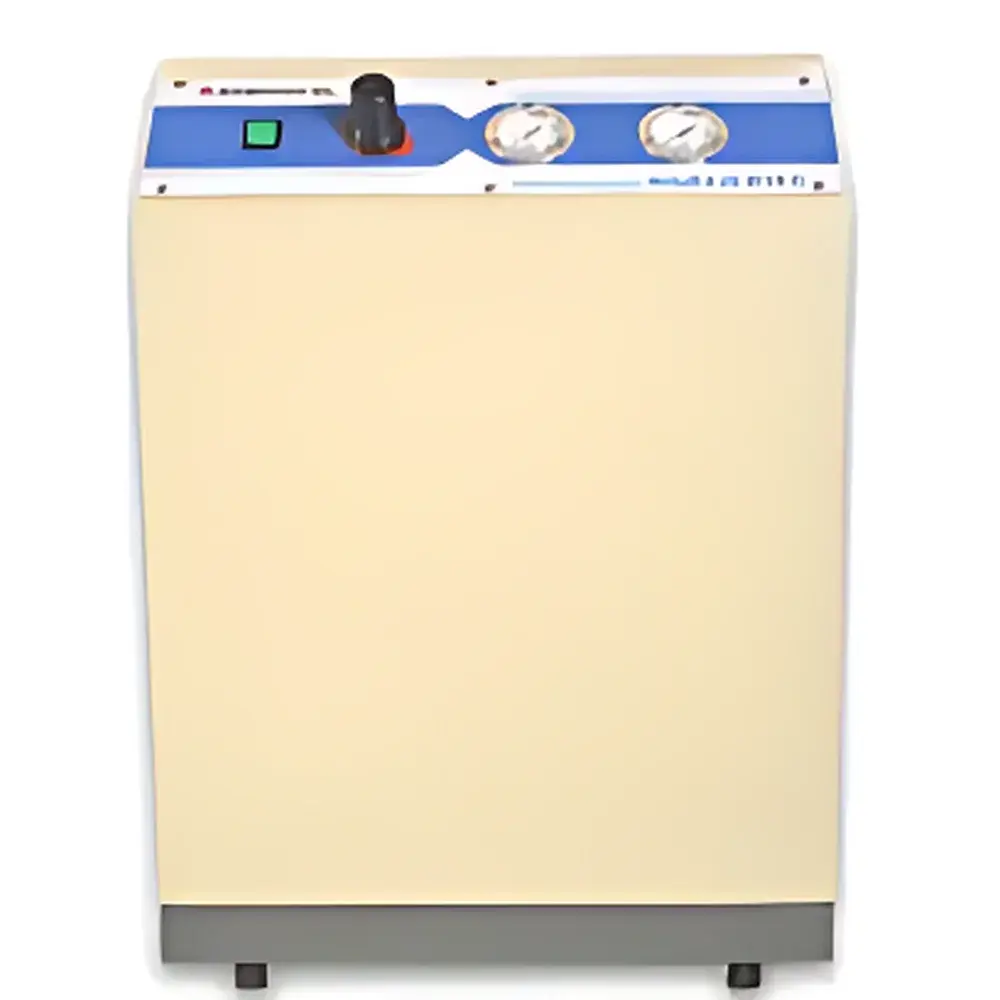
WondaLab W58-G Oil-Free Air Compressor
| Origin | Japan |
|---|---|
| Manufacturer Type | Authorized Distributor |
| Origin Category | Imported |
| Model | W58-G |
| Pricing | Upon Request |
| Weight | 43 kg |
| Rated Power Supply | 220 V, 50 Hz |
| Motor Speed | 1400 rpm |
| Rated Power | 560 W |
| Air Receiver Volume | 16 L |
| Free Air Delivery | 58 L/min |
| Sound Pressure Level | 48 dB(A) |
| Maximum Discharge Pressure | ≤ 0.8 MPa |
| Dimensions (W×D×H) | 450 × 360 × 670 mm |
Overview
The WondaLab W58-G Oil-Free Air Compressor is an engineered solution designed specifically to support flame atomization in atomic absorption spectrometry (AAS), particularly for Shimadzu AA-6300CF and AA-7000CF instruments. Unlike oil-lubricated compressors, the W58-G employs a piston-type mechanism with dry-running cylinder walls and non-contact sealing elements—eliminating hydrocarbon contamination at the source. Its operation is based on positive displacement compression, where intake air undergoes sequential compression in a single-stage chamber, followed by regulated storage in a corrosion-resistant 16 L receiver tank. The system delivers clean, dry, oil-free air at a stable pressure of up to 0.8 MPa, meeting the stringent gas purity requirements for flame AAS applications where trace-level metal analysis demands zero organic interference or particulate carryover.
Key Features
- Oil-free piston compression architecture ensures Class 0 air purity per ISO 8573-1:2010 — no lubricants contact the airstream, eliminating risk of carbon buildup or oil vapor carryover into nebulizers or burner heads.
- Stainless steel ball-and-spring check valve assembly replaces conventional elastomeric designs; engineered for fail-safe operation — even if the spring fractures, the stainless steel ball maintains functional sealing integrity under backpressure.
- Integrated delay-start control circuit enables unloading during startup: the solenoid unloader valve vents residual tank pressure for 1–2 seconds prior to motor engagement, reducing mechanical stress and inrush current.
- Electromagnetic interference suppression built into the delay module mitigates reverse EMF transients, protecting solenoid valves from voltage spikes and extending service life.
- Internally passivated air receiver tank with electrophoretic coating resists oxidation and moisture-induced corrosion — critical for long-term stability in humid laboratory environments.
- Low-noise operation at 48 dB(A) achieved through balanced flywheel dynamics and vibration-damped mounting — no acoustic foam required, supporting compliance with ISO 7779 and ANSI S12.55 laboratory noise guidelines.
- Compact footprint (450 × 360 × 670 mm) and integrated swivel casters enable flexible placement within instrument benches or centralized gas supply cabinets.
Sample Compatibility & Compliance
The W58-G is validated for continuous-duty operation with Shimadzu AA-6300CF and AA-7000CF flame AAS systems, delivering consistent airflow (58 L/min) at regulated pressures required for pneumatic nebulizer performance and flame stability. It meets essential safety and electromagnetic compatibility standards including IEC 61000-4-5 (surge immunity), IEC 61000-4-4 (electrical fast transient/burst), and conforms to RoHS Directive 2011/65/EU. While not certified to UL or CSA as a standalone appliance, its design aligns with GLP-compliant lab infrastructure requirements for auxiliary gas supply equipment — particularly where audit trails, maintenance logs, and documented pressure stability are integral to method validation (e.g., USP , ASTM D1946, ISO 11843-4).
Software & Data Management
The W58-G operates as a stand-alone hardware unit without embedded firmware or digital interfaces. However, its mechanical reliability and pressure consistency support seamless integration into automated AAS workflows governed by Shimadzu LabSolutions software. Pressure output remains stable across ambient temperature fluctuations (10–35 °C), minimizing drift-related recalibration needs. For labs implementing 21 CFR Part 11-compliant data governance, the compressor’s passive role — coupled with its documented MTBF (>15,000 hours) and traceable maintenance intervals — facilitates inclusion in instrument qualification protocols (IQ/OQ/PQ) without requiring electronic audit trails.
Applications
- Primary compressed air source for flame atomic absorption spectrometry (FAAS), especially with acetylene/air or nitrous oxide/air combustion systems.
- Gas supply for pneumatic nebulizers in ICP-OES sample introduction where oil-free air is mandated to prevent torch clogging or plasma instability.
- Support gas for flame photometers, gas chromatography detectors (e.g., FID, NPD), and laboratory air tools requiring contaminant-free flow.
- Benchtop air source in environmental testing labs conducting EPA Method 200.7, 200.8, or ISO 11885 analyses where reagent-grade air purity is specified.
FAQ
Is the W58-G suitable for use with non-Shimadzu AAS instruments?
Yes — provided the instrument requires ≤ 0.8 MPa regulated oil-free air at ≥ 50 L/min flow rate and tolerates intermittent duty cycles typical of flame AAS operation.
Does the unit include an air dryer or filter?
No — the W58-G delivers dry air via compression-induced dew point depression and internal condensate separation; external coalescing and desiccant filters are recommended for high-humidity environments or ultra-trace applications.
What maintenance schedule is recommended?
Annual inspection of valve seating, piston ring wear, and receiver tank drain valve functionality; no lubrication required.
Can the W58-G be mounted vertically or integrated into a rack?
It is designed for horizontal benchtop or floor-standing use only — vertical orientation compromises condensate drainage and thermal management.
Is CE marking applied to this model?
As an imported device distributed under Japanese regulatory oversight, it complies with EMC and Low Voltage Directive principles but does not bear CE marking; EU-based users should verify conformity via local authorized representative documentation.
Related Products







