
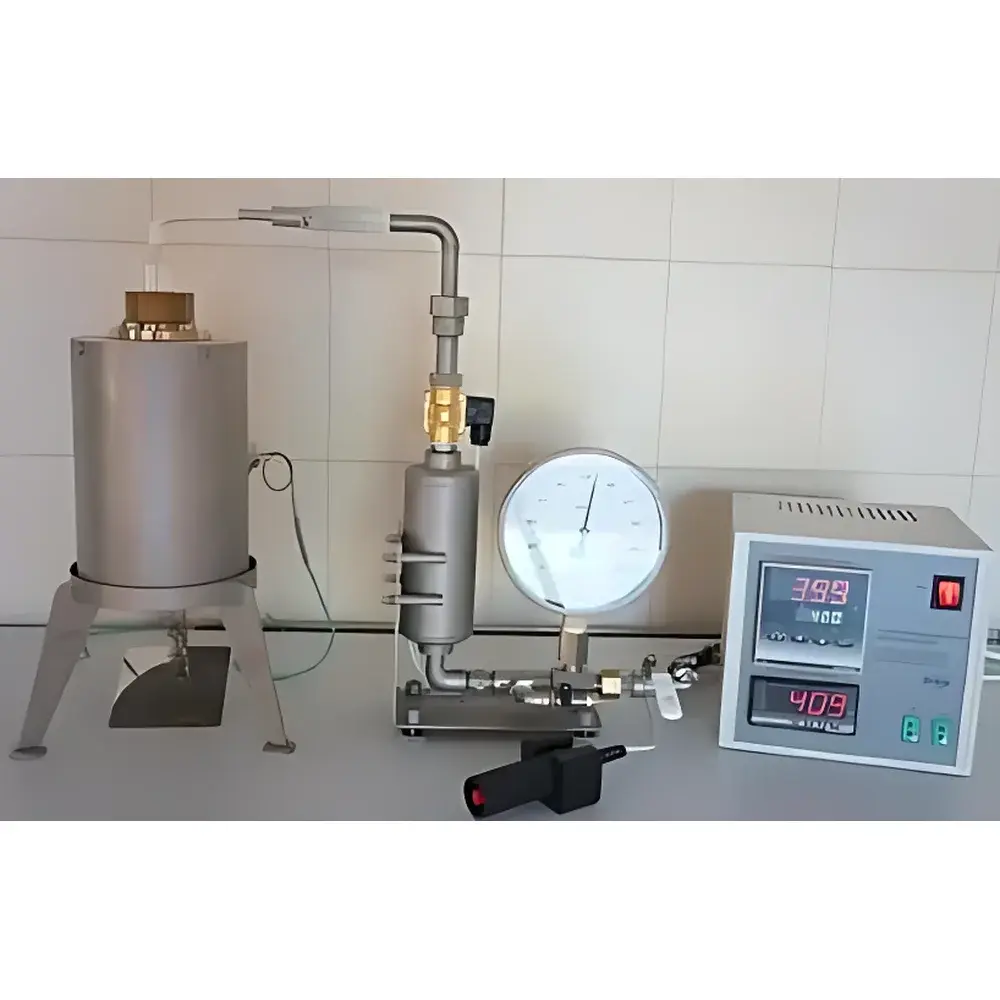
ANKO MIT3 Dust Cloud Minimum Ignition Temperature Analyzer
| Origin | Poland |
|---|---|
| Manufacturer Type | Distributor |
| Origin Category | Imported |
| Model | MIT3 |
| Price Range | USD 27,000 – 68,000 |
| Standards Compliance | EN 50281-2-1, ASTM E1491-06, IEC 61241-2-1, ISO/IEC 80079-20-2:2016 |
| Heating Range | Ambient to 1000 °C |
| Heating Element | Kanthal® alloy resistive heater |
| Chamber Construction | AISI 316 stainless steel |
| Dispersion Nozzle | ANKO-designed, geometry and orifice dimensions fully compliant with ISO/IEC 80079-20-2 |
| Temperature Control | Digital PID controller with ±1.5 °C stability over full range |
| Temperature Measurement | Calibrated ceramic-sheathed thermocouple (Type K), integrated LED digital display |
| System Configuration | Single-unit standard configuration |
Overview
The ANKO MIT3 Dust Cloud Minimum Ignition Temperature Analyzer is a precision-engineered laboratory instrument designed for the quantitative determination of the minimum ignition temperature (MIT) of combustible dust clouds under standardized thermal exposure conditions. Operating on the principle of controlled, reproducible dust dispersion into a pre-heated, vertically oriented cylindrical furnace chamber, the MIT3 enables systematic assessment of thermal ignition susceptibility — a critical parameter in hazard classification, process safety design, and ATEX/IECEx zone classification for facilities handling organic, metallic, or hybrid particulates. The system adheres strictly to internationally recognized test protocols, including EN 50281-2-1, ASTM E1491-06, IEC 61241-2-1, and ISO/IEC 80079-20-2:2016, ensuring data integrity required for regulatory submissions, DSEAR compliance reports, and Process Hazard Analysis (PHA) documentation.
Key Features
- High-stability thermal chamber: Constructed from AISI 316 stainless steel with optimized thermal mass and uniform wall thickness, the furnace provides exceptional thermal homogeneity and mechanical durability across repeated thermal cycling from ambient to 1000 °C.
- Kanthal® heating system: Precision-wound resistance heating elements deliver rapid thermal ramping, stable plateau maintenance, and long-term calibration retention without degradation.
- Standard-compliant dispersion nozzle: ANKO-engineered pneumatic nozzle meets exact dimensional and flow-dynamic specifications defined in ISO/IEC 80079-20-2, ensuring repeatable dust cloud density, particle suspension time, and spatial distribution within the hot zone.
- Remote-controlled dust injection: Integrated solenoid-driven actuation allows operator-initiated dispersion without physical proximity to the heated chamber, enhancing procedural safety and reducing human error during sequence execution.
- Digital PID temperature regulation: Microprocessor-based controller maintains setpoint accuracy within ±1.5 °C over the entire operational range, with configurable ramp rates and dwell times for method-specific thermal profiles.
- Ceramic-sheathed Type K thermocouple: High-purity alumina insulation ensures long-term stability, oxidation resistance, and traceable calibration up to 1000 °C; real-time readings displayed via front-panel LED interface with 0.1 °C resolution.
Sample Compatibility & Compliance
The MIT3 accommodates a broad spectrum of powdered materials — including but not limited to coal dust, aluminum powder, sugar, lactose, polyethylene, and pharmaceutical excipients — provided they exhibit sufficient dispersibility and thermal volatility below 1000 °C. Sample mass loading (typically 0.5–5 g) and carrier gas flow rate (compressed air or nitrogen, 0.5–2.0 bar) are adjustable to match material-specific dispersion behavior. All test procedures conform to GLP-aligned documentation practices, supporting audit readiness for FDA, OSHA, or EU Notified Body inspections. Data output supports integration into enterprise LIMS environments and satisfies traceability requirements under ISO/IEC 17025 accreditation frameworks.
Software & Data Management
While the MIT3 operates as a standalone benchtop unit with embedded firmware control, optional USB- or RS-232-enabled data logging modules permit time-stamped acquisition of chamber temperature, dispersion trigger timing, and ignition event detection (via optional optical flame sensor add-on). Exported CSV files include metadata fields for sample ID, operator, ambient conditions, and calibration certificate numbers — facilitating automated report generation compliant with 21 CFR Part 11 electronic record requirements when deployed with validated software platforms. Firmware updates are delivered via secure authenticated channels and maintain full backward compatibility with historical test method configurations.
Applications
- Hazard identification and classification per UN GHS Chapter 2.13 and CLP Regulation Annex VI
- Supporting basis-of-design for explosion protection measures (e.g., inerting, suppression, venting)
- Verification of safe operating temperatures for dryers, mills, silos, and pneumatic conveying systems
- Input parameter for Dust Explosion Severity (Kst) and Maximum Pressure (Pmax) testing campaigns
- Quality control of raw material batches where thermal stability impacts downstream processing safety
- Academic and industrial research on dust ignition kinetics, surface oxidation effects, and humidity-dependent ignition thresholds
FAQ
What standards does the MIT3 fully support for MIT testing?
EN 50281-2-1, ASTM E1491-06, IEC 61241-2-1, and ISO/IEC 80079-20-2:2016 — all implemented at hardware and procedural levels.
Is the heating chamber calibrated traceably to NIST or equivalent national standards?
Yes; each unit ships with a factory calibration certificate referencing PTB-traceable reference thermocouples, and field recalibration kits are available with documented uncertainty budgets.
Can the MIT3 be used for layered dust ignition temperature (LIT) testing?
No; the MIT3 is specifically configured for dust cloud ignition only. Layered ignition requires separate apparatus per IEC 61241-2-3.
What maintenance intervals are recommended for the dispersion nozzle and heating elements?
Nozzle inspection every 50 tests; Kanthal® elements require no scheduled replacement under normal use but should be verified for continuity and resistance drift annually.
Does the system support automated pass/fail evaluation based on observed ignition?
Not inherently; ignition determination remains operator-observed per standard visual criteria, though optional photodiode-based detection modules enable objective event timestamping.






