
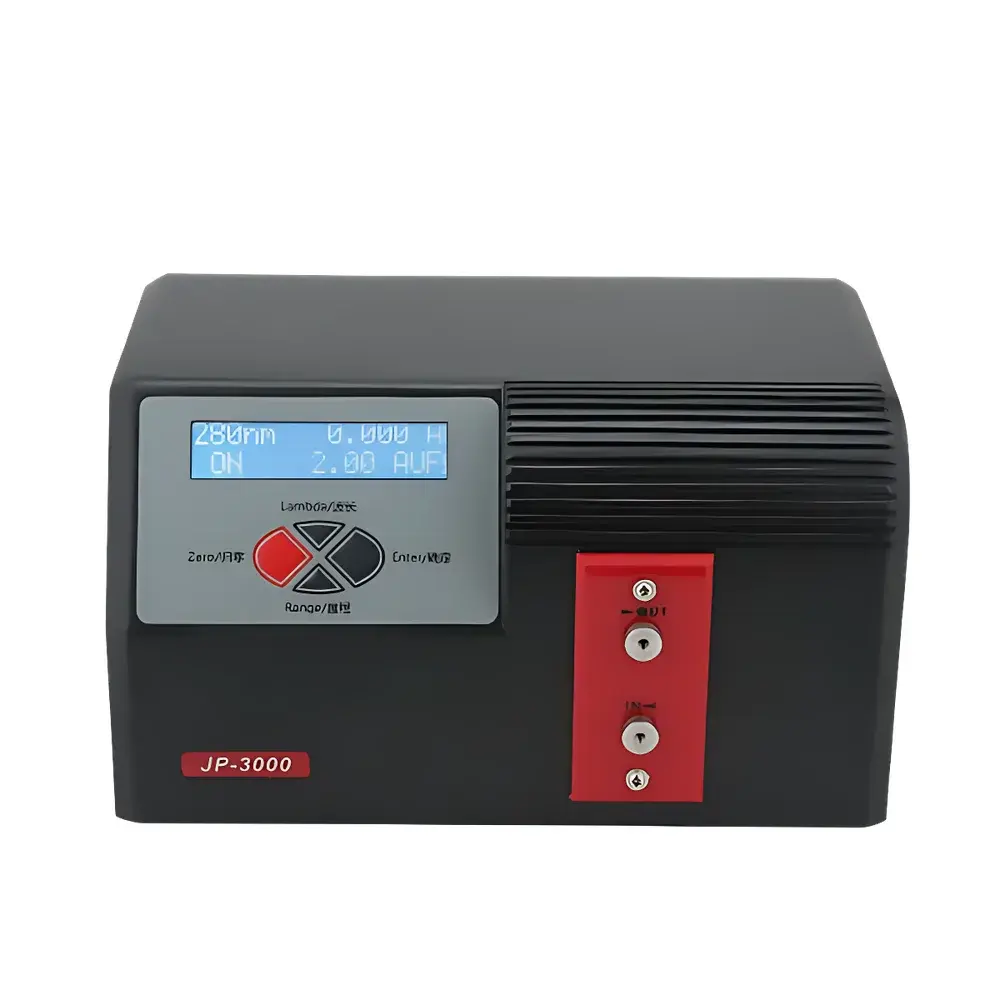
Jiapeng JP-3000 Dual-Beam UV-Vis Nucleic Acid & Protein Detector
| Brand | Jiapeng |
|---|---|
| Origin | Shanghai, China |
| Model | JP-3000 |
| Purification Principle | Ion Exchange Chromatography (IEX) |
| Gradient Type | Linear Gradient |
| Detector Type | UV-Vis Absorbance Detector |
| Detection Range | –6 AU to +6 AU |
| Pressure Rating | 3 MPa |
| Wavelengths | 260 nm, 280 nm, 295 nm, 310 nm |
| Minimum Detectable Concentration | 20 µg/mL |
| Light Source | LED (Lifespan > 50,000 h) |
| Optical Path Length | 2 mm |
| Flow Cell Volume | 10–120 µL |
| Baseline Stability | Drift ≤ 0.002 A/h |
| Noise | < 0.0001 A (RMS) |
| Sensitivity Settings | 0.05–4 A full scale |
| Zero Adjustment | Dual-beam real-time auto-zero |
| Display | High-contrast blue-membrane LCD |
| Power Supply | AC 220 V, 50/60 Hz |
| Dimensions (W×D×H) | 205 × 300 × 180 mm |
| Weight | 2.6 kg |
Overview
The Jiapeng JP-3000 Dual-Beam UV-Vis Nucleic Acid & Protein Detector is a dedicated absorbance-based detection module engineered for integration into low-to-medium pressure liquid chromatography (LC) systems used in protein purification, nucleic acid analysis, and biomolecule characterization. Operating on the principle of Beer–Lambert law-based ultraviolet–visible absorbance measurement, the JP-3000 delivers stable, reproducible quantification of macromolecules—including proteins (280 nm), nucleic acids (260 nm), tryptophan-rich peptides (295 nm), and aromatic compounds (310 nm)—during real-time elution monitoring. Its dual-beam optical architecture—comprising a reference beam and a sample beam—compensates for lamp intensity drift and solvent baseline fluctuations, enabling rapid system stabilization without pre-heating and supporting high-fidelity chromatographic peak integration under dynamic gradient conditions.
Key Features
- Dual-beam photometric design with real-time reference subtraction, eliminating baseline drift caused by lamp aging or temperature variation
- LED-based cold light source with >50,000-hour operational lifetime and negligible heat generation—minimizing thermal perturbation to sensitive biomolecular samples
- Multi-wavelength selection (260 nm, 280 nm, 295 nm, 310 nm) via precision stepper motor-controlled filter wheel for targeted biomolecule detection
- Seven-step programmable sensitivity range (0.05–4 A full scale), optimized for both high-concentration crude lysates and dilute elution fractions
- Integrated Blupad Chromatography Workstation software with real-time data acquisition, automatic chromatogram generation, and one-click JPG export for documentation and reporting
- Mechanical and electrical interface compatibility with GE Healthcare AKTA systems and standard 1/16″ PEEK tubing fittings—enabling seamless deployment in existing IEX, SEC, or affinity purification workflows
- Compact benchtop footprint (205 × 300 × 180 mm) and lightweight construction (2.6 kg) suitable for shared core facilities and mobile lab configurations
Sample Compatibility & Compliance
The JP-3000 supports aqueous and mild organic solvent mobile phases commonly employed in ion exchange chromatography (IEX), including phosphate, Tris-HCl, and sodium acetate buffers with up to 25% (v/v) ethanol or isopropanol. Its 2-mm-pathlength flow cell accommodates sample volumes from 10 µL to 120 µL, ensuring compatibility with analytical-scale columns (e.g., 4.6 × 150 mm) and preparative microbore systems. The detector complies with fundamental requirements for laboratory instrumentation per IEC 61010-1 (Safety of Electrical Equipment for Measurement, Control, and Laboratory Use). While not certified for GMP production environments, its data integrity features—including timestamped chromatogram storage, non-editable binary raw data files, and audit-ready export logs—support GLP-aligned research workflows in academic, biotech R&D, and contract testing laboratories.
Software & Data Management
The embedded Blupad Chromatography Workstation provides native Windows-compatible acquisition and visualization. It records absorbance signals at user-defined sampling rates (default: 1 Hz), applies digital smoothing filters (Savitzky–Golay, optional), and overlays multi-wavelength traces for ratio analysis (e.g., A260/A280). All chromatograms are saved in proprietary .blu format (with metadata embedding) and exportable as lossless JPG, CSV, or PDF. Software version 3.2+ includes configurable alarm thresholds, peak integration parameters (tangent skim, valley-to-valley), and batch report templates compliant with internal SOPs. Raw data files retain instrument serial number, acquisition timestamp, wavelength setting, and sensitivity configuration—facilitating traceability during method validation or regulatory review.
Applications
- Real-time monitoring of protein elution profiles during cationic/anionic exchange purification of monoclonal antibodies, enzymes, and recombinant fusion proteins
- Quantitative assessment of DNA/RNA purity and concentration in plasmid prep and oligonucleotide synthesis workflows
- Monitoring of enzymatic activity assays involving chromogenic substrates or cofactor absorbance shifts
- Quality control of natural product extracts—e.g., polyphenols, alkaloids, and flavonoids—using characteristic UV signatures
- Educational use in undergraduate biochemistry labs for teaching chromatographic theory, Beer’s law calibration, and spectral deconvolution
- Preparative fraction collection triggering based on threshold absorbance events in food-grade protein isolation (e.g., soy, whey)
FAQ
Does the JP-3000 support wavelength scanning or spectral acquisition?
No. The JP-3000 is a fixed-wavelength, single-channel absorbance detector. It does not perform full-spectrum scanning; users select one of four discrete wavelengths prior to run initiation.
Is the detector compatible with HPLC systems operating above 3 MPa?
No. The JP-3000 is rated for maximum system pressure of 3 MPa (≈435 psi) and is intended for low-pressure FPLC and gravity-fed or peristaltic-pump-driven chromatography—not UHPLC or high-pressure analytical HPLC.
Can raw data be imported into third-party analysis platforms such as OriginLab or GraphPad Prism?
Yes. Exported CSV files contain time (min) and absorbance (mAU or AU) columns with header metadata, enabling direct import and custom curve fitting.
What maintenance is required for long-term optical stability?
No routine optical alignment is needed. Users should periodically inspect the flow cell for particulate buildup and rinse with 20% isopropanol followed by deionized water between runs involving viscous or precipitating samples.
Is FDA 21 CFR Part 11 compliance supported?
The JP-3000 workstation does not include electronic signature, role-based access control, or audit trail features required for Part 11 compliance. It is suitable for non-GMP research use only.





