
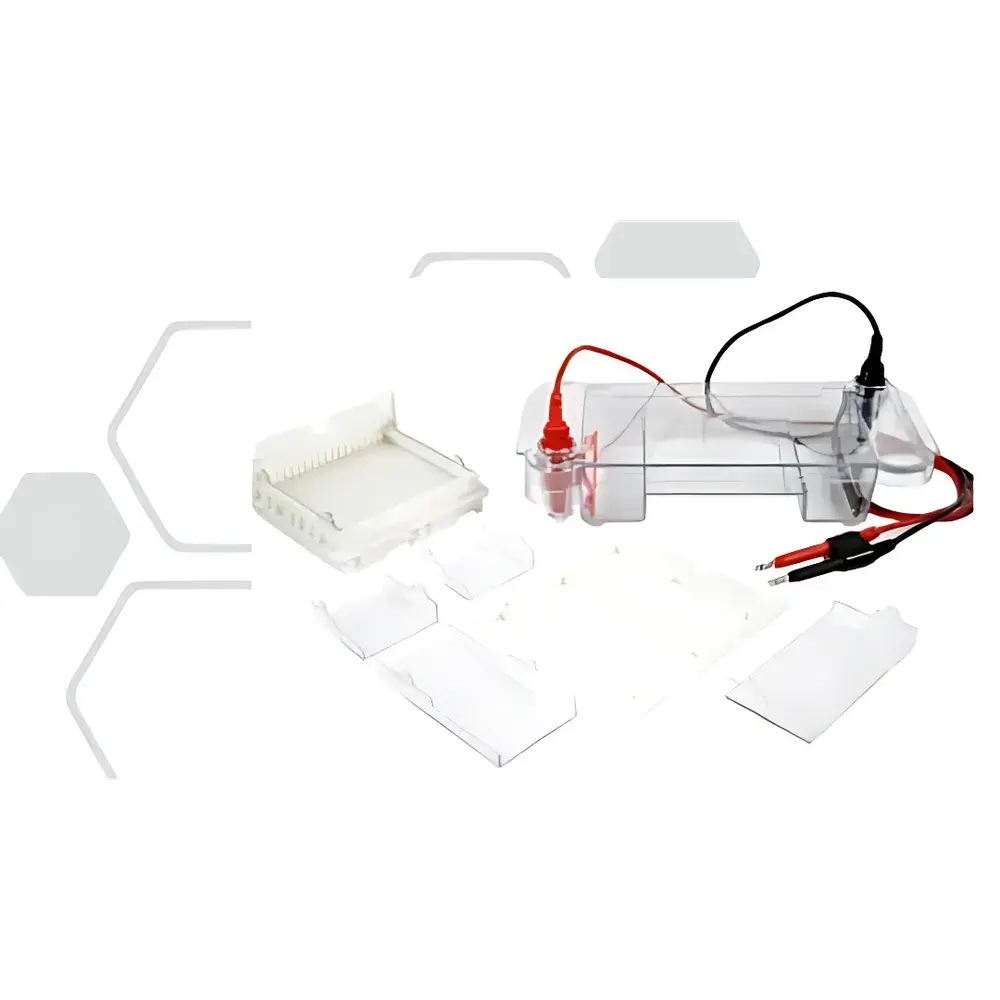
Keebio HE130 Horizontal Nucleic Acid Electrophoresis Tank
| Brand | Keebio |
|---|---|
| Model | HE130 |
| Instrument Type | Horizontal Nucleic Acid Electrophoresis Apparatus |
| Gel Dimensions (mm) | 130 × 200, 130 × 150, 60 × 120, 60 × 60 |
| Max Voltage | 500 V |
| Buffer Capacity | 800 mL |
| Sample Wells | 2–25 wells (configurable via comb selection) |
| Comb Options | 1.0 mm (25 teeth), 1.5 mm (13/18 teeth), 2.0 mm (3 teeth) |
| Max Sample Volume per Well | 15–550 µL |
| External Dimensions (mm) | 320 × 180 × 85 |
| Weight | 1.2 kg |
| Electrode Material | 99.95% Pure Platinum |
| Housing Material | Injection-Molded Polycarbonate |
| Gel Casting | Integrated Multi-Size Gel Tray System (no tape sealing required) |
| Operating Temperature Range | Up to 135 °C (tray material) |
Overview
The Keebio HE130 Horizontal Nucleic Acid Electrophoresis Tank is a precision-engineered laboratory instrument designed for routine and high-fidelity separation of DNA, RNA, and oligonucleotides in agarose or polyacrylamide gels. Based on the fundamental principle of electrophoretic mobility—where nucleic acid fragments migrate through a porous matrix under an applied electric field—the HE130 delivers consistent, reproducible resolution across a broad molecular weight range. Its horizontal configuration enables rapid gel casting, straightforward sample loading, and direct UV visualization post-electrophoresis without gel transfer. The system is optimized for compatibility with standard molecular biology workflows including PCR product analysis, restriction digest verification, plasmid screening, and genotyping assays. Engineered for daily use in academic, clinical, and industrial molecular laboratories, the HE130 emphasizes operational safety, dimensional stability, and long-term electrode integrity.
Key Features
- Precision-molded polycarbonate tank body ensures structural rigidity, optical clarity for real-time monitoring, and complete resistance to buffer leakage—even during extended runs.
- Patented button-actuated lid mechanism provides one-handed, tool-free access while maintaining secure electrical isolation and preventing accidental contact with electrodes.
- Multi-size gel tray system (130 × 200 mm, 130 × 150 mm, 60 × 120 mm, 60 × 60 mm) is fabricated from heat-resistant polymer (up to 135 °C), eliminating warping during hot agarose pouring and removing the need for sealing tape or wax.
- Center-aligned leveling platform with vertical reference guides ensures accurate, repeatable gel positioning—critical for uniform field distribution and band sharpness.
- High-purity (99.95%) platinum electrodes offer superior conductivity, minimal polarization, and exceptional corrosion resistance in TAE, TBE, and MOPS buffers across pH 7.0–9.0.
- Integrated buffer reservoir design accommodates up to 800 mL, supporting stable current delivery and thermal dissipation during high-voltage operation (up to 500 V DC).
Sample Compatibility & Compliance
The HE130 supports standard nucleic acid electrophoresis protocols compliant with ISO/IEC 17025–accredited quality systems. It accommodates common gel matrices—including 0.5–3.0% agarose and 4–20% polyacrylamide—with validated performance for fragments ranging from 50 bp to >20 kbp. The system is compatible with ethidium bromide, SYBR Safe, GelRed, and other commercial nucleic acid stains. All materials in direct contact with buffers or gels meet USP Class VI biocompatibility requirements and are free of detectable heavy metals or leachables. The unit conforms to IEC 61010-1:2010 for electrical safety in laboratory equipment and carries CE marking for EMC and Low Voltage Directive compliance.
Software & Data Management
As a standalone electrophoresis apparatus, the HE130 operates without embedded firmware or proprietary software. It functions as a passive, analog electrophoresis module compatible with all commercially available power supplies (e.g., Bio-Rad PowerPac, Thermo Fisher Owl E1000) and imaging systems (e.g., Azure Biosystems cSeries, UVP ChemStudio). For GLP/GMP environments, users may integrate the HE130 into documented workflows using external power supply units that support FDA 21 CFR Part 11–compliant audit trails, electronic signatures, and parameter locking. Gel documentation—including lane annotation, molecular weight calibration, and densitometric analysis—is performed via third-party image analysis platforms such as ImageLab (Bio-Rad), AlphaView SA (ProteinSimple), or Fiji/ImageJ with established SOPs.
Applications
- Routine DNA fragment sizing and purity assessment in cloning and CRISPR validation workflows.
- RNA integrity evaluation (RIN estimation) via denaturing agarose or formaldehyde gels.
- Preparative electrophoresis for excision and extraction of target bands (≥50 ng sensitivity with SYBR Gold staining).
- Quality control of synthetic oligonucleotides and next-generation sequencing library preparations.
- Teaching laboratory implementation—designed for student safety, intuitive handling, and robustness against repeated thermal cycling and mechanical stress.
FAQ
Is the HE130 compatible with both TAE and TBE running buffers?
Yes. The platinum electrodes and polycarbonate housing are chemically inert in Tris-acetate-EDTA (TAE), Tris-borate-EDTA (TBE), and MOPS-based systems across standard concentrations (0.5× to 1×) and operating temperatures (4–30 °C).
Can I pour a 130 × 200 mm gel without edge leakage?
Yes. The integrated multi-size tray features raised perimeter walls and precision-machined alignment grooves that prevent buffer seepage at the gel–tray interface—eliminating the need for agarose sealing or parafilm wrapping.
What is the maximum recommended run time at 500 V?
For optimal resolution and thermal management, continuous operation at 500 V is validated for ≤45 minutes with adequate buffer volume (≥600 mL) and ambient lab temperature ≤25 °C. Extended high-voltage runs require active cooling or lower voltage settings.
Are replacement combs traceable to lot-specific calibration records?
All combs are manufactured under controlled conditions and supplied with batch-specific dimensional certification (±0.05 mm tolerance on tooth thickness and spacing), supporting ISO/IEC 17025 traceability when used within validated methods.
Does the HE130 meet requirements for ISO 13485-certified medical device manufacturing labs?
While the HE130 itself is not a medical device, its material composition, dimensional stability, and absence of extractables make it suitable for use in ISO 13485 environments where nucleic acid testing supports device-related QC—provided it is operated per manufacturer-specified parameters and included in the lab’s equipment qualification (IQ/OQ/PQ) protocol.



