
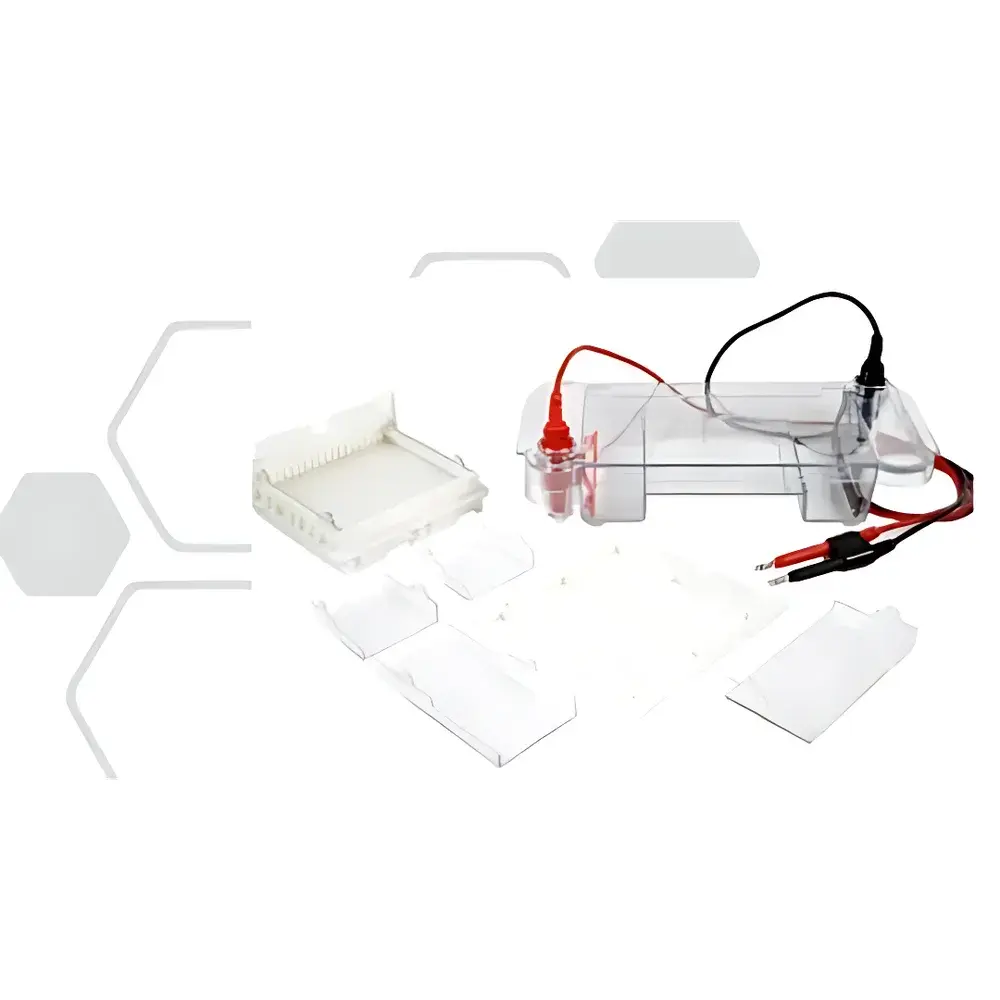
Keebio HE110 Horizontal Nucleic Acid Electrophoresis Tank
| Brand | Keebio |
|---|---|
| Origin | Shanghai, China |
| Model | HE110 |
| Gel Tray Dimensions | 75 × 60 mm |
| Max Voltage | 500 V |
| Buffer Capacity | 300 mL |
| Sample Capacity | 6–11 wells per comb (4 comb types included) |
| Electrode Material | 99.95% Pure Platinum |
| Housing Material | Injection-Molded Polycarbonate |
| Dimensions (L×W×H) | 230 × 100 × 65 mm |
| Weight | 1.2 kg |
| Compliance | CE-marked design for laboratory use under ISO/IEC 17025-aligned environments |
Overview
The Keebio HE110 Horizontal Nucleic Acid Electrophoresis Tank is a precision-engineered system designed for routine and high-reproducibility agarose or polyacrylamide gel electrophoresis of DNA, RNA, and oligonucleotides. Operating on the fundamental principle of electrophoretic mobility—where charged biomolecules migrate through a porous matrix under an applied electric field—the HE110 delivers consistent separation resolution across standard analytical and preparative applications. Its horizontal configuration enables direct visualization during electrophoresis, facilitating real-time monitoring of sample migration without interrupting the run. Engineered for compatibility with UV transilluminators and gel documentation systems, the tank supports downstream imaging and quantitative analysis in molecular biology laboratories adhering to GLP and ISO 15189 quality frameworks.
Key Features
- Precision-molded polycarbonate tank body ensures structural integrity, chemical resistance to common electrophoresis buffers (TAE, TBE, SB), and zero leakage—even during extended runs or elevated voltage conditions.
- Patented horizontal platform with vertical alignment reference ensures uniform gel thickness and precise centering of sample wells relative to the cathode–anode axis, minimizing band distortion and improving inter-run reproducibility.
- Integrated platinum electrode assembly (99.95% purity) provides stable current distribution, minimal polarization, and long-term corrosion resistance—critical for repeated use with high-salt or alkaline buffers.
- Tool-free, push-button lid mechanism allows rapid access to the gel chamber while maintaining secure electrical isolation and buffer containment.
- Multi-functional gel casting tray (75 × 60 mm) eliminates the need for sealing tape or wax; its heat-resistant thermoplastic construction withstands up to 135°C, enabling safe pouring of molten agarose (typically 50–65°C) without warping or dimensional drift.
- Four interchangeable combs included: dual 1.0 mm × 6-well, dual 1.0 mm × 11-well, dual 1.5 mm × 6-well, and dual 1.5 mm × 11-well—supporting both high-resolution analytical separations and larger-volume preparative loading.
Sample Compatibility & Compliance
The HE110 accommodates standard nucleic acid samples ranging from 50 bp to >20 kbp, including PCR products, restriction digests, plasmid preps, and RNA integrity assays. It is compatible with ethidium bromide, SYBR Safe, GelRed, and other commercially available nucleic acid stains. The system meets general safety requirements for Class II laboratory equipment per IEC 61010-1 and incorporates insulation-rated terminals compliant with EN 61010-2-040. While not certified for clinical diagnostics under FDA 21 CFR Part 820, its design aligns with Good Laboratory Practice (GLP) documentation workflows—including traceable buffer volume records, voltage logging, and gel lot tracking when integrated with LIMS-compatible software platforms.
Software & Data Management
As a standalone electrophoresis tank, the HE110 does not include embedded firmware or digital controls. However, it is fully interoperable with third-party gel documentation systems (e.g., Bio-Rad ChemiDoc, Azure Biosystems cSeries, UVP VisionWorks) via standardized USB or Ethernet interfaces. When used in conjunction with image acquisition software supporting ASTM E2740-10 (Standard Guide for Digital Imaging of Gels), users can generate audit-ready reports containing metadata such as exposure time, lens aperture, gel dimensions, and lane annotation—all critical for regulatory submissions in academic, biotech, and contract research settings.
Applications
- Routine genotyping and PCR product verification in academic teaching labs and core facilities.
- Quality control of plasmid preparations and in vitro transcription outputs in process development workflows.
- RNA integrity assessment (RIN-equivalent visual scoring) prior to qRT-PCR or NGS library preparation.
- Preparative gel extraction of DNA fragments for cloning, sequencing, or enzymatic modification.
- Training modules on electrophoretic theory, buffer chemistry, and molecular weight calibration using lambda-HindIII or 100 bp DNA ladders.
FAQ
What is the maximum recommended voltage for continuous operation?
The HE110 is rated for sustained use at ≤500 V DC; however, optimal resolution for most agarose gels (0.8–2.0%) is achieved between 80–150 V. Higher voltages may accelerate migration but risk band smearing or gel overheating if buffer circulation is inadequate.
Can this system be used for SDS-PAGE or native protein electrophoresis?
No—the HE110 is specifically engineered for nucleic acid separation in horizontal format. Protein electrophoresis requires vertical tanks with stacking/resolving gel assemblies and different electrode geometries.
Is the platinum electrode replaceable?
Yes—electrodes are modular and user-serviceable; replacement kits (including mounting hardware and contact leads) are available directly from Keebio authorized distributors.
Does the tank include a built-in power supply?
No—the HE110 is a passive electrophoresis chamber and must be paired with an external DC power supply meeting current-limiting and voltage-stability specifications (e.g., 0–500 V, 0–500 mA, constant voltage/current modes).
How should the tank be cleaned after ethidium bromide use?
Rinse thoroughly with deionized water, followed by 70% ethanol; avoid chlorine-based disinfectants or strong oxidizers that may degrade polycarbonate or platinum surfaces. For routine maintenance, ultrasonic cleaning at 40 kHz for 5 minutes is validated for residue removal without material fatigue.




