
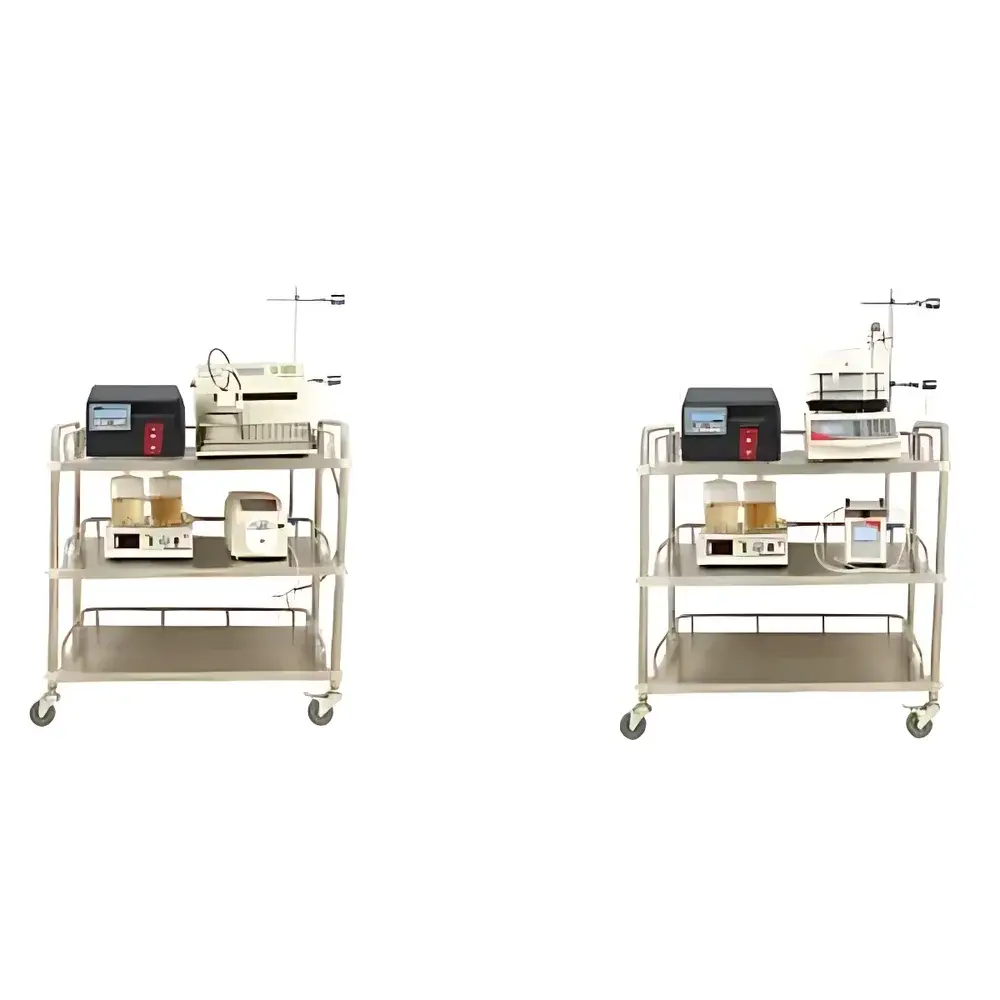
JP-2001-A Series Automatic Low-Pressure Liquid Chromatography System
| [Brand | JiaPeng |
|---|---|
| Origin | Shanghai, China |
| Model | JP-2001-A Series |
| Instrument Type | Fast Low-Pressure Liquid Chromatograph |
| Max Operating Pressure | 3 MPa |
| Detection Wavelengths | 260 nm, 280 nm (optional: 310 nm, 405 nm) |
| Flow Rate Range | 0.5–900 mL/h (dual-pump configuration) |
| Fraction Collection | 100 tubes × 12 mL capacity |
| Timer Range | 1 s – 199 h 59 min 59 s |
| Drop Counting | 1–9999 drops |
| Peak Trigger Range | 0–100 mV / 0–250 mV |
| Gradient Capacity | 1000 mL (with TH-500A mixer) |
| Column Compatibility | GE-compatible interfaces (1.0×50 cm, 1.0×70 cm, 2.6×50 cm columns included)] |
Overview
The JP-2001-A Series Automatic Low-Pressure Liquid Chromatography System is an engineered solution for preparative and analytical-scale chromatographic separations under ambient or mildly elevated pressure conditions. Designed around the principles of classical liquid chromatography—including gel filtration (size exclusion), ion exchange, affinity, and hydrophobic interaction chromatography—the system operates within a validated pressure envelope of up to 3 MPa (≈435 psi), making it suitable for soft-gel matrices (e.g., Sephadex®, Sepharose®, Bio-Gel®), desalting, buffer exchange, protein purification, and nucleic acid isolation. Unlike high-performance liquid chromatography (HPLC) platforms, this system emphasizes robustness, ease of operation, and compatibility with standard laboratory glassware and commercial prepacked columns—particularly those conforming to GE Healthcare’s column interface specifications. Its modular architecture supports seamless integration into academic teaching labs, QC/QA workflows in food and pharmaceutical manufacturing, and early-stage bioprocess development in R&D settings.
Key Features
- Modular pump configurations: Selectable combinations of HL-2F, DHL-B, BT-100SD, or dual-pump setups enabling precise flow control across 0.5–900 mL/h (dual) or up to 14500 mL/h (single), with speed resolution down to 0.1 rpm.
- JP-3000 dual-beam UV/Vis detector with factory-calibrated 260 nm and 280 nm channels; optional wavelengths (310 nm, 405 nm) support broader analyte detection including aromatic amino acids, nucleotides, and enzyme co-factors.
- DBS-100/CBS-B automatic fraction collectors featuring programmable tube indexing, drop-counting trigger, peak-threshold collection (0–250 mV range), and user-defined start-tube numbering—ensuring unambiguous sample traceability per tube.
- TH-500A gradient mixer with 1000 mL total mixing volume, delivering linear, step, or custom-defined solvent gradients with minimal dead volume and low pulsation.
- High-contrast blue-membrane LCD interface supporting real-time display of elapsed time, UV absorbance, gradient profile, collection status, and system alarms—without reliance on external PCs.
- Column kit includes three standard dimensions (1.0×50 cm, 1.0×70 cm, 2.6×50 cm) with GE-compatible end fittings, enabling direct use with AKTA-ready prepacked columns during scouting or pre-purification steps.
Sample Compatibility & Compliance
The JP-2001-A Series accommodates aqueous and polar organic mobile phases (e.g., PBS, Tris-HCl, NaCl gradients, ethanol/water mixtures) compatible with agarose-, dextran-, and polyacrylamide-based stationary phases. It supports common bioseparation applications defined in ASTM E2915-21 (Standard Guide for Validation of Chromatographic Methods), ISO 17025:2017 (General Requirements for the Competence of Testing and Calibration Laboratories), and USP Chromatography. While not certified for GMP production environments, its hardware design—including leak-tight fittings, calibrated flow paths, and non-volatile memory for method recall—aligns with GLP documentation requirements. All UV detector optical components utilize LED cold-light sources rated for >50,000 hours, eliminating mercury-lamp replacement cycles and thermal drift concerns.
Software & Data Management
The system provides native real-time data acquisition via embedded firmware: time-stamped UV traces, gradient profiles, temperature readings (if external probe connected), conductivity signals (when paired with optional conductivity detector), and fraction tube identifiers are simultaneously logged to internal flash memory. Export formats include CSV and ASCII text for post-processing in MATLAB®, Python (Pandas), or industry-standard tools such as Chromeleon™ or Empower™ via manual import. Audit trails—comprising operator ID (via optional keypad login), method version, start/stop timestamps, and parameter change history—are retained for ≥3 months. Though not 21 CFR Part 11 compliant out-of-the-box, the architecture permits third-party validation packages for regulated environments upon installation of digital signature modules and networked authentication servers.
Applications
- Protein purification: Rapid desalting and buffer exchange prior to SEC-MALS or IEX analysis; capture-step polishing using affinity resins.
- Nucleic acid isolation: Plasmid DNA clean-up after alkaline lysis; RNA fractionation from ribosomal subunits.
- Plant metabolite profiling: Extraction and fractionation of flavonoids, alkaloids, and terpenoids from crude botanical extracts.
- Enzyme assay support: Separation of reaction products from substrates in kinetic studies (e.g., protease cleavage, kinase phosphorylation).
- Educational use: Hands-on chromatography training in undergraduate biochemistry and analytical chemistry laboratories—covering retention time calibration, resolution calculation, and column efficiency (N, HETP) estimation.
- Food quality control: Quantitative analysis of preservatives (e.g., benzoates, sorbates), sweeteners (aspartame, sucralose), and mycotoxins (aflatoxin B1) following AOAC Official Method protocols.
FAQ
Is the JP-2001-A Series compatible with AKTA systems?
Yes—columns supplied with GE-compatible fittings (Luer lock or 10-32 threaded) can be directly mounted on AKTA avant, pure, or pilot systems for method transfer and scale-up validation.
What is the minimum detectable absorbance change at 280 nm?
The JP-3000 detector achieves a noise level of ≤0.002 AU at 280 nm (1 s response time, 1 mm pathlength cell), supporting quantitation of proteins down to ~10 µg/mL in standard flow cells.
Can gradient methods be saved and recalled without a computer?
Yes—up to 16 gradient programs, including slope, hold time, and solvent composition, are stored in non-volatile memory and accessible via front-panel navigation.
Does the system support conductivity detection?
Not natively, but the analog output port (0–1 V DC) allows integration with third-party conductivity detectors (e.g., Mettler Toledo InPro 7250) when configured for voltage-scaling input.
Are validation documents (IQ/OQ) available?
Factory-issued IQ templates and OQ test protocols—including flow accuracy verification, UV linearity assessment, and fraction collector positional repeatability—are provided with each shipment and customizable per site-specific SOPs.





