
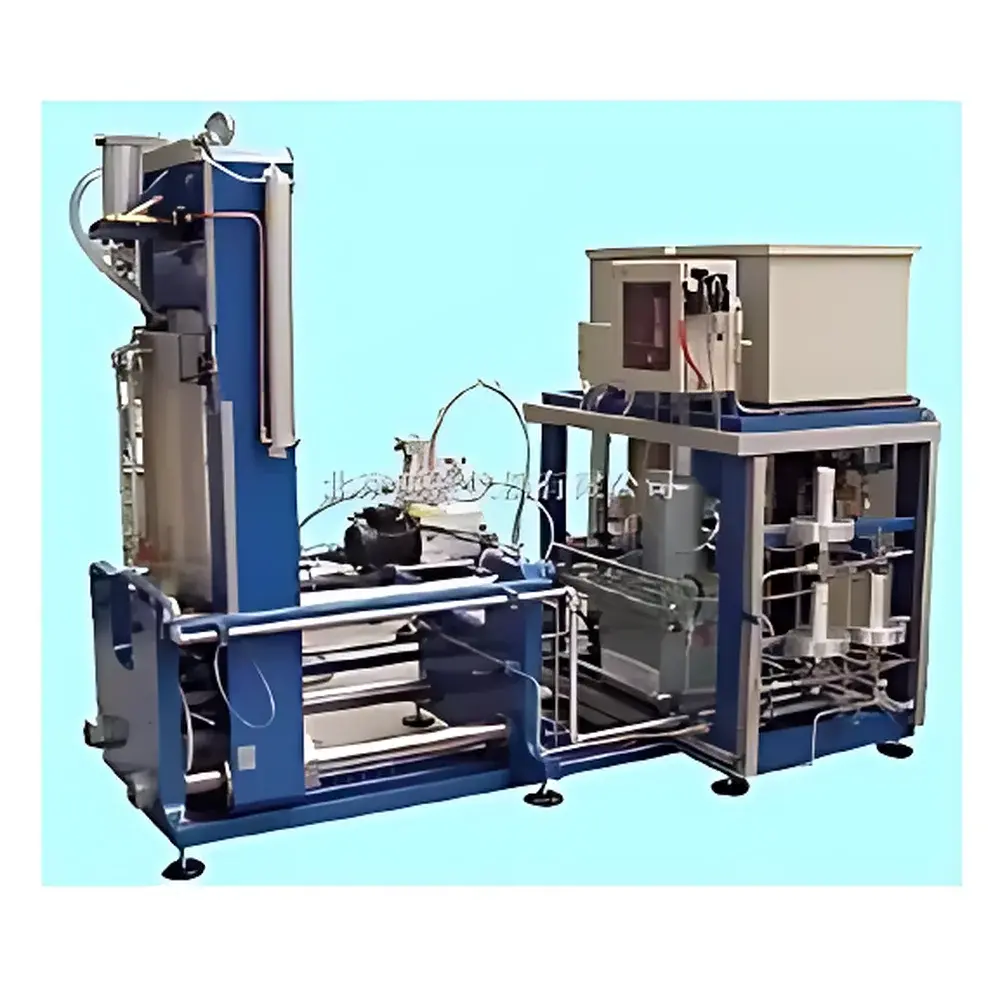
HIP200 Hot Isostatic Press
| Origin | Germany |
|---|---|
| Manufacturer Type | Authorized Distributor |
| Origin Category | Imported |
| Model | HIP200 |
| Pricing | Available Upon Request |
Overview
The HIP200 Hot Isostatic Press is a high-precision, industrial-grade thermal processing system engineered for simultaneous application of elevated temperature and isostatic gas pressure—typically argon—to achieve full densification, microstructural homogenization, and elimination of internal porosity in advanced engineering materials. Operating on the fundamental principle of hot isostatic pressing (HIP), this system subjects enclosed samples to uniform pressure from all directions while maintaining precise thermal profiles up to 2000 °C. Unlike conventional sintering or hot pressing, HIP leverages gas-mediated pressure transmission (via inert argon) to ensure isotropic stress distribution, enabling near-theoretical density attainment in components with complex geometries and critical performance requirements. The HIP200 is purpose-built for research laboratories, aerospace component manufacturers, and medical implant producers requiring reproducible, traceable, and qualification-ready densification processes compliant with ASTM B964, ISO 13357-1, and aerospace material specifications such as AMS 2750 and AMS 7705.
Key Features
- Robust high-pressure vessel chamber with reinforced yoke-type closure system, designed for long-term cyclic operation under extreme thermomechanical loads.
- Graphite heating furnace assembly with internal usable diameter of 75 mm and height of 150 mm—optimized for small-batch R&D and prototype-scale production runs.
- Maximum operating temperature of 2000 °C, supported by high-purity graphite insulation and precision-wound heating elements ensuring thermal uniformity within ±5 °C across the hot zone.
- Integrated high-pressure gas compression system delivering isostatic argon pressure up to 200 MPa (2,000 bar), with redundant pressure relief and rupture disc protection per PED 2014/68/EU.
- PLC-based control architecture with real-time monitoring of temperature, pressure, and time parameters—fully programmable ramp-hold-cool cycles with multi-step profiles.
- Dedicated industrial PC housed externally (not integrated into the console) for secure data acquisition, cycle logging, and audit-ready electronic record generation.
Sample Compatibility & Compliance
The HIP200 accommodates a broad spectrum of refractory and reactive materials, including nickel-based superalloys (e.g., Inconel 718, Rene 88DT), titanium aluminides (TiAl), tungsten carbide-cobalt composites, silicon nitride and zirconia ceramics, metal matrix composites (MMCs), and additively manufactured (AM) preforms. All internal wetted surfaces are compatible with high-purity argon atmosphere, minimizing oxidation and interstitial contamination. The system conforms to European Pressure Equipment Directive (PED) safety certification requirements and supports implementation of Good Manufacturing Practice (GMP) and ISO 9001-compliant process validation protocols. Optional documentation packages include IQ/OQ protocols aligned with FDA 21 CFR Part 11 for regulated biomedical device manufacturing environments.
Software & Data Management
Control and data handling are executed via a Windows-based HMI interface linked to the embedded PLC controller. Each HIP cycle generates timestamped, tamper-resistant log files containing full thermal and pressure history (sampled at 1 Hz minimum), operator ID, cycle name, and alarm event records. Data export is supported in CSV and XML formats for integration into LIMS or enterprise MES platforms. Audit trail functionality meets GLP and GMP requirements, with user access levels configurable for operators, engineers, and QA personnel. No cloud connectivity is embedded—data remains on-premise unless explicitly interfaced via customer-approved network gateways.
Applications
- Densification of powder metallurgy compacts to eliminate residual porosity and improve fatigue life in turbine disks and structural airframe components.
- Healing of internal defects (e.g., micro-shrinkage, gas pores) in investment-cast or additive-manufactured parts prior to service qualification.
- Sintering and grain refinement of ultra-high-performance ceramics used in cutting tools, wear-resistant liners, and nuclear fuel cladding.
- Diffusion bonding of dissimilar metals and metal-ceramic interfaces without interfacial oxidation or brittle phase formation.
- Processing of biocompatible Ti-6Al-4V and Co-Cr-Mo implants to meet ISO 13357-2 mechanical property thresholds for orthopedic load-bearing devices.
FAQ
What is the maximum working pressure of the HIP200?
The HIP200 is rated for operational pressures up to 200 MPa (2,000 bar) using high-purity argon as the pressurizing medium.
Does the system support automated cycle programming and repeatability verification?
Yes—fully programmable multi-stage thermal and pressure profiles are stored and recalled via the HMI; repeatability is verified through post-cycle data review and optional statistical process control (SPC) reporting.
Is third-party calibration and qualification support available?
Authorized technical service partners provide on-site temperature uniformity mapping (per AMS 2750), pressure transducer calibration, and IQ/OQ documentation upon request.
Can the HIP200 be integrated into an existing factory automation infrastructure?
The system provides Modbus TCP and OPC UA communication interfaces for integration with SCADA and MES systems, subject to site-specific network security assessment.
What maintenance intervals are recommended for long-term reliability?
Preventive maintenance is scheduled every 1,000 operating hours or annually—whichever occurs first—with emphasis on furnace element resistance checks, pressure seal inspection, and coolant loop filtration.



