
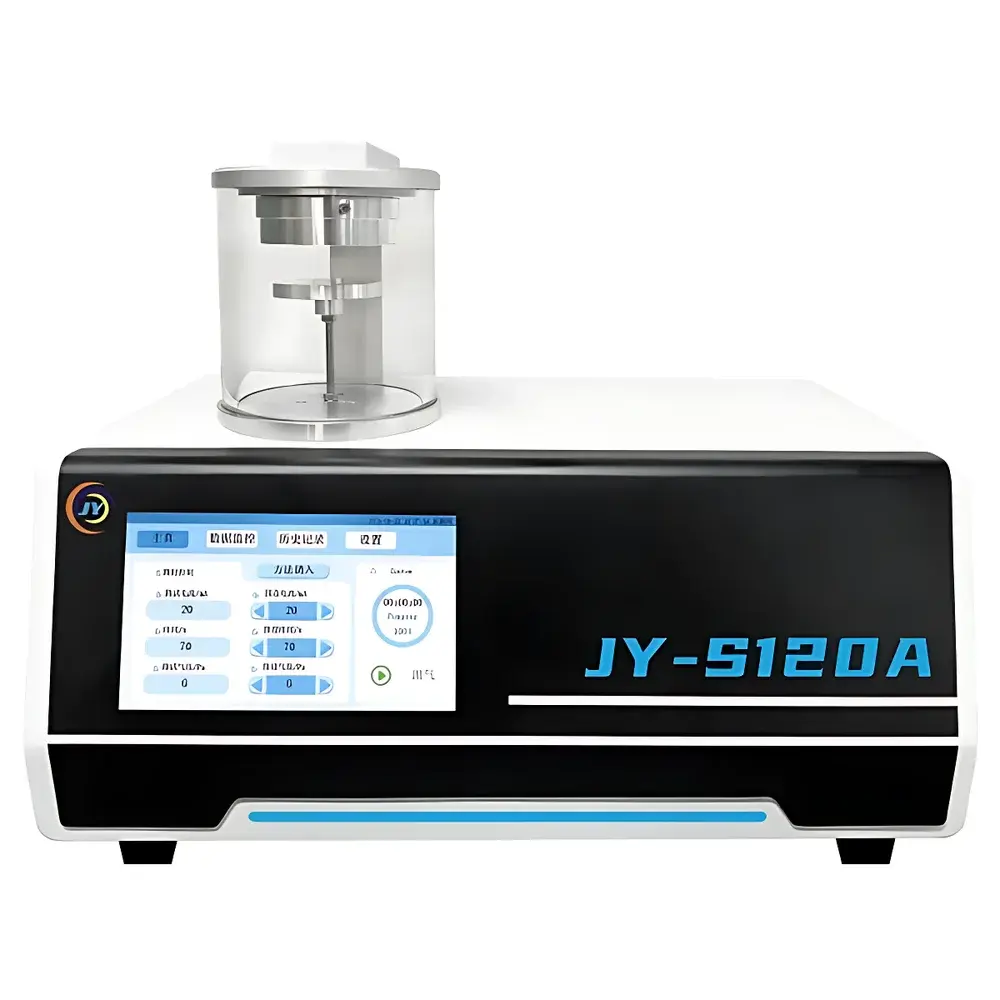
Guangzhou Jingying JY-S120A Fully Automated Ion Sputter Coater
| Brand | Guangzhou Jingying |
|---|---|
| Origin | Guangdong, China |
| Manufacturer Type | Direct Manufacturer |
| Country of Origin | China |
| Model | JY-S120A |
| Target Materials | Au, Pt |
| Target Diameter | 57 mm |
| Control Method | Fully Automatic |
| Sample Stage Diameter | 63 mm |
| Sputtering Gases | Air and Argon |
| Chamber Material | High-silica borosilicate glass |
| Chamber Dimensions | Ø120 × 120 mm |
| Operating Vacuum Range | 3–15 Pa (1 Pa step) |
| Sputtering Current | 3–40 mA (1 mA step) |
| Sputtering Time | 1–999 s (1 s step) |
| Pumping Speed | 8 m³/h (2.2 L/s) |
| Ultimate Vacuum | 5×10⁻² Pa |
| Power Consumption | 80 W (coater), 400 W (pump) |
| Noise Level | 56 dB(A) |
| Display | Touch-enabled IPS LCD with Chinese/English toggle |
Overview
The Guangzhou Jingying JY-S120A Fully Automated Ion Sputter Coater is a precision-engineered thin-film deposition system designed specifically for high-fidelity conductive coating of non-conductive specimens prior to scanning electron microscopy (SEM) analysis. It operates on the principle of low-pressure direct-current (DC) magnetron sputtering—a physically vapor deposition (PVD) technique in which energetic argon ions bombard a metallic target (e.g., Pt or Au), ejecting atoms that condense uniformly onto the sample surface. Unlike thermal evaporation, magnetron sputtering delivers superior grain refinement, enhanced adhesion, and minimal thermal load—critical for preserving delicate biological, polymeric, or ceramic microstructures. The JY-S120A integrates vacuum science, digital current regulation, and programmable process sequencing into a compact benchtop platform compliant with routine laboratory workflows in materials science, life sciences, geology, and failure analysis laboratories.
Key Features
- Fully automated process sequence: One-touch initiation triggers integrated vacuum pumping, chamber purging (with air or argon), pressure stabilization, current ramping, timed sputtering, and controlled venting—eliminating manual intervention and inter-operator variability.
- Digital DC current control: Independent of chamber pressure fluctuations, ensuring repeatable deposition rates and consistent film thickness across multiple runs—even when operating at the lower end of the 3–15 Pa vacuum range.
- Real-time dual-parameter monitoring: Simultaneous graphical display of sputtering current (mA) and working vacuum (Pa) during operation, with automatic logging of all critical parameters per run.
- Intuitive touch interface: 7-inch IPS LCD with responsive capacitive touch, bilingual (English/Chinese) firmware, and context-sensitive soft keys for rapid parameter entry and confirmation.
- Modular target compatibility: Accepts standard 57 mm diameter targets—including Pt, Au, Au/Pd, Pd, Ag, and Pt/Pd—with tool-free mounting and alignment verification indicators.
- Optimized chamber design: Ø120 × 120 mm high-silica borosilicate glass chamber provides full visual access during sputtering, facilitates optical inspection of film uniformity, and resists chemical etching from residual gases.
- Target usage tracking: Internal counter logs cumulative sputtering time and cycle count per installed target, supporting predictive maintenance and cost-per-sample calculation.
Sample Compatibility & Compliance
The JY-S120A accommodates up to twelve 12.7 mm SEM stubs on its Ø63 mm motorized height-adjustable stage (25–65 mm range), enabling precise source-to-substrate distance control—key for optimizing shadowing effects and minimizing edge buildup. Its low-energy sputtering regime (≤40 mA, ≤15 Pa) minimizes charging artifacts and beam-induced damage in beam-sensitive specimens such as pollen grains, freeze-dried tissues, or nanoparticle monolayers. While not certified to ISO/IEC 17025 or accredited for GLP-regulated environments, the system supports traceable process documentation via exportable CSV log files containing timestamped vacuum profiles, current curves, and operator-assigned run IDs—facilitating internal audit readiness and alignment with ISO 14644-1 cleanroom-compatible handling protocols.
Software & Data Management
No external PC or proprietary software is required; all logic resides onboard the embedded ARM-based controller. Six user-configurable preset protocols can be stored locally with descriptive labels (e.g., “Pt_15s_25mA”). Each protocol retains vacuum setpoint, current, duration, gas selection, and venting mode. Historical run data—including date/time stamp, total sputtering time, average current, final pressure, and target ID—is retained for ≥1,000 cycles and exportable via USB flash drive. Audit-trail functionality records operator login (if enabled), parameter modifications, and emergency stop events—supporting basic 21 CFR Part 11–aligned data integrity practices where electronic signatures are not mandated.
Applications
- Preparation of insulating biological specimens (e.g., plant cuticles, diatom frustules, bacterial biofilms) for high-resolution secondary electron imaging.
- Conductive coating of geological thin sections (e.g., shale, volcanic ash) to suppress topographic charging during backscattered electron (BSE) mapping.
- Routine metallization of polymer nanocomposites and MOF crystals for EDS quantification without carbon-coating interference.
- Deposition of Pt films for high-aspect-ratio nanostructures where columnar growth must be minimized—enabled by stable low-current (<10 mA) operation at 5–8 Pa.
- Teaching labs requiring robust, low-maintenance sputter coaters with transparent process feedback and reproducible outcomes across student cohorts.
FAQ
What vacuum pump is compatible with the JY-S120A?
The system is supplied with a dedicated 400 W two-stage rotary vane pump (8 m³/h, ultimate vacuum 5×10⁻² Pa). It is not designed for turbomolecular or diffusion pump integration.
Can the JY-S120A operate with pure argon only—or is air acceptable?
Both gases are supported. Air is suitable for rapid pre-coating or educational use; high-purity argon (≥99.998%) is recommended for reproducible Pt or Au film resistivity and reduced oxide formation.
Is remote operation or network connectivity available?
No Ethernet, Wi-Fi, or RS-232 interfaces are provided. All operations are local via the front-panel touchscreen.
How often does the vacuum oil require replacement?
Under typical usage (≤10 runs/day), oil change is recommended every 6 months or after 1,000 operating hours—whichever occurs first—as per the pump manufacturer’s service schedule.
Does the system include a film thickness monitor or quartz crystal microbalance?
No. Thickness estimation relies on empirical calibration using reference samples and fixed current/time parameters; optional external QCM systems may be mounted externally but are not interfaced with the JY-S120A controller.
Related Products



