
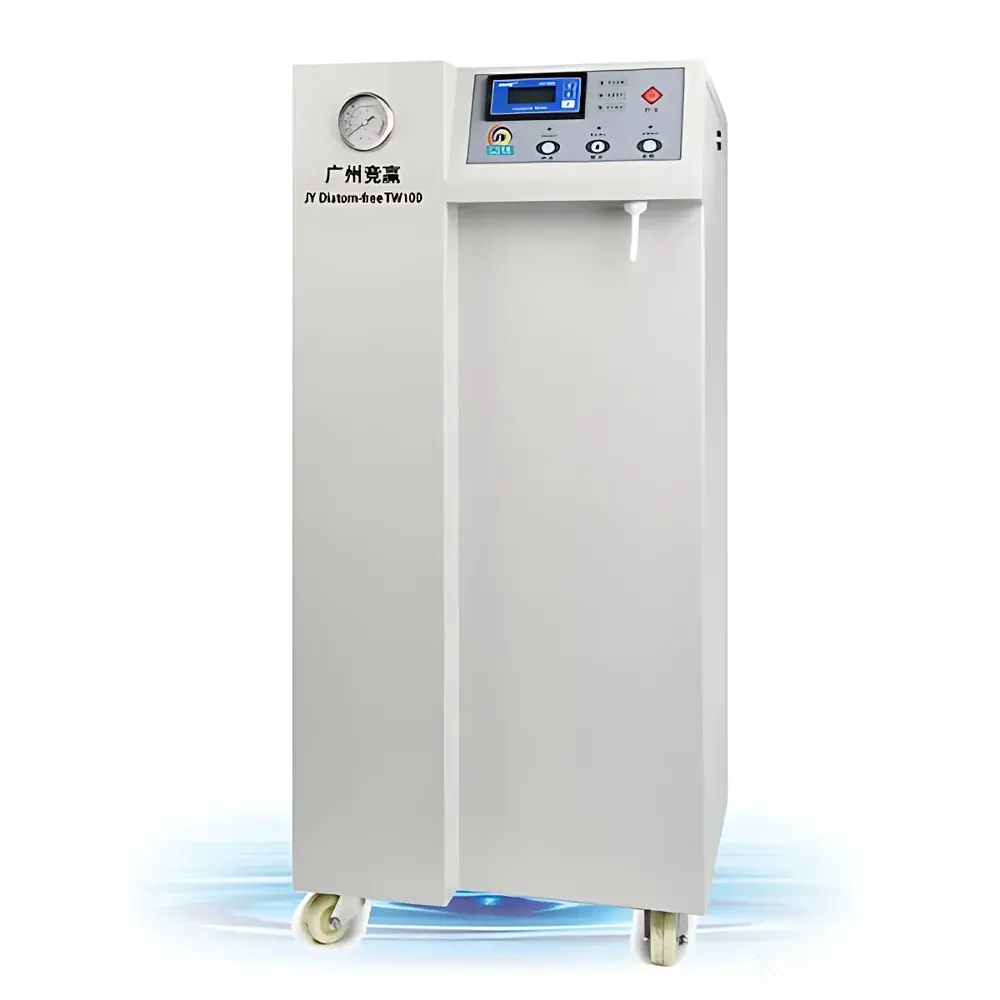
Jingying TW100 Diatom-Free Autopsy Room Tap Water Treatment System
| Brand | Guangzhou Jingying |
|---|---|
| Origin | Guangdong, China |
| Manufacturer Type | Direct Manufacturer |
| Product Category | Domestic |
| Model | TW100 |
| Price Range | USD 1,400 – 7,000 (FOB) |
| Purified Water Grade | GB/T 6682–2008 Grade II (Equivalent to ASTM D1193 Type III / ISO 3696 Class 3) |
| Feed Water | Municipal tap water (TDS ≤ 300 ppm, temp. 1–45 °C, pressure 0.1–0.5 MPa) |
| Output Flow Rate | 100 L/h |
| Conductivity | ≤ 0.2 µS/cm @ 25 °C |
| Salt Rejection Rate | ≥ 99% |
| Dimensions (W×D×H) | 470 × 390 × 860 mm |
| Weight | 50 kg |
| Power Supply | 220 V / 50 Hz, 50–100 W |
| Noise Level | ≤ 40 dB(A) |
| RO Membrane | Dow Filmtec™ FT30 certified composite polyamide membrane |
| Pre-treatment | NSF-certified integrated dual-channel injection-molded cartridge system (15"/30") |
| Storage Tank | 100 L open PE tank with triple-level float control + NSF-certified vacuum-pressure bladder tank |
| Pump | CE-certified adjustable-pressure quiet RO booster pump (rated >10,000 h MTBF) |
| Pressure Monitoring | Analog RO inlet/outlet pressure gauges |
| Safety Features | Low-water cutoff, auto-restart after power failure, full-tank shutoff, ultra-low pressure protection, auto-flush on startup |
Overview
The Jingying TW100 Diatom-Free Autopsy Room Tap Water Treatment System is an engineered solution specifically designed for forensic pathology laboratories where diatom analysis plays a critical role in determining the cause and location of drowning-related deaths. Unlike standard laboratory water purification systems, the TW100 integrates multi-stage physical and membrane-based filtration—including pre-filtration, activated carbon adsorption, precision sediment removal, and high-rejection reverse osmosis—to achieve complete removal of intact diatoms and their frustules from municipal tap water. Its core function is not general-purpose ultrapure water production, but rather targeted biological particulate elimination while maintaining stable conductivity and low ionic contamination—ensuring that downstream diatom identification via light microscopy, SEM, or ICP-MS remains analytically unambiguous. The system operates under strict adherence to forensic water handling protocols and supports GLP-aligned documentation requirements for chain-of-custody integrity.
Key Features
- Automated operation with backlit LCD interface displaying real-time conductivity, system status, and maintenance alerts
- Comprehensive safety architecture: automatic shutdown during low feed pressure, empty reservoir, or power interruption; auto-resume functionality upon restoration
- In-line temperature-compensated conductivity sensor (±0.01 µS/cm resolution) continuously monitors effluent quality at point-of-use
- CE-certified variable-pressure RO booster pump engineered for continuous duty cycles exceeding 10,000 hours without performance degradation
- NSF-certified dual-channel pre-treatment module (15-inch + 30-inch configuration), featuring molded housing, leak-resistant fittings, and extended service life
- Dow Filmtec™ FT30 reverse osmosis membrane elements—validated for >99% rejection of suspended particulates ≥0.1 µm, including intact diatom cells and siliceous frustules
- Modular design compliant with GLP maintenance logging: individual component isolation enables traceable filter replacement and audit-ready service records
- 100 L open polyethylene storage tank with three-tier level sensing (high/medium/low) and secondary NSF-certified vacuum-pressure bladder tank to eliminate atmospheric recontamination
- Dedicated delivery pump delivering consistent 0.2–0.4 MPa output pressure—compatible with sensitive instrumentation requiring regulated feed pressure
- Integrated raw water pressure regulation system prevents over-pressurization damage to RO membranes and plumbing joints
- Analog RO pressure gauges installed at both inlet and outlet ports for routine membrane fouling assessment and predictive maintenance scheduling
Sample Compatibility & Compliance
The TW100 is validated for use with forensic water samples intended for diatom concentration and morphological analysis per standard methods including ISO 14403-1:2015 (water quality — determination of diatoms), ASTM D5116 (standard guide for forensic water sample handling), and China’s GA/T 1194–2014 (technical specification for forensic diatom examination). Its output meets or exceeds GB/T 6682–2008 Grade II water specifications, with conductivity ≤ 0.2 µS/cm and total dissolved solids < 1 ppm. All wetted components—including tubing, valves, and tank linings—comply with NSF/ANSI Standard 61 for drinking water system components. The system supports traceability through optional timestamped conductivity logs and can be configured with external data logging interfaces compatible with LIMS integration.
Software & Data Management
While the TW100 operates as a standalone hardware platform, its digital interface provides non-volatile memory for up to 12 months of operational history—including daily flow volume, cumulative runtime, conductivity trends, and alarm event timestamps. Optional RS-485 or Modbus RTU connectivity allows integration into centralized lab infrastructure monitoring platforms. All stored data adheres to ALCOA+ principles (Attributable, Legible, Contemporaneous, Original, Accurate, Complete, Consistent, Enduring, Available) and may be exported in CSV format for audit review. For laboratories operating under FDA 21 CFR Part 11 or ISO/IEC 17025 frameworks, third-party validation packages—including IQ/OQ documentation templates and electronic signature readiness—are available upon request.
Applications
- Forensic autopsy suites requiring diatom-free rinse water for lung tissue processing and slide preparation
- Reference laboratories performing comparative diatom analysis across multiple drowning cases
- Medical examiner offices integrating water quality assurance into SOPs for postmortem toxicology workflows
- Research institutions studying diatom bioaccumulation patterns in aquatic environments using controlled baseline water
- Hospitals with in-house forensic pathology departments needing ISO-compliant water for histological washing steps prior to staining
FAQ
Does the TW100 remove only live diatoms, or does it also eliminate fossilized frustules?
The Dow FT30 RO membrane achieves nominal retention of particles ≥0.1 µm; diatom frustules—typically 5–200 µm in size—are physically excluded with >99.99% efficiency. Both intact cells and fragmented silica shells are retained within the reject stream.
Can this system replace distilled water for preparing mounting media in diatom microscopy?
Yes—TW100 output meets or exceeds ASTM D1193 Type III water specifications and is suitable for aqueous mounting media preparation, provided final sterility is achieved via filtration (0.22 µm) if required by protocol.
Is the 100 L/h flow rate sustainable under continuous operation?
Rated output assumes optimal feed conditions (25 °C, 0.3 MPa, TDS < 200 ppm); actual throughput may decrease by up to 15% at lower temperatures or higher TDS, as governed by RO membrane flux physics.
How often must the RO membrane be replaced?
Under typical municipal feed water conditions, the Dow FT30 element maintains >95% salt rejection for 24–36 months; replacement intervals are determined empirically using pressure differential and conductivity drift thresholds outlined in the O&M manual.
Does the system support remote monitoring via Ethernet or Wi-Fi?
Standard configuration includes local LCD display only; optional industrial IoT modules (RS-485/Modbus TCP) enable integration with building management or lab-wide SCADA systems.



