
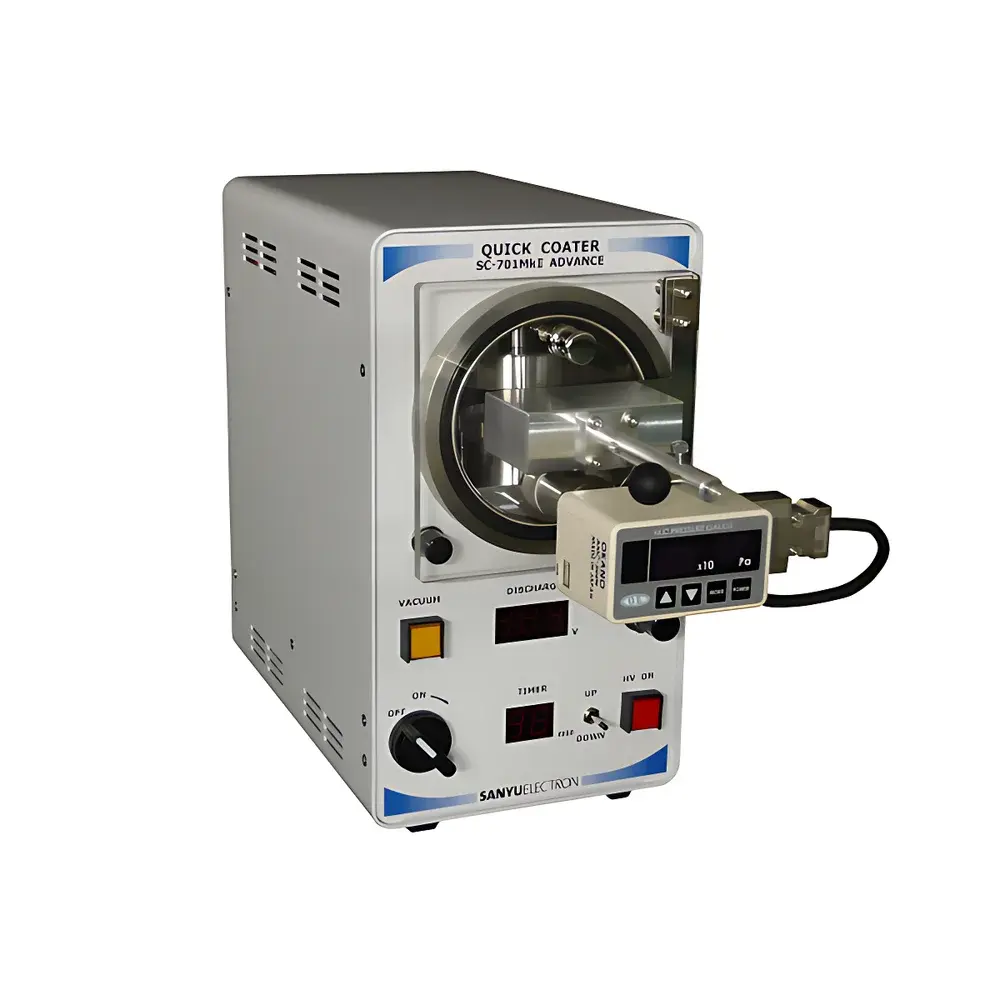
Sanyu SC-701MKII Ion Sputter Coater
| Origin | Japan |
|---|---|
| Manufacturer Type | Authorized Distributor |
| Origin Category | Imported |
| Model | SC-701MKII |
| Target Material | Au (standard), optional Pt, Pt-Pd, Au-Pd, Pd, Ag |
| Target Diameter | 49 mm |
| Control Method | Manual |
| Chamber Dimensions | 90 mm × 90 mm (D × H) |
| Sample Stage Diameter | 50 mm |
| Sputtering Gas | Argon (Ar) under high vacuum |
| Sputtering Mode | DC Magnetron Sputtering |
| Sputtering Time Range | 0–15 min (standard), up to 30 min in continuous mode |
| Operating Pressure | 5–30 Pa |
| High Voltage/Current | 1.2 kV / 9.9 mA |
| Gas Inlet Control | Precision needle valve |
| Pumping Speed | 20 L/min |
Overview
The Sanyu SC-701MKII Ion Sputter Coater is a compact, benchtop DC magnetron sputtering system engineered for high-reproducibility conductive thin-film deposition on non-conductive specimens prior to scanning electron microscopy (SEM) analysis. Designed and manufactured in Japan, the instrument operates on the principle of physical vapor deposition (PVD) via inert-gas ion bombardment—typically argon—at low-pressure vacuum conditions (5–30 Pa). Under applied DC voltage (1.2 kV), argon ions accelerate toward a metallic target (e.g., Au, Pt, or Pd alloys), dislodging atoms that subsequently condense uniformly onto the sample surface. This process yields nanoscale, continuous, and electrically conductive coatings—critical for eliminating charging artifacts, enhancing secondary electron yield, and enabling stable high-resolution imaging at accelerating voltages ranging from 1 kV to 30 kV. Its robust SUS304 stainless-steel chamber ensures long-term vacuum integrity and chemical resistance, while its small footprint (≤350 mm × 350 mm × 300 mm) makes it ideal for space-constrained laboratories, core SEM facilities, and teaching labs requiring routine, operator-controlled coating protocols.
Key Features
- DC magnetron sputtering architecture with built-in permanent magnet array for enhanced plasma confinement and target utilization efficiency
- Manually operated interface with tactile time selector (0–15 min, extendable to 30 min in continuous mode) and analog pressure gauge for real-time vacuum monitoring
- Standard 49 mm diameter gold (Au) target; interchangeable targets (Pt, Pt-Pd, Au-Pd, Pd, Ag) compatible with same mounting geometry
- Stainless-steel (SUS304) vacuum chamber (90 mm × 90 mm) with O-ring sealed front door and integrated vent valve for rapid sample exchange
- Precision needle-valve gas inlet control enabling fine-tuned argon flow regulation and stable discharge initiation
- Integrated high-voltage power supply (1.2 kV / 9.9 mA) with over-current protection and arc suppression circuitry
- 50 mm diameter rotating sample stage (manual positioning) ensuring uniform film thickness distribution across standard SEM stubs and multi-well substrates
Sample Compatibility & Compliance
The SC-701MKII accommodates a wide range of non-conductive or semi-conductive specimens—including biological tissues (freeze-dried or critical-point dried), polymers, ceramics, geological sections, and insulating nanoparticles—mounted on standard 12.7 mm or 25 mm aluminum stubs or custom holders fitting within the 50 mm stage. Chamber geometry supports simultaneous coating of up to six 12.7 mm stubs or one 50 mm wafer fragment. All wetted components comply with ISO 8573-1 Class 4 compressed air purity standards when used with external dry-air purge lines. While the unit itself does not carry CE or UL certification out-of-the-box, its vacuum and electrical subsystems conform to IEC 61000-6-3 (EMC emission) and IEC 61010-1 (safety requirements for laboratory equipment) design principles. Routine operation aligns with ASTM E1558–22 (Standard Guide for Preparation of Specimens for SEM Analysis) and supports GLP-compliant documentation when paired with external logbooks or LIMS-integrated workflow tracking.
Software & Data Management
The SC-701MKII is a manually controlled instrument without embedded microprocessor-based software or digital data logging. All operational parameters—including sputtering duration, observed chamber pressure, and target material—are recorded manually by the user. This analog architecture eliminates firmware vulnerabilities, reduces calibration dependencies, and ensures deterministic behavior across decades of service life—particularly valued in regulated academic core facilities and industrial QA labs where traceability relies on handwritten SOP execution logs and signed batch records. For laboratories requiring electronic audit trails, integration with external time-stamped cameras or digital pressure loggers (e.g., calibrated capacitance manometers with RS-232 output) is supported via standard vacuum port interfaces.
Applications
- Routine SEM sample preparation for morphological and elemental analysis (EDS/WDS) of insulating materials
- Thin-film electrode fabrication for electrochemical characterization (e.g., Au-coated carbon electrodes)
- Conductive underlayer deposition for FIB-SEM lamella lift-out and TEM sample preparation
- Low-dose metallization of beam-sensitive biological specimens to minimize thermal and radiolytic damage
- Teaching demonstrations of vacuum physics, plasma generation, and thin-film nucleation kinetics
- Preparation of reference standards for X-ray photoelectron spectroscopy (XPS) charge referencing
FAQ
What vacuum level is required before initiating sputtering?
A base pressure ≤5 Pa is recommended; optimal sputtering occurs between 5–30 Pa with argon backfill.
Can the SC-701MKII be used with reactive gases such as oxygen or nitrogen?
No—this model supports DC sputtering only with inert gases (Ar); reactive sputtering requires RF or pulsed-DC power supplies not present in this configuration.
Is rotation of the sample stage motorized?
No—the 50 mm stage is manually positioned and does not rotate during sputtering; uniformity relies on fixed-stage geometry and optimized plasma distribution.
What maintenance intervals are recommended for the vacuum pump and target?
Mechanical pump oil should be changed every 200 operating hours; target replacement is indicated when surface erosion exceeds 1 mm depth or coating uniformity degrades visibly after 50–100 runs.
Does the system include a vacuum pump?
No—the SC-701MKII requires an externally connected rotary vane or diaphragm pump capable of achieving ≤5 Pa base pressure and sustaining ≥20 L/min pumping speed at operating pressure.



