
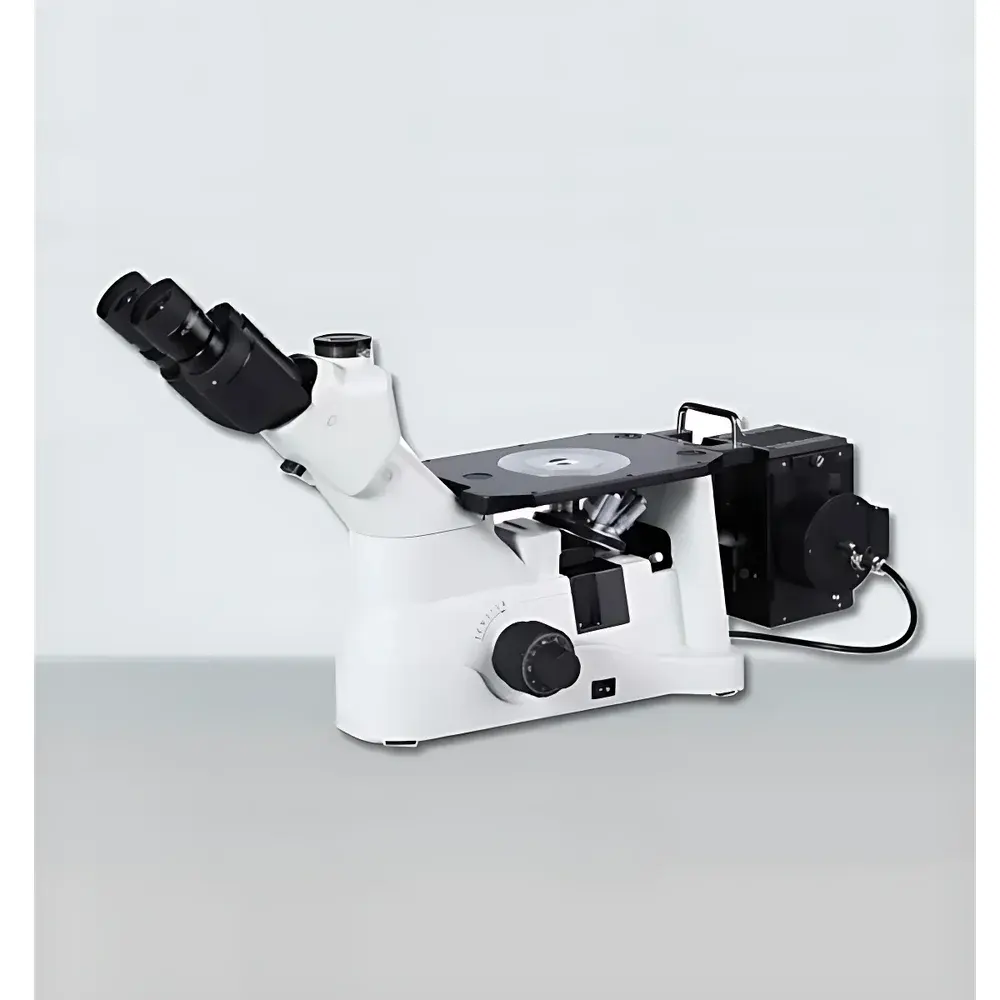
JYJX Inverted Metallurgical Microscope by Guangzhou Jingying
| Brand | Guangzhou Jingying |
|---|---|
| Origin | Guangdong, China |
| Manufacturer Type | Direct Manufacturer |
| Product Type | Inverted |
| Total Magnification Range | 50×–1000× |
| Eyepiece | PL10×/18 mm (High-Eyepoint Wide-Field Plan Eyepiece) |
| Objective Lenses | Long Working Distance Plan Achromatic Metallurgical Objectives (5×, 10×, 20×, 50×, 100×) |
| Stage | Triple-Layer Mechanical Stage (180 mm × 155 mm) |
| Illumination | Reflected Köhler Illumination with Adjustable Aperture and Centerable Field Diaphragm |
| Micrometer Scale | 0.01 mm per division (1 mm total span) |
| Compliance | Designed for ASTM E3, ISO 643, and GB/T 6394 metallographic evaluation standards |
Overview
The JYJX Inverted Metallurgical Microscope is an engineered optical instrument specifically optimized for high-fidelity microstructural analysis of metallic specimens—including fusion beads, weld zones, heat-affected zones, and cast or forged alloys. Its inverted configuration positions the objective lenses beneath the specimen stage, enabling stable observation of large, heavy, or irregularly shaped samples—such as mounted melt beads—without requiring top-side access or reorientation. The system operates on standard reflected-light (epi-illumination) principles, utilizing Köhler illumination to deliver uniform, glare-free contrast across the entire field of view. This optical architecture ensures consistent resolution, minimal chromatic aberration, and high depth-of-field stability—critical for accurate grain size measurement, phase boundary delineation, inclusion identification, and quantitative metallography in accordance with ASTM E3, ISO 643, and GB/T 6394.
Key Features
- Inverted optical design accommodates bulky or vertically constrained specimens—including metallurgical mounts up to 40 mm in height—without compromising focus stability or working distance.
- Long working distance plan achromatic objectives (5×, 10×, 20×, 50×, 100×) minimize risk of lens contact during coarse focusing and support routine use with cover slips or protective coatings on polished surfaces.
- Reflected Köhler illumination system features independently adjustable aperture and field diaphragms, allowing precise control of numerical aperture, contrast, and resolution for differential interference contrast (DIC)-ready imaging and brightfield/darkfield compatibility.
- Triple-layer mechanical stage (180 mm × 155 mm) provides precise X-Y translation with vernier scales and locking capability—essential for systematic grid-based analysis and ASTM E112 grain counting protocols.
- High-eye-point wide-field plan eyepieces (PL10×/18 mm) ensure ergonomic viewing and full-field sharpness, supporting extended operator sessions and optional integration with digital imaging systems via trinocular port.
- Calibrated micrometer scale (0.01 mm/division) enables direct linear measurement of features such as dendrite arm spacing, inclusion length, and precipitate distribution density without software interpolation.
Sample Compatibility & Compliance
The JYJX microscope is routinely deployed in QC laboratories for evaluating fusion bead morphology in arc welding, laser cladding, and additive manufacturing processes. It supports standard 30 mm and 40 mm metallographic mounts, as well as custom-sized specimens secured via spring-loaded clamps. All optical components meet RoHS-compliant material specifications. The system’s optical path and illumination geometry conform to ISO/IEC 17025 calibration traceability requirements when used with NIST-traceable stage micrometers and reference standards. Routine verification follows ASTM E883 guidelines for optical microscopy validation, including resolution testing with USAF 1951 target and contrast assessment using certified stainless steel grain reference blocks.
Software & Data Management
While the base configuration operates as a standalone optical platform, the trinocular tube enables seamless coupling with C-mount digital cameras (e.g., 5 MP or 12 MP CMOS sensors). When integrated with third-party image analysis software—including Olympus Stream, Zeiss ZEN, or open-source Fiji/ImageJ—the system supports automated grain sizing (ASTM E112), phase fraction quantification (ISO 9042), and report generation compliant with GLP audit trails. Optional USB-powered LED illuminators and motorized focus modules can be added to support semi-automated workflows under FDA 21 CFR Part 11–aligned environments where electronic signatures and audit logs are required.
Applications
- Microstructural characterization of fusion beads from GTAW, GMAW, and plasma arc welding processes.
- Grain size determination in austenitic stainless steels and nickel-based superalloys post-heat treatment.
- Identification and classification of non-metallic inclusions (e.g., Al₂O₃, MnS) per ASTM E45 and ISO 4967.
- Assessment of intergranular corrosion susceptibility through oxalic acid etch testing (ASTM A262 Practice A).
- Phase mapping of duplex stainless steels and titanium alloys using polarized light and tint etching techniques.
- Failure analysis of fracture surfaces and fatigue crack propagation zones in structural components.
FAQ
What is the maximum specimen height supported by the inverted stage?
The working clearance between the top surface of the stage and the lowest objective (5×) is 42 mm—sufficient for standard 40 mm metallographic mounts with standard holders.
Can this microscope be used for differential interference contrast (DIC)?
Yes—its infinity-corrected optical path and Köhler illumination architecture are compatible with aftermarket DIC slider kits designed for standard metallurgical objectives.
Is the eyepiece reticle interchangeable?
Yes—the PL10×/18 mm eyepieces accept standardized 22 mm field-stop reticles, including graticules for area fraction analysis and concentric circle overlays for circular intercept grain counting.
Does the system include calibration documentation?
A factory-issued optical alignment certificate and stage micrometer calibration report (traceable to CNAS-accredited labs) are provided with each unit upon request.
What power supply and voltage requirements does the illumination system have?
The built-in halogen or optional LED illumination module operates on 100–240 V AC, 50/60 Hz, with CE and CCC safety certifications.




