
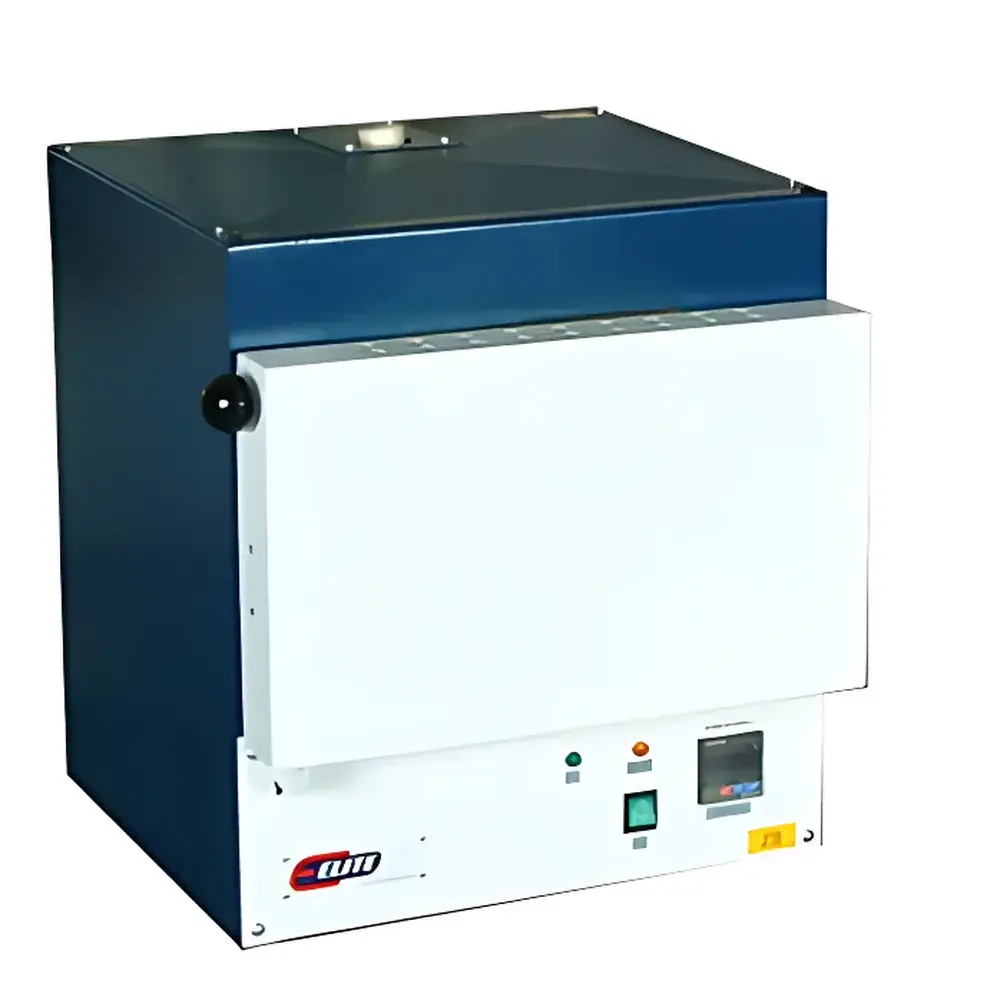
BMF11/7 Advanced Ashing Furnace – Carbolite Gero (UK)
| Origin | UK |
|---|---|
| Manufacturer Type | Authorized Distributor |
| Origin Category | Imported |
| Model | BMF11/7 |
| Instrument Type | Box-Type Muffle Furnace |
| Max Temperature | 1100 °C |
| Operating Temperature Range | Ambient to 1050 °C (continuous) |
| Temperature Uniformity | ±5 °C at 1050 °C |
| Control Accuracy | ±2 °C |
| Internal Dimensions (W×D×H) | 178 × 305 × 125 mm |
| Effective Volume | 7 L |
| Max Power Consumption | 2 kW |
| Heating Rate to 1100 °C | ≤50 min |
| Heating Element | Dual-sided Kanthal A1 wire embedded in ceramic fibre grooves |
| Insulation | Low-mass, high-purity ceramic fibre (density ~128 kg/m³) |
| External Casing | Galvanised steel with polyester powder coating |
| Door Mechanism | Top-hinged or front-hinged insulated door with automatic power cut-off interlock |
| Exhaust | Integrated chimney port (standard) |
| Thermocouple | Type N (NiCr–NiSi), calibrated per IEC 60584 |
| Electrical Supply | 240 V AC, single-phase |
| Net Weight | 48 kg |
| Compliance | CE-marked, conforms to EN 61000-6-3 (EMC), EN 61000-6-2 (Immunity), EN 60519-1 (Electrical Safety for Industrial Heating Equipment) |
Overview
The BMF11/7 Advanced Ashing Furnace is a precision-engineered, laboratory-grade box-type muffle furnace manufactured under strict quality control by Carbolite Gero in the United Kingdom. Designed specifically for quantitative ash residue determination in compliance with ASTM D3174, ISO 1171, USP , and AOAC Official Methods, it operates on the principle of controlled oxidative thermal decomposition — enabling complete organic matrix removal from solid samples while preserving inorganic ash constituents. Its robust dual-zone heating architecture, low-thermal-mass insulation, and N-type thermocouple-based feedback loop ensure stable temperature maintenance at up to 1050 °C continuously, with rapid thermal response and minimal thermal lag. The furnace chamber is fully isolated from combustion gases and external atmosphere, eliminating contamination risks during gravimetric ash analysis.
Key Features
- Dual-sided heating configuration with Kanthal A1 resistance wire embedded in precision-machined ceramic fibre grooves — ensures uniform radial and axial heat distribution across the 7 L chamber
- Low-density, high-purity ceramic fibre insulation (≤128 kg/m³) — reduces thermal inertia, enabling faster ramp-up (≤50 min to 1100 °C) and accelerated cooling cycles without compromising structural integrity
- Interlocked insulated door mechanism — automatically de-energises heating elements upon opening, meeting EN 60519-1 safety requirements for operator protection
- Integrated chimney port as standard — facilitates passive venting of volatile combustion by-products and maintains consistent internal atmospheric composition
- Galvanised steel enclosure with durable polyester powder coating — provides corrosion resistance and mechanical stability in demanding laboratory environments
- Type N thermocouple (IEC 60584 compliant) with direct chamber wall mounting — delivers long-term calibration stability and traceable temperature measurement accuracy of ±2 °C
Sample Compatibility & Compliance
The BMF11/7 accommodates a wide range of sample formats including crucibles (porcelain, platinum, alumina), filter papers, biological tissues, coal, foodstuffs, polymers, and pharmaceutical excipients. Its air-atmosphere operation supports standard ashing protocols per ISO 1171 (coal and coke), ASTM D3174 (coal ash content), and USP (ash residue in drug substances). All electrical and thermal safety systems conform to CE directives, including EN 61000-6-2 (electromagnetic immunity), EN 61000-6-3 (EMC emission limits), and EN 60519-1 (industrial electroheating equipment safety). Optional controller configurations support audit-ready data logging when paired with external recorders compliant with FDA 21 CFR Part 11 requirements.
Software & Data Management
While the BMF11/7 operates as a standalone instrument, its optional digital controllers provide layered functionality for process reproducibility and documentation. The 2116 offers basic setpoint control; the 2216 adds PID regulation with digital display; the 2416CG introduces 8-step programmable ramps; the 2408CP enables storage of one 16-step profile; the 2408P4 supports four independent programs; and the 2408CM allows concurrent storage of twenty 16-step profiles — all with real-time temperature readout and deviation alarms. When connected to external USB or RS485 data loggers, these controllers generate timestamped, tamper-evident thermal profiles suitable for GLP/GMP validation reports and regulatory submissions.
Applications
- Gravimetric ash content determination in feed, food, and agricultural commodities (AOAC 942.05, ISO 5984)
- Inorganic residue analysis in pharmaceutical raw materials and finished dosage forms (USP , Ph. Eur. 2.4.15)
- Coal and coke ash testing per ASTM D3174 and ISO 1171
- Preparation of ash-free filters for elemental analysis (ICP-OES, AAS)
- Thermal pre-treatment of catalysts and ceramics prior to BET surface area measurement
- Residue-on-ignition (ROI) assays in environmental soil and sludge testing (EPA Method 1650)
FAQ
What is the maximum continuous operating temperature of the BMF11/7?
The furnace is rated for continuous operation at 1050 °C; 1100 °C is the absolute upper limit for short-duration calibration or qualification runs.
Does the BMF11/7 require external ventilation or fume extraction?
Yes — although the integrated chimney port supports passive exhaust, connection to a dedicated lab fume hood or active ducted extraction system is recommended when processing halogenated or sulfur-containing samples.
Can the BMF11/7 be validated for GMP use?
Yes — when equipped with the 2408CM controller and paired with third-party IQ/OQ documentation packages and calibrated thermocouple verification kits, it meets core requirements for equipment qualification under EU Annex 15 and FDA guidance.
Is the internal chamber resistant to acidic ash residues?
The standard chamber lining is ceramic fibre; for repeated exposure to fluorides or strong acids, optional alumina brick lining upgrades are available upon request.
What maintenance intervals are recommended for optimal performance?
Visual inspection of door seal integrity and thermocouple calibration verification every 6 months; full ceramic fibre integrity assessment recommended annually or after 2,000 operational hours.
Related Products



