
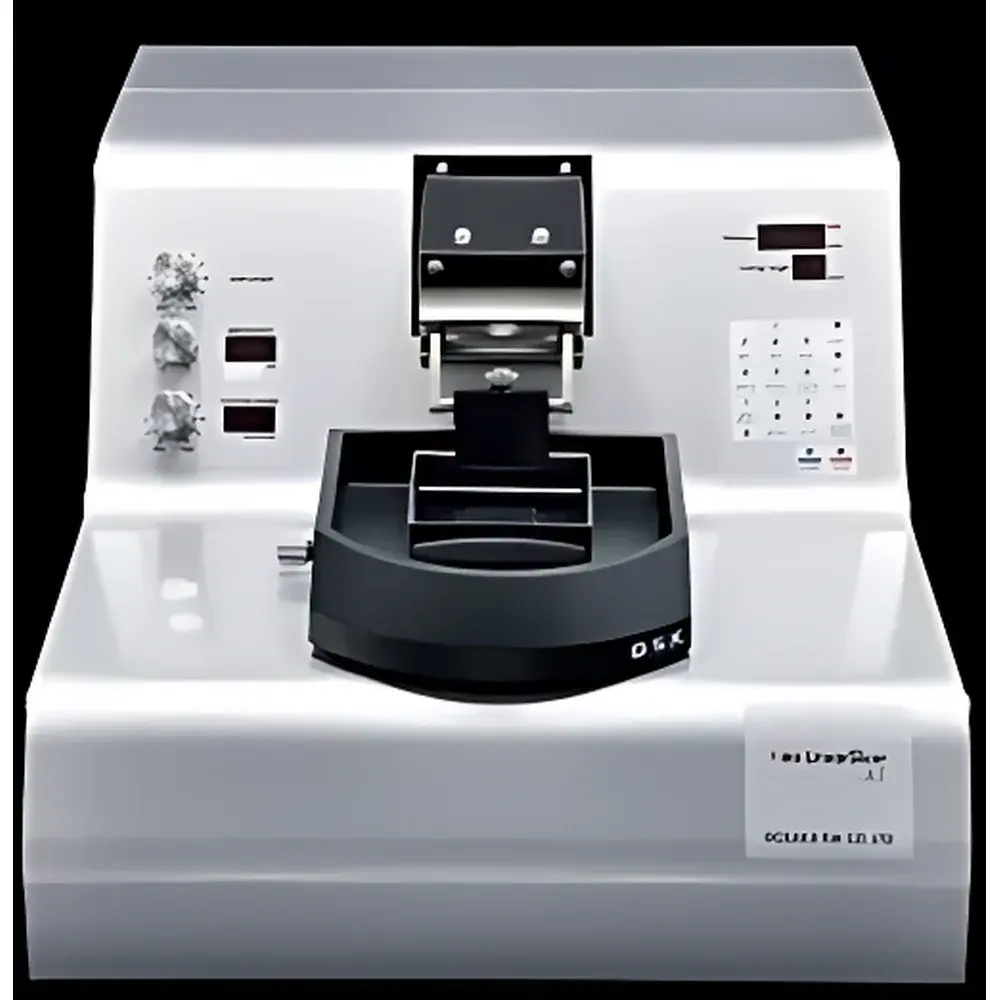
DOSAKA NLS-AT Fully Automated Vibrating Microtome
| Brand | DOSAKA |
|---|---|
| Origin | Japan |
| Model | NLS-AT |
| Maximum Sample Size | 30 × 30 mm |
| Vibration Frequency Range | 50–100 Hz |
| Vibration Amplitude | 0–2 mm |
| Advancement Speed | 0–44 mm/min |
| Retraction Speed | 71 mm/min |
| Vertical Sample Travel | 15 mm |
| Dimensions (W×D×H) | 345 × 500 × 240 mm |
| Weight | 35 kg |
| Power Supply | 100 V, 2 A, 50/60 Hz |
Overview
The DOSAKA NLS-AT Fully Automated Vibrating Microtome is an advanced precision instrument engineered for high-fidelity sectioning of soft, unfixed, or lightly fixed biological tissues—including live, cryopreserved, and hydrogel-embedded specimens—without compromising structural integrity or antigenicity. Unlike conventional rotary or sliding microtomes, the NLS-AT operates on the principle of controlled harmonic oscillation: a high-stability linear motor drives the blade in a precisely regulated vertical vibration perpendicular to the cutting direction, enabling clean, low-shear separation of tissue layers with minimal compression or chatter. This mechanism eliminates the Z-axis parasitic vibrations inherent in DC-motor-driven systems, reducing thickness deviation to sub-2 µm reproducibility—critical for quantitative immunohistochemistry, electrophysiology, and serial block-face imaging applications. Designed as the evolutionary successor to DOSAKA’s LinearSlicer and Neo LinearSlicer platforms, the NLS-AT integrates a stainless-steel monocoque chassis, active resonance-damping base, and digitally synchronized motion control architecture to sustain metrological performance across extended operational cycles.
Key Features
- Linear Motor–Driven Vibration System: High-efficiency brushless linear actuator delivers stable, repeatable oscillation at user-selectable frequencies (50–100 Hz) with real-time digital display—enabling empirical optimization of resonance matching for diverse tissue viscoelasticities.
- Independent Parameter Control: Vibration amplitude (0–2 mm), advancement speed (0–44 mm/min), and retraction speed (71 mm/min) are fully decoupled and programmable, supporting both manual fine-tuning and automated protocol-based sectioning sequences.
- Auto-Retract Function: Prevents post-cut blade contact with specimen surface during return stroke, eliminating mechanical artifact formation and preserving delicate tissue architecture—especially critical for fragile neuroslices or organotypic cultures.
- Modular Sample Handling: Removable stainless-steel ice bath tray ensures consistent thermal stabilization during cryosectioning; interchangeable knife holders accommodate standard disposable blades or custom-ground tungsten-carbide tools.
- Vibration-Damped Mechanical Architecture: Rigid stainless-steel frame mounted on a proprietary anti-resonance base isolates cutting dynamics from ambient floor vibrations, maintaining slice uniformity even in shared laboratory environments.
Sample Compatibility & Compliance
The NLS-AT excels in preparing sections from unprocessed or minimally processed soft tissues—including brain, spinal cord, retina, embryonic tissue, tumor spheroids, and 3D-bioprinted constructs—without requiring paraffin embedding, dehydration, or high-temperature processing. This preserves native protein conformation, epitope accessibility, and enzymatic activity, directly supporting protocols compliant with ISO 13842 (histological techniques), ASTM E2919 (biological specimen preparation), and GLP-aligned tissue banking workflows. Its ability to generate consistent 10–200 µm sections without membrane rupture or antigen masking supports pre-analytical requirements for USP sterility testing, FDA 21 CFR Part 11–enabled digital pathology archives, and CLIA-certified IHC validation studies.
Software & Data Management
The NLS-AT operates via an embedded microcontroller interface with non-volatile parameter memory, storing up to 16 user-defined protocols with timestamped execution logs. While no external PC software is required for basic operation, optional RS-232/USB connectivity enables integration into laboratory information management systems (LIMS) for audit-trail generation, protocol version control, and remote calibration verification—meeting traceability requirements under ISO/IEC 17025 and GMP Annex 11. All parameter changes are logged with operator ID (via optional RFID badge reader), session start/end timestamps, and environmental condition tags (if paired with external temperature/humidity sensors), satisfying ALCOA+ data integrity principles.
Applications
- Electrophysiological slice preparation for patch-clamp recording in hippocampal, cortical, and thalamic explants
- Serial sectioning of cryo-preserved human biopsy specimens for spatial transcriptomics and multiplexed ion beam imaging (MIBI)
- Sectioning of decellularized extracellular matrix scaffolds for regenerative medicine scaffold characterization
- Preparation of intact plant meristem and vascular tissue sections for confocal live-cell imaging
- Generation of uniform 30–100 µm sections from organ-on-chip devices for pharmacokinetic/toxicokinetic modeling
- Routine histology of lipid-rich tissues (e.g., adipose, myelin) where conventional microtomes induce smearing or delamination
FAQ
What types of tissue can be sectioned with the NLS-AT without freezing or embedding?
Soft, hydrated tissues—including fresh brain slices, retinal explants, and primary cell aggregates—can be sectioned directly using agarose or low-melting-point gel support, eliminating fixation-induced epitope masking.
Is the NLS-AT compatible with standard histology knife blades?
Yes—it accepts commercially available vibrating microtome blades (e.g., Leica VT1200 S-compatible disposable blades) via its universal quick-release holder.
How does the NLS-AT ensure long-term dimensional stability?
The all-stainless-steel frame, thermally compensated linear scale feedback, and maintenance-free linear motor eliminate mechanical drift typical of belt- or gear-driven systems, ensuring ≤0.5% thickness variation over 10,000 cuts.
Can cutting parameters be exported for regulatory documentation?
Yes—parameter sets and execution logs are exportable via USB as CSV files, supporting 21 CFR Part 11-compliant electronic records when used with validated LIMS integration.
What safety certifications does the NLS-AT hold?
CE-marked per IEC 61010-1:2010 (Safety Requirements for Electrical Equipment for Measurement, Control, and Laboratory Use) and conforms to JIS T 0601-1 for Japanese domestic compliance.



