
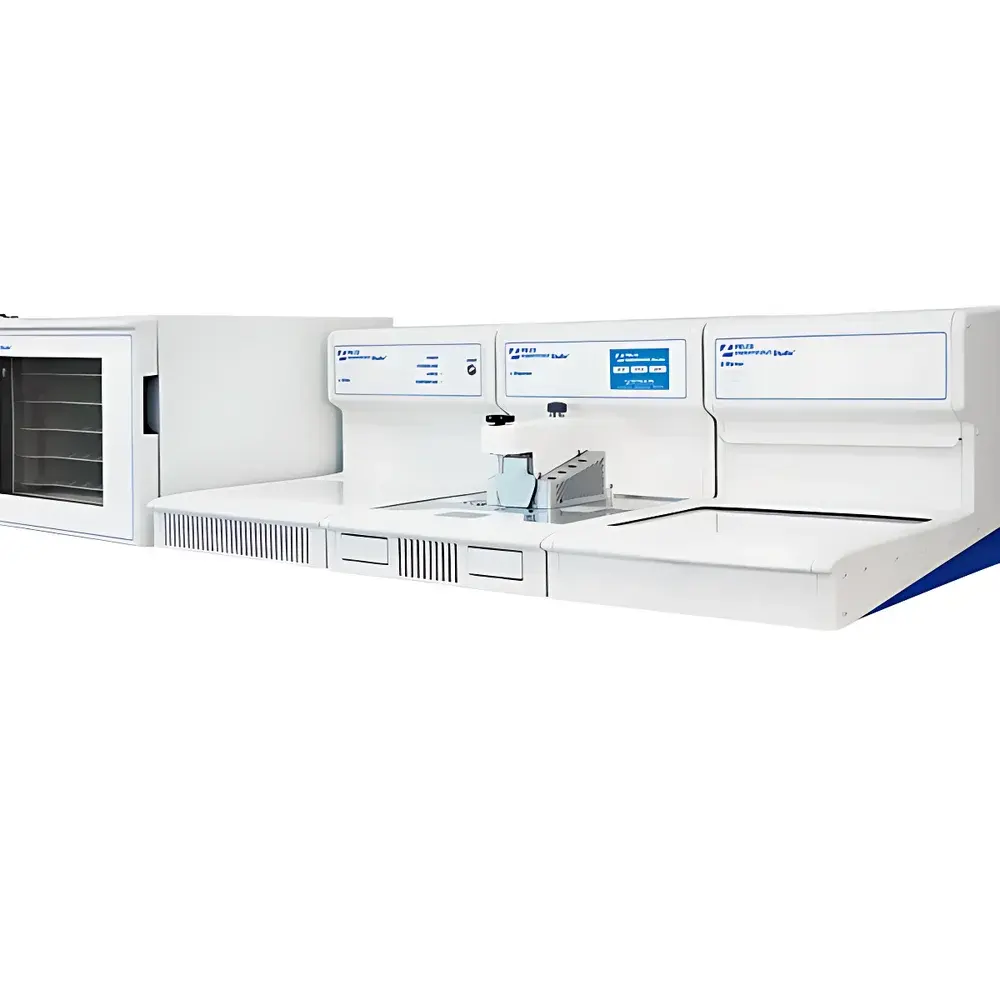
Ted Pella PELCO Embedding Studio Modular Tissue Embedding System
| Brand | Ted Pella |
|---|---|
| Origin | USA |
| Model | 13000 |
| Module Configuration | PELCO Warmer™, PELCO Chiller™, PELCO Freezer™ |
| Cooling/Heating Technology | Solid-state thermoelectric (Peltier) |
| Capacity | Up to 260 standard blocks (20 per tray × 13 trays) or 78 oversized blocks (6 per tray × 13 trays) |
| Compliance | RoHS-compliant thermal management, no CFCs or hydrocarbon refrigerants |
| Regulatory Context | Designed for GLP-compliant histopathology workflows |
Overview
The Ted Pella PELCO Embedding Studio Modular Tissue Embedding System (Model 13000) is an engineered solution for precision tissue embedding in clinical, academic, and industrial histology laboratories. Unlike conventional single-unit embedding centers, this system implements a distributed thermal architecture based on solid-state thermoelectric (Peltier) technology—eliminating compressors, refrigerants, and associated maintenance overhead. It operates on the principle of controlled, gradient thermal staging: tissue specimens undergo sequential conditioning across three independently regulated modules—warming for paraffin fluidity, chilling for partial solidification, and deep-freezing for final block hardening and archival storage. This staged approach decouples workflow bottlenecks, enabling concurrent processing of multiple batch types (e.g., routine biopsies alongside large surgical resections) without cross-temperature interference. The system is purpose-built for reproducible embedding outcomes aligned with CAP-accredited laboratory standards and ISO 15189–compliant quality management frameworks.
Key Features
- Modular tri-zone thermal architecture: PELCO Warmer™ (heating range: 45–70 °C), PELCO Chiller™ (cooling range: 0–12 °C), and PELCO Freezer™ (storage range: –10 to –25 °C), each with independent PID temperature control and real-time digital monitoring.
- High-throughput tray-based handling: Supports up to 13 standardized stainless-steel embedding trays; each accommodates 20 standard (25 × 25 mm) or 6 oversized (45 × 45 mm) blocks—scalable to 260 or 78 total blocks per full cycle.
- Peltier-based thermal management: Zero ozone-depleting substances (ODS), RoHS-compliant operation, silent performance, and extended service intervals compared to vapor-compression systems.
- Workflow-optimized spatial logic: Partially embedded blocks move from Warmer™ → Chiller™ → Freezer™, freeing Chiller™ capacity for incoming specimens while maintaining consistent crystallization kinetics in Freezer™.
- Tool-less module interconnection: DIN-rail mounting and standardized thermal interface gaskets enable field reconfiguration without calibration recalibration or vendor service dispatch.
Sample Compatibility & Compliance
The PELCO Embedding Studio accommodates all standard histological specimen formats—including formalin-fixed, alcohol-dehydrated, and xylene-cleared tissues—as well as specialized protocols involving low-melting-point paraffin (e.g., 52–56 °C range), methyl salicylate clearing agents, and cryo-compatible embedding media. Each module maintains temperature stability within ±0.3 °C over 24-hour operation, satisfying ASTM E2234 requirements for thermal consistency in diagnostic tissue processing. The system’s firmware logs all thermal events with timestamped audit trails, supporting FDA 21 CFR Part 11 compliance when integrated with validated LIMS environments. All surfaces contacting embedding media are electropolished stainless steel (ASTM A967) to prevent paraffin residue buildup and ensure traceable cleaning validation.
Software & Data Management
While the Embedding Studio operates via intuitive front-panel controls, optional USB data logging enables export of temperature profiles, cycle timestamps, and module status flags (e.g., “Chiller™ active”, “Freezer™ door open >15 s”) in CSV format. These logs integrate natively with laboratory information systems compliant with HL7 ADT and ASTM E1384 standards. No proprietary software installation is required; raw log files are human-readable and compatible with common statistical analysis platforms (e.g., JMP, Minitab) for SPC charting of embedding consistency metrics. Audit trail integrity is preserved through write-once memory allocation—preventing post-hoc modification per GLP Annex 11 principles.
Applications
- Routine surgical pathology: High-volume embedding of biopsy specimens with staggered turnaround time requirements.
- Research core facilities: Simultaneous processing of heterogeneous sample sets (e.g., murine tissue, human tumor biopsies, plant sections) under protocol-specific thermal profiles.
- Quality assurance labs: Embedding validation studies requiring documented thermal history per specimen batch (e.g., ISO 13485 medical device histocompatibility testing).
- Training environments: Modular visibility allows direct observation of phase-change dynamics during paraffin infiltration and solidification—supporting competency-based histotechnologist education.
FAQ
Does the PELCO Embedding Studio require external ventilation or refrigerant servicing?
No. Its Peltier-based modules operate passively cooled via aluminum heat sinks and low-noise DC fans—no venting ducts, compressor oil changes, or refrigerant recharging are necessary.
Can I use non-Ted Pella embedding molds or trays?
Yes. The system accepts industry-standard stainless-steel and disposable plastic molds (e.g., Fisherbrand, Sakura, Leica) conforming to ANSI/AAMI ST79 dimensions.
Is remote monitoring supported?
Not natively—but optional USB-to-Ethernet adapters enable integration with existing building management systems (BMS) via Modbus TCP for facility-wide thermal equipment oversight.
What maintenance schedule is recommended?
Quarterly visual inspection of thermal interface gaskets and annual verification of PID controller accuracy using NIST-traceable RTD probes—documented in accordance with ISO/IEC 17025 clause 6.4.6.



