
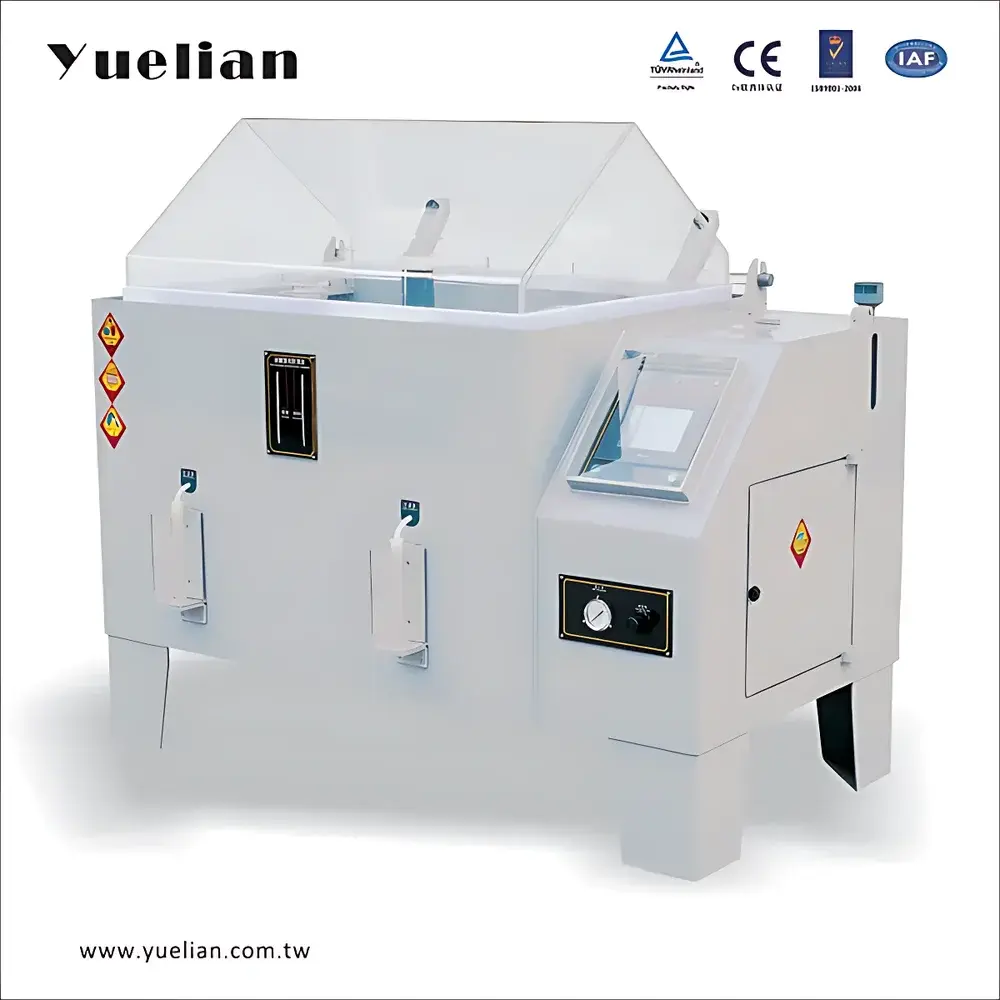
Yuelian SAS Series Automotive Wire Harness Salt Spray Test Chamber
| Brand | Yuelian |
|---|---|
| Origin | Guangdong, China |
| Manufacturer Type | Authorized Distributor |
| Product Origin | Domestic (China) |
| Model | SAS-108 / SAS-270 / SAS-480 / SAS-800 |
| Internal Chamber Dimensions (L×W×H, cm) | 60×40×45 |
| Chamber Volume | 108 L |
| Construction Material | Imported PVC板材 & PP lining |
| Test Temperature Range | Neutral Salt Spray (NSS): 35 ±1 °C |
| Acetic Acid Salt Spray (AASS) | 50 ±1 °C |
| Saturated Air Chamber Temperature | NSS: 47 ±1 °C |
| AASS | 63 ±1 °C |
| Salt Solution Temperature | 35 ±1 °C |
| pH Range | NSS: 6.5–7.2 |
| AASS | 3.0–3.2 |
| Fog Generation Method | Bernoulli-effect pneumatic atomization |
| Fog Deposition Rate | 1.0–2.0 mL/80 cm²/h (±0.3 mL/80 cm²/h uniformity) |
| Timer Range | 0–999.9 h (power-failure memory function with buzzer alarm) |
| Spray Mode | Continuous or cyclic spray selectable |
| Power Supply | AC 220 V ±10%, 1-phase, 50/60 Hz |
| Safety Features | Dual overtemperature protection, low-water-level alarm, electronic + mechanical heater overheat cutoff, circuit breakers on all circuits, full-system fault detection with LED indicator |
| Nozzle Lifetime | ≥4000 h (precision borosilicate glass nozzle, crystallization-resistant) |
| Control Interface | Digital membrane keypad with waterproof/fog-proof design |
| Water Supply | Auto/manual fill system with level-sensing feedback |
Overview
The Yuelian SAS Series Automotive Wire Harness Salt Spray Test Chamber is an engineered environmental test system designed to evaluate the corrosion resistance of coated, plated, and chemically treated components under standardized accelerated salt fog exposure conditions. It operates in strict accordance with internationally recognized test protocols—including ASTM B117 (Neutral Salt Spray), ISO 9227 (NSS, AASS, CASS), and JIS Z2371—making it suitable for validation of surface protection systems used in automotive wiring harnesses, connectors, terminals, crimped joints, and related electro-mechanical assemblies. The chamber utilizes a controlled pneumatic雾化 system based on the Bernoulli principle to generate a stable, reproducible saline aerosol, while its precisely regulated thermal environment ensures consistent test kinetics across repeated cycles. Its robust construction—featuring imported high-purity PVC and polypropylene (PP) internal linings—prevents chemical degradation and guarantees long-term dimensional stability during continuous operation.
Key Features
- Five-wall heating architecture ensures uniform temperature distribution throughout the test chamber, minimizing thermal gradients that could compromise test repeatability.
- High-accuracy PID temperature controller maintains chamber setpoints within ±0.1 °C deviation, critical for maintaining defined corrosion reaction rates per ASTM B117 Annex A2.
- Borosilicate glass nozzles rated for ≥4000 hours of uninterrupted service, engineered to resist crystallization and clogging from sodium chloride residue.
- Saturated air chamber employs Henry’s Law-based humidification to deliver precise relative humidity and temperature control—essential for replicating real-world condensation-driven corrosion mechanisms.
- Integrated dual overtemperature protection (electronic + mechanical) and automatic low-water-level detection prevent operational hazards and ensure continuity of long-duration tests.
- Digital membrane keypad interface with IP65-rated waterproofing supports reliable operation in high-humidity laboratory environments and simplifies parameter entry and monitoring.
- Full-system fault detection logic provides immediate visual indication (LED status lighting) and audible alert (buzzer) upon sensor failure, power anomaly, or safety interlock activation.
- Auto-fill water replenishment system with level-sensing feedback enables unattended operation over multi-day test cycles without manual intervention.
- Configurable spray mode selection—continuous or programmable cyclic spray—supports both standard compliance testing and custom corrosion aging profiles.
Sample Compatibility & Compliance
The SAS Series accommodates a broad range of automotive wire harness configurations—from single-strand shielded cables to multi-pin connector subassemblies—via adjustable sample racks and non-metallic support fixtures. All internal surfaces are constructed from corrosion-inert PVC and PP, eliminating metallic ion contamination risks that could interfere with electrochemical corrosion pathways. The system complies with key regulatory and quality frameworks including ISO/IEC 17025 calibration traceability requirements, GLP-compliant data integrity provisions (audit trail-capable timer logs), and alignment with IATF 16949 clause 8.5.1.1 for process validation of corrosion protection processes. Optional RS-232/RS-485 communication interfaces enable integration into centralized lab management systems for automated data capture and report generation.
Software & Data Management
While the base SAS model features embedded digital control logic with local display and manual logging, optional firmware upgrades support time-stamped event recording—including start/stop timestamps, temperature deviations, spray cycle initiation, and fault events—with non-volatile memory retention (power-failure memory). Logged data can be exported via USB or serial interface for post-test analysis in Excel or LIMS-compatible formats. For laboratories operating under FDA 21 CFR Part 11 or EU Annex 11 requirements, validated software packages are available upon request—providing electronic signatures, role-based access control, and immutable audit trails for full regulatory traceability.
Applications
- Qualification of zinc-nickel, tin, and trivalent chromium plating on copper alloy terminals and crimp barrels.
- Validation of conformal coatings (acrylic, silicone, urethane) applied to wire harness junctions and splice points.
- Corrosion resistance benchmarking of heat-shrink tubing, adhesive-lined sleeves, and overmolded connector housings.
- Process capability studies for electroplating, phosphating, and passivation lines supplying Tier-1 automotive suppliers.
- Accelerated aging of solder joints and PCB-mounted connectors exposed to road-salt environments.
- Comparative evaluation of anti-corrosion greases and dielectric compounds used in high-voltage EV battery harness assemblies.
FAQ
What standards does the SAS Series comply with?
ASTM B117, ISO 9227 (NSS/AASS/CASS), JIS Z2371, GB/T 2423.17, and DIN 50021 are fully supported through hardware configuration and operational parameters.
Can the chamber perform cyclic corrosion testing (CCT)?
Yes—when equipped with optional programmable controller firmware, the SAS Series supports user-defined multi-stage cycles combining salt spray, drying, and humidity phases per ISO 16701 or SAE J2334 protocols.
Is calibration documentation provided with shipment?
Each unit ships with factory calibration certificates for temperature sensors and fog deposition rate verification, traceable to NIM (National Institute of Metrology, China) standards.
How is fog deposition uniformity verified?
The system includes four standardized collection funnels (per ASTM B117 Section 7.2.3) positioned at cardinal locations inside the working chamber, enabling routine verification of ±0.3 mL/80 cm²/h consistency.
What maintenance intervals are recommended?
Daily visual inspection of nozzle integrity and solution level; monthly cleaning of saturation chamber and air filters; annual recalibration of temperature and timer modules by authorized service personnel.



