
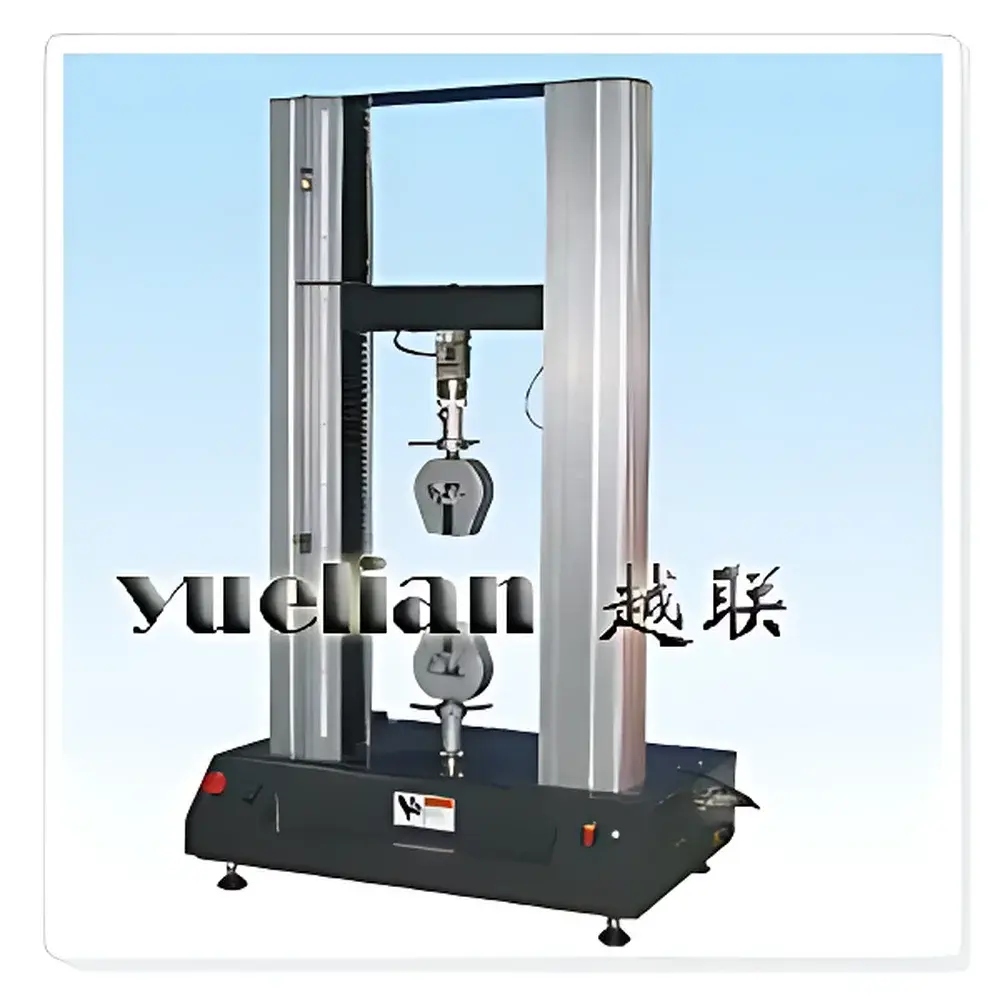
Yuelian YL-1123 Universal Testing Machine (2 Ton Capacity)
| Brand | Yuelian |
|---|---|
| Origin | Guangdong, China |
| Model | YL-1123 |
| Load Capacity Options | 10N–20kN (dual-range configurable) |
| Force Resolution | 1/500,000 |
| Force Accuracy | ≤ ±0.5% FS |
| Travel Resolution | 0.005 mm |
| Max Test Speed | 0.01–1000 mm/min |
| Stroke | 700 mm |
| Test Width | 350 mm |
| Drive System | Servo Motor + Precision Ball Screw |
| Power Supply | 220 V, 50/60 Hz, 10 A |
| Power Consumption | 400 W |
| Dimensions (W×D×H) | 72 × 52 × 130 cm |
| Weight | ~115 kg |
| Control Interface | PC-based with USB connectivity |
| Standard Accessories | One set of grips, proprietary test software, USB cable |
Overview
The Yuelian YL-1123 Universal Testing Machine is an electromechanical force-testing system engineered for precision mechanical characterization of solid materials across research, quality assurance, and production environments. Based on the fundamental principles of uniaxial tensile, compressive, flexural, shear, peel, and tear testing—governed by standardized mechanical equilibrium and Hookean deformation theory—the YL-1123 delivers repeatable load-displacement data under controlled displacement or load-rate conditions. Its 2-ton (20 kN) nominal capacity supports dual-range sensor configurations, enabling high-resolution measurement from low-force polymer film peel tests (10 N) to high-load metallic tensile specimens (20 kN), all within a single platform architecture. The machine complies with core mechanical testing frameworks defined in ASTM E4, ASTM E8/E8M, ISO 6892-1, ISO 178, ISO 1421, and GB/T 228.1, ensuring compatibility with internationally accepted test methodologies for modulus, yield strength, ultimate tensile strength, elongation at break, and fracture energy calculation.
Key Features
- High-fidelity force measurement with ≤ ±0.5% full-scale accuracy and 1/500,000 internal resolution, traceable to national metrological standards
- Electromechanical actuation via industrial-grade servo motor coupled with preloaded precision ball screw and synchronous timing belt transmission—ensuring minimal backlash and long-term positional repeatability
- Programmable crosshead speed range of 0.01–1000 mm/min, adjustable in real time via PC interface with ramp-hold-step profiling capability
- Integrated safety architecture: overload cutoff, emergency stop button, automatic specimen rupture detection, programmable upper/lower travel limits, and auto-return-to-initial-position function
- Modular grip interface supporting standardized wedge-action, pneumatic, hydraulic, and custom fixtures—including ASTM D638-compliant tensile grips and ISO 8510-2 peel jigs
- Robust structural frame fabricated from high-rigidity steel with vibration-damped base and linear motion guides rated for >10⁶ cycles
Sample Compatibility & Compliance
The YL-1123 accommodates diverse specimen geometries and material classes—including elastomers, thermoplastics, composites, thin films, textiles, paperboard, adhesives, biomedical polymers, and structural metals—within its 350 mm test width and 700 mm vertical stroke envelope. Specimen thickness up to 120 mm is supported with optional height-adjustable load train. All mechanical test protocols adhere to GLP-aligned data integrity requirements: audit trails, user-level access control, electronic signature support (in compliance with FDA 21 CFR Part 11 when configured with validated software version), and raw-data immutability during post-test analysis. Calibration certificates conform to ISO/IEC 17025 guidelines and include uncertainty budgets per force and displacement axes.
Software & Data Management
The embedded PC-based control suite provides real-time acquisition, visualization, and post-processing of force–displacement, stress–strain, and time-dependent curves. It supports multi-channel synchronization (up to four transducers), customizable test templates, and automated parameter extraction—including Young’s modulus, yield offset (0.2%), tensile strength, elongation, peel average force, and tear propagation energy. Data export formats include CSV, XML, and native MS Access (.accdb) for integration into LIMS or ERP systems. Graphical overlays, derivative analysis (e.g., dF/dx for stiffness mapping), and statistical batch reporting (mean, SD, CV%, confidence intervals) are natively supported. Software validation documentation—including IQ/OQ protocols and change control logs—is available upon request for regulated laboratory deployment.
Applications
- Mechanical validation of injection-molded automotive interior components per SAE J2113
- Peel strength assessment of pressure-sensitive adhesives per ASTM D3330
- Tensile property benchmarking of biodegradable packaging films per ISO 527-3
- Compression testing of foam cushioning materials per ASTM D3574
- Bending modulus determination for fiber-reinforced polymer laminates per ISO 14125
- Incoming raw material verification against supplier specifications in ISO 9001-certified QC labs
- Academic research on viscoelastic response under variable strain rates (0.001–1 s⁻¹ equivalent)
FAQ
Is the YL-1123 compliant with ISO/IEC 17025 calibration requirements?
Yes—when paired with accredited third-party calibration services, the system meets traceability requirements for force and displacement metrology as specified in ISO/IEC 17025:2017 Annex B.
Can the software generate 21 CFR Part 11-compliant audit trails?
The validated software package includes role-based user authentication, electronic signatures, immutable raw data storage, and full activity logging—meeting core technical controls outlined in FDA 21 CFR Part 11 Subpart B.
What is the recommended maintenance interval for the ball screw and drive system?
Under standard laboratory use (≤40 hrs/week), lubrication and functional verification are recommended every 6 months; full preventive maintenance including encoder alignment and load cell zero-drift verification is advised annually.
Does the system support external environmental chambers?
Yes—the machine features auxiliary I/O ports and TTL-triggered synchronization, enabling seamless integration with temperature/humidity chambers (e.g., ESPEC, Weiss) for conditioned mechanical testing per ASTM D618.
Are calibration certificates included with shipment?
A factory-as-found calibration report is provided; full ISO/IEC 17025-accredited calibration with uncertainty statements requires optional on-site or return-to-factory service.



