
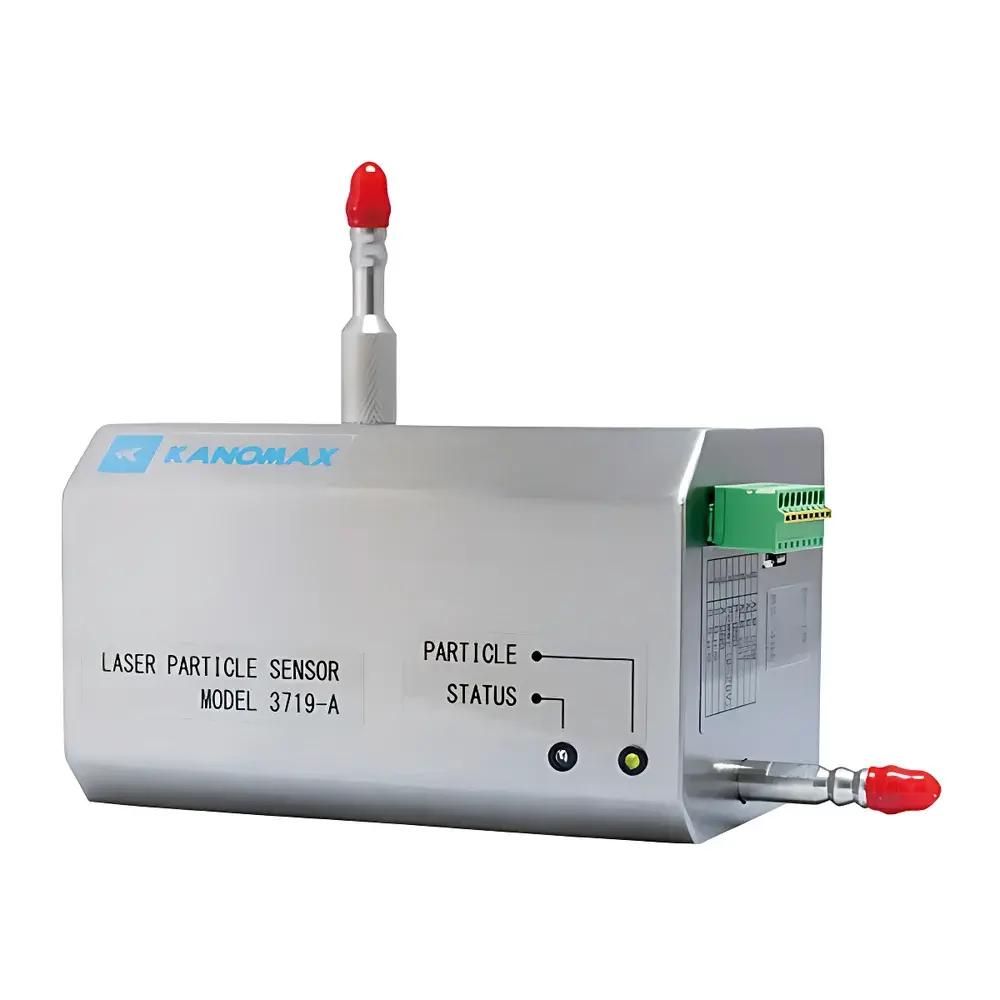
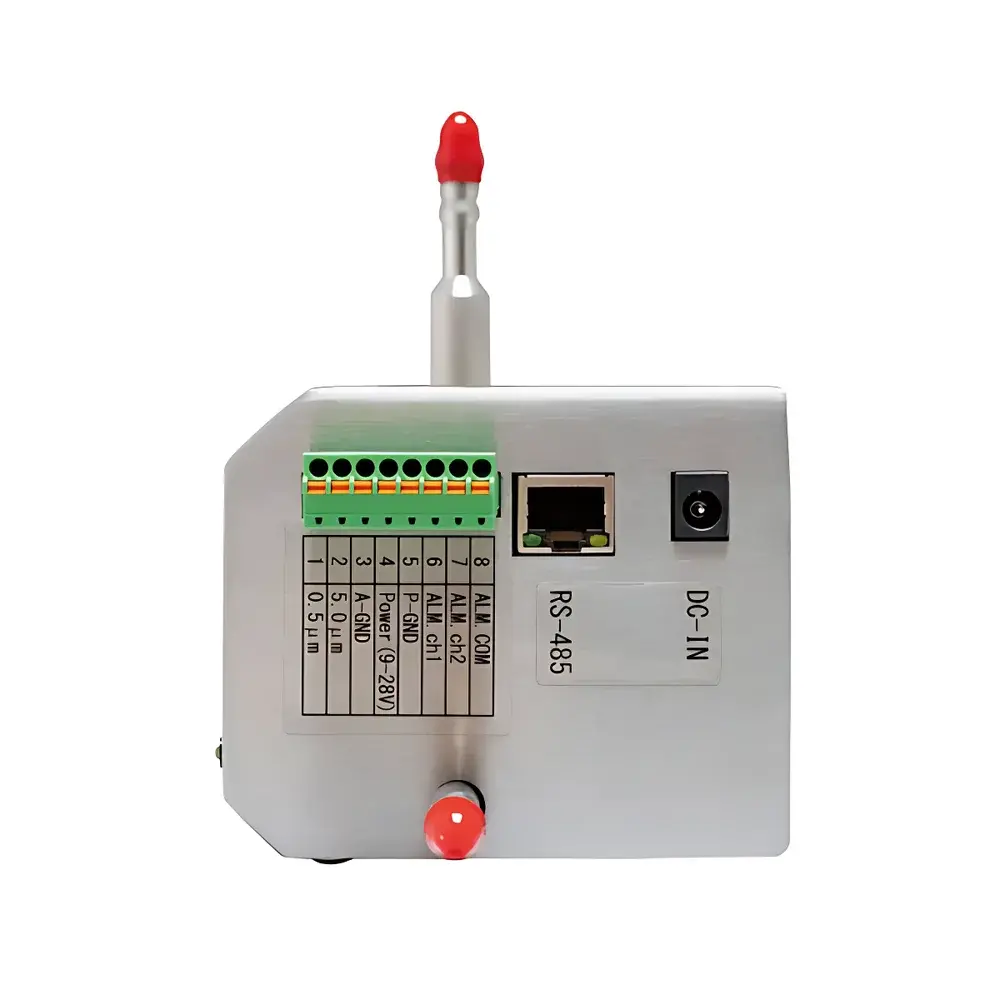
KANOMAX 3718-A & 3719-A Remote Online Airborne Particle Counters
| Brand | KANOMAX |
|---|---|
| Origin | Japan |
| Model | 3718-A / 3719-A |
| Particle Size Channels | 0.3 & 0.5 µm (3718-A) / 0.5 & 5.0 µm (3719-A) |
| Flow Rate | 28.3 L/min (1 CFM) |
| Light Source | Long-life laser diode |
| Counting Efficiency | Compliant with ISO 21501-4 and JIS B 9921 |
| Max Concentration | 500,000 counts/ft³ |
| Data Storage | 4,320 measurement records with redundancy backup |
| Output Interfaces | RS485, Modbus RTU/TCP/IP, 4–20 mA analog output |
| Power Supply | DC 9–28 V, PoE, or AC 100–240 V |
| Housing Material | 316 stainless steel with VHP- and alcohol vapor-resistant sealing |
| Operating Environment | 10–30 °C, 20–85% RH (non-condensing) |
| Dimensions | 133 × 95 × 80 mm |
| Weight | 1.0 kg |
| Compliance | ISO 14644-1:2015, JIS B 9921, ISO 21501-4 |
Overview
The KANOMAX 3718-A and 3719-A are certified remote online airborne particle counters engineered for continuous, unattended monitoring of cleanroom and controlled environments in semiconductor fabrication, pharmaceutical manufacturing, and advanced electronics assembly. These instruments operate on the principle of light scattering photometry—where particles drawn through a calibrated laminar airflow intersect a collimated laser beam, generating scattered light pulses proportional to particle size and count. Each unit maintains a precise volumetric flow rate of 28.3 L/min (1 CFM) via integrated pressure sensing and external air supply regulation—ensuring metrological stability across variable backpressure conditions. Designed for permanent installation in Grade A/B GMP zones, RABS, isolators, and ISO Class 3–8 cleanrooms, the dual-channel configuration supports concurrent detection of two discrete particle size thresholds: the 3718-A monitors 0.3 µm and 0.5 µm particles—critical for detecting sub-micron contamination in lithography and wafer handling; the 3719-A targets 0.5 µm and 5.0 µm particles—essential for verifying filter integrity and monitoring larger particulate shedding in packaging and filling lines.
Key Features
- High-reliability optical architecture featuring a long-life laser diode with ≥10 years MTBF—minimizing scheduled maintenance and source replacement cycles.
- 316 stainless steel enclosure with IP65-rated hermetic sealing—validated for resistance to vaporized hydrogen peroxide (VHP) decontamination and ethanol/isopropanol vapor exposure, enabling safe deployment in aseptic processing suites.
- Dual independent particle size channels with real-time, simultaneous counting—each channel configurable with user-defined alarm thresholds and concentration output ranges (e.g., 0–10,000 counts/m³ or 0–35,300,000 counts/m³).
- Robust data integrity system: 4,320 timestamped measurement records stored locally with redundant backup—ensuring continuity of critical environmental monitoring data during power loss or network interruption. Upon recovery, buffered records are prioritized for transmission to central SCADA or MES systems.
- Industrial-grade connectivity: native support for Modbus RTU (RS485), Modbus TCP/IP (Ethernet), and 4–20 mA analog output—enabling seamless integration into existing facility monitoring platforms compliant with ISA-88/ISA-95 and FDA 21 CFR Part 11 audit trail requirements.
- Flexible power architecture: compatible with DC 9–28 V, IEEE 802.3af PoE (enabling single-cable installation and hot-swap capability), or universal AC 100–240 V input—reducing infrastructure complexity and lifecycle cost of ownership.
Sample Compatibility & Compliance
The 3718-A and 3719-A are validated for use in compressed air, nitrogen, and ambient cleanroom air streams—with inlet compatibility for isokinetic sampling probes and standardized 3/8″ tubing interfaces. Both models meet the performance verification criteria defined in ISO 21501-4:2018 (Calibration and Testing of Light Scattering Airborne Particle Counters) and JIS B 9921:2019 (Methods for Testing Performance of Airborne Particle Counters). Their design and validation documentation align with ISO 14644-1:2015 Annex B for continuous monitoring applications in classified environments. Units are supplied with zero-count filters, isokinetic sampling nozzles, and calibration certificates traceable to NIST standards—supporting GLP/GMP audit readiness and qualification protocols (IQ/OQ/PQ).
Software & Data Management
Data acquisition and system control are managed via open-protocol interfaces—eliminating vendor lock-in. The embedded firmware supports configurable sampling intervals (1–60 seconds), dynamic alarm states (0–100% threshold), and multi-level status reporting (operational, fault, calibration due). When integrated with enterprise monitoring software (e.g., Siemens Desigo, Honeywell Experion, or custom LabVIEW/Python-based dashboards), the counters provide full traceability—including timestamps, instrument ID, channel-specific counts, and environmental metadata (temperature, humidity, pressure if externally fed). All communication logs and configuration changes comply with electronic record retention requirements under 21 CFR Part 11 when deployed with appropriate access controls and audit trail activation.
Applications
- Semiconductor front-end fabs: real-time particle surveillance at photolithography tool loadports and FOUP transfer zones.
- Aseptic fill-finish lines: continuous monitoring upstream and downstream of HEPA filters in isolators and RABS.
- Medical device cleanrooms: validation of ISO Class 5–7 environments during Class I–III device manufacturing.
- Advanced battery dry rooms: detection of electrode coating contaminants impacting cell yield and safety.
- Research laboratories: long-term environmental baseline studies for nanomaterial synthesis and microelectronics prototyping.
FAQ
What particle size channels does each model support?
The 3718-A measures 0.3 µm and 0.5 µm simultaneously; the 3719-A measures 0.5 µm and 5.0 µm simultaneously.
Is the instrument suitable for VHP decontamination cycles?
Yes—the 316 stainless steel housing and sealed optical chamber are rated for repeated exposure to vaporized hydrogen peroxide at concentrations up to 35% w/w and temperatures up to 60 °C.
How is data integrity ensured during power failure?
All measurement records are written to non-volatile memory with dual-buffer redundancy; upon restart, unsent records are automatically retransmitted in chronological order.
Does the unit require annual recalibration?
Per ISO 21501-4, field verification using NIST-traceable aerosol generators is recommended every 12 months; full recalibration is required only after sensor replacement or mechanical impact.
Can multiple units be daisy-chained on one RS485 bus?
Yes—up to 32 devices can share a single RS485 line using unique Modbus slave addresses (0–512 range), supporting scalable deployment across large cleanroom facilities.







