
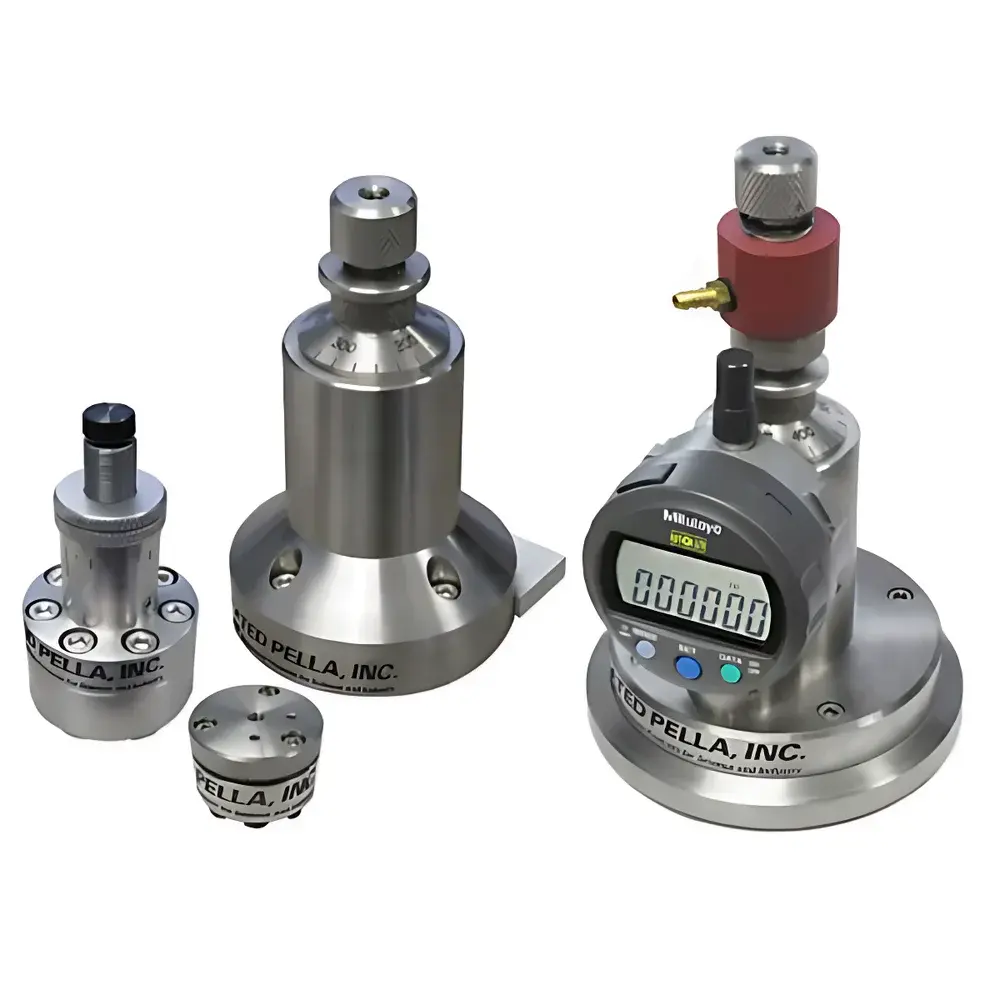
Ted Pella PELCO Precision Grinding Fixture Model 77500
| Brand | Ted Pella |
|---|---|
| Origin | USA |
| Manufacturer Type | Authorized Distributor |
| Origin Category | Imported |
| Model | 77500 |
| Instrument Type | Precision Grinding Fixture |
| Sample Compatibility | Hard, brittle, and high-hardness materials (e.g., Si wafers, sapphire, fused silica, ceramics, geological specimens) |
| Maximum Sample Diameter | 50 mm |
| Maximum Sample Thickness | 13 mm |
| Feed Resolution | 25 µm (digital micrometer) |
| Typical Grinding Accuracy | ±1 µm |
| Mounting Options | Wax bonding or vacuum-assisted clamping |
| Replaceable Base Material | Tungsten carbide |
| Base Diameter | 102 mm |
| Compatible Accessories | PELCO Grinding Trays (300 × 300 mm), PELCO 590 Tri-Polisher |
Overview
The Ted Pella PELCO Precision Grinding Fixture Model 77500 is an engineered mechanical grinding platform designed for controlled, repeatable material removal in the preparation of planar, parallel, and thickness-controlled specimens—particularly for transmission electron microscopy (TEM), focused ion beam (FIB) site-specific milling, semiconductor metrology, and optical component fabrication. Unlike conventional abrasive grinders or automated lapping systems, the 77500 operates on a precision mechanical displacement principle: sample height is defined and advanced via a calibrated digital micrometer with 25 µm incremental adjustment, enabling deterministic control over material removal depth. The fixture maintains rigid orthogonal alignment between the sample surface and the grinding medium (e.g., diamond-impregnated discs or silicon carbide papers mounted on flat platen surfaces), minimizing tilt-induced thickness variation and edge rounding. Its tungsten carbide base ensures long-term dimensional stability under repeated mechanical loading and thermal cycling, while the large 102 mm base diameter provides superior vibration damping during manual or semi-automated grinding protocols.
Key Features
- High-resolution digital micrometer with 25 µm graduation and sub-micron repeatability (±1 µm typical grinding accuracy under controlled conditions)
- Modular, vacuum-assisted or wax-bonded sample mounting system compatible with flat, irregular, or fragile substrates up to 50 mm in diameter and 13 mm thick
- Interchangeable tungsten carbide base plate for wear resistance and consistent thermal expansion matching with common grinding media
- Quick-release, threaded sample stage facilitating rapid specimen exchange without realignment
- Designed for integration with standard laboratory grinding trays (e.g., PELCO 300 × 300 mm glass trays) and tri-polishers (e.g., PELCO 590)
- No moving parts or motorized components—ensures intrinsic mechanical stability, eliminates electromagnetic interference, and supports glove-box or inert-atmosphere operation
Sample Compatibility & Compliance
The Model 77500 accommodates hard, non-ductile, and highly polished materials including single-crystal silicon, sapphire, quartz, borosilicate glass, alumina ceramics, geological thin sections, and metallurgical cross-sections embedded in epoxy resin. Its geometry and force distribution profile are optimized to minimize chipping, subsurface damage, and lateral stress-induced microcracking—critical for TEM lamella pre-thinning and subsequent ion milling. The fixture conforms to standard specimen preparation workflows aligned with ASTM E3-22 (Standard Guide for Preparation of Metallographic Specimens) and ISO 14577-1:2015 (Metallic materials — Instrumented indentation test). When used in regulated environments (e.g., semiconductor fab QA labs), its passive mechanical design supports GLP-compliant documentation of grinding parameters (micrometer position logs, grinding time, abrasive grade, slurry composition) and facilitates audit-ready traceability.
Software & Data Management
As a purely mechanical, non-electronic grinding fixture, the Model 77500 does not incorporate onboard firmware, connectivity, or proprietary software. However, its digital micrometer output is fully compatible with external data acquisition systems via analog voltage output (0–5 V) or optional RS-232 interface (available with upgraded micrometer module). Users may log positional data directly into LIMS platforms, Excel-based SOP trackers, or electronic lab notebooks (ELNs) compliant with FDA 21 CFR Part 11 requirements when paired with appropriate audit-trail-enabled software. Calibration certificates for the micrometer are provided traceable to NIST standards, supporting ISO/IEC 17025-accredited laboratory validation protocols.
Applications
- Precision thinning of TEM cross-sections prior to final ion polishing
- Controlled thickness reduction of semiconductor wafers for layer-resolved electrical characterization
- Flatness and parallelism correction of optical substrates (e.g., laser cavity mirrors, interferometric flats)
- Preparation of standardized rock/mineral thin sections for petrographic analysis
- Dimensional calibration of reference specimens for profilometry and AFM tip certification
- Manual grinding of brittle intermetallics or ceramic composites where automated lapping induces delamination
FAQ
Can the Model 77500 be used for wet or dry grinding?
Yes—it is compatible with both aqueous slurries and oil-based lubricants; the base design includes recessed channels to retain fluid and prevent lateral migration during manual grinding.
Is the digital micrometer recalibratable in-house?
Yes—micrometer modules are field-serviceable and include NIST-traceable calibration instructions; annual recalibration is recommended for applications requiring ≤2 µm thickness tolerance.
What is the maximum recommended grinding pressure?
For optimal surface integrity, apply ≤5 N axial load using a calibrated hand press or low-force arbor press; excessive force accelerates base wear and compromises micrometer linearity.
Does Ted Pella offer OEM integration support for custom automation?
Yes—mechanical interface drawings and mounting flange specifications are available under NDA for integration into semi-automated grinding stations or robotic sample handling systems.
Are replacement tungsten carbide bases available separately?
Yes—part number 77500-BASE-WC is stocked globally and ships with pre-lapped flatness ≤0.5 µm PV across the 102 mm diameter surface.



