
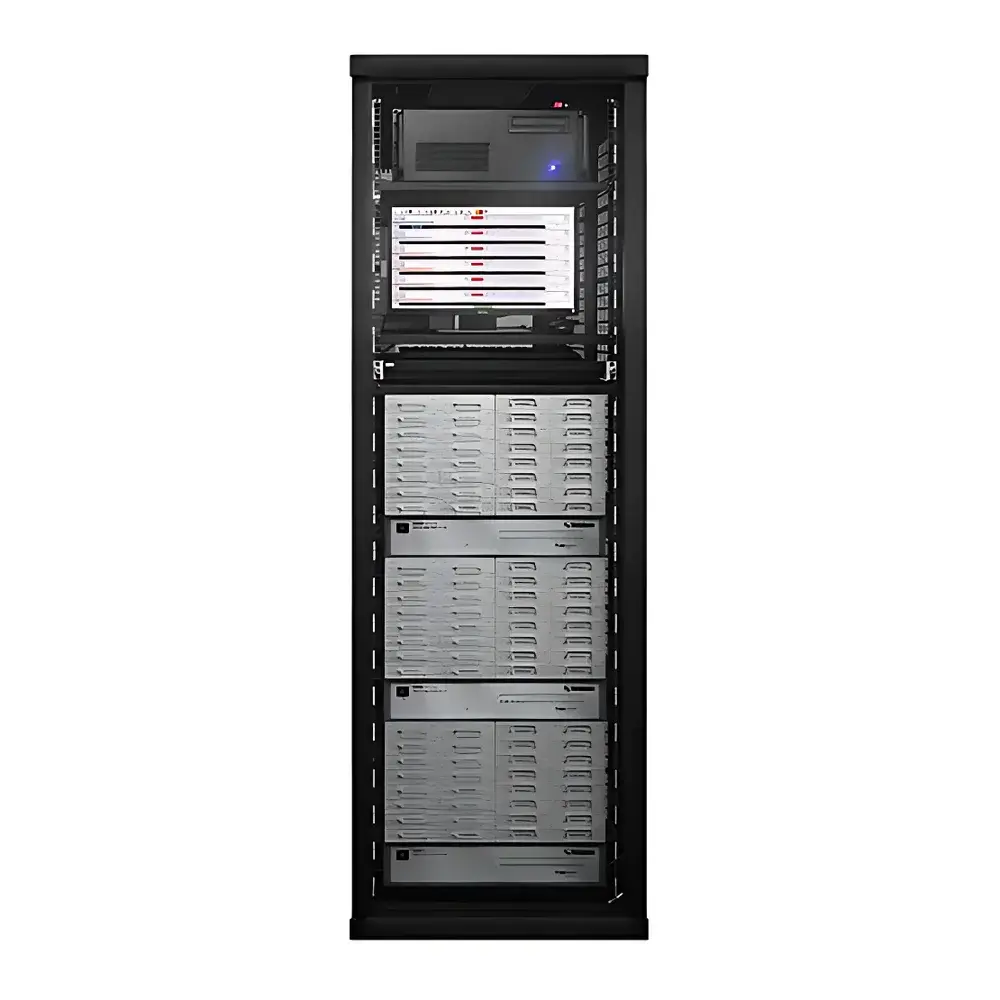
McScience M6600 Multi-Channel OLED/Perovskite QLED Lifetime & IVL Testing System
| Brand | McScience |
|---|---|
| Origin | South Korea |
| Model | M6600 |
| Category | Current-Voltage-Luminance (IVL) Tester for Organic & Perovskite Light-Emitting Devices |
| Configuration | Multi-channel, recipe-driven, photodiode-based luminance monitoring |
| Compliance | Designed for R&D and reliability qualification per IEC 62715-2-1, ISO/IEC 17025-aligned test environments |
| Optional Integration | Environmental chamber compatibility (temperature/humidity control) |
Overview
The McScience M6600 Multi-Channel OLED/Perovskite QLED Lifetime & IVL Testing System is an engineered platform for accelerated reliability assessment of emissive optoelectronic devices under controlled electrical stress. It operates on the principle of periodic, synchronized current–voltage–luminance (IVL) characterization during constant-current or pulsed-current aging protocols. By applying programmable drive conditions to multiple device sites simultaneously—and concurrently measuring forward current (IF), applied voltage (VF), and photodiode-converted luminance (L)—the system captures time-resolved degradation signatures critical for lifetime modeling (e.g., T50, T70, L0 drift, voltage rise at fixed current). The architecture supports both small-molecule OLEDs and solution-processed perovskite LEDs (PeLEDs), accommodating their distinct operational stability profiles, including ion migration effects, interfacial delamination, and electroluminescent quantum efficiency decay.
Key Features
- Multi-channel parallel testing: Up to 16 independent channels with isolated current sourcing and voltage sensing—enabling statistical reliability analysis across substrate batches or pixel architectures.
- High-dynamic-range IVL acquisition: Dual-range current measurement (pA to 100 mA full scale) and calibrated photodiode detection (0.01–100,000 cd/m² equivalent) ensure fidelity across initial turn-on and late-stage degradation regimes.
- Recipe-driven aging sequences: Users define time-stamped voltage/current waveforms, measurement intervals (from 1 s to 24 h), and trigger conditions (e.g., ΔV ≥ 0.1 V or ΔL ≤ 5% from baseline) to automate long-term stress experiments.
- Real-time degradation indexing: Onboard computation generates normalized parameters—including relative luminance retention (L/L0), voltage increase (ΔVF), and efficiency decay (η/η0)—with timestamped metadata exportable via CSV or HDF5.
- Modular hardware design: Front-panel accessible channel modules support field replacement; optional integration with environmental chambers (−40 °C to +85 °C, 5–95% RH non-condensing) enables accelerated life testing per JEDEC JESD22-A108 or IEC 60068-2 standards.
Sample Compatibility & Compliance
The M6600 interfaces with standard glass or flexible TEG (test element group) substrates featuring patterned anode/cathode contacts and integrated reference photodiodes. It accommodates pixel sizes from 0.1 mm² to 10 mm² and driving voltages up to ±100 V. All electrical outputs comply with IEC 61000-4-5 surge immunity and SELV (Safety Extra-Low Voltage) Class II isolation requirements. Data integrity adheres to GLP/GMP-aligned practices: audit-trail-enabled software logs operator ID, calibration timestamps, instrument firmware version, and raw sensor readings with SHA-256 hash verification. System validation documentation supports IQ/OQ protocols for regulated R&D labs operating under ISO/IEC 17025 or internal quality management systems.
Software & Data Management
The proprietary McScience Lifetest Suite (v4.2+) provides a deterministic, scriptable interface for experiment orchestration and post-processing. It features real-time dashboard visualization of all channels, automatic outlier detection using 3σ deviation thresholds, and built-in Weibull distribution fitting for failure probability estimation. Raw datasets include synchronized timestamps (UTC), hardware-calibrated units (A, V, APD → cd/m² via NIST-traceable PD responsivity), and user-defined metadata tags (e.g., “HTL_variation”, “encapsulation_type”). Export formats meet FAIR data principles: CSV (tabular), HDF5 (hierarchical, self-describing), and JSON-LD (semantic annotation ready). Software complies with FDA 21 CFR Part 11 requirements for electronic records and signatures when configured with role-based access control and digital certificate authentication.
Applications
- Accelerated lifetime prediction of blue-emitting PeLEDs under constant-current stress at 1000 cd/m² initial luminance.
- Comparative evaluation of hole-transport layer (HTL) materials in tandem OLED stacks using voltage-rise kinetics at fixed luminance.
- Correlation of encapsulation barrier performance (WVTR < 10⁻⁶ g/m²/day) with luminance half-life under thermal-humidity cycling (85°C/85% RH).
- Screening of emissive layer composition gradients across inkjet-printed QLED arrays via spatially resolved IVL mapping.
- Supporting JEDEC JEP182 reliability qualification for display-grade micro-OLED backplanes.
FAQ
What is the minimum measurable luminance change resolution?
The system achieves ±0.5% relative luminance resolution over 4 decades of dynamic range, limited by photodiode linearity and dark-current compensation accuracy—not by digitization noise.
Can the M6600 perform pulsed stress testing with variable duty cycles?
Yes—users define arbitrary current pulse profiles (width: 1 µs–10 s; frequency: 0.1 Hz–10 kHz; amplitude: 0.1 µA–100 mA) with synchronized IVL sampling at user-specified phase points.
Is third-party chamber integration supported?
Standard RS-232 and Ethernet (TCP/IP) interfaces enable bidirectional communication with commercial environmental chambers (e.g., ESPEC, Angelantoni); McScience provides documented API call templates and Modbus RTU register maps.
How is photodiode calibration traceability maintained?
Each unit ships with a NIST-traceable calibration certificate for its integrated Si photodiode array, with recalibration recommended annually or after mechanical shock exceeding 5 g.
Does the system support automated pass/fail criteria for batch release?
Yes—threshold-based rules (e.g., “T70 ≥ 500 h AND ΔVF ≤ 1.2 V at 1000 cd/m²”) can be embedded in recipes and enforced during real-time monitoring, triggering email/SNMP alerts upon violation.






