
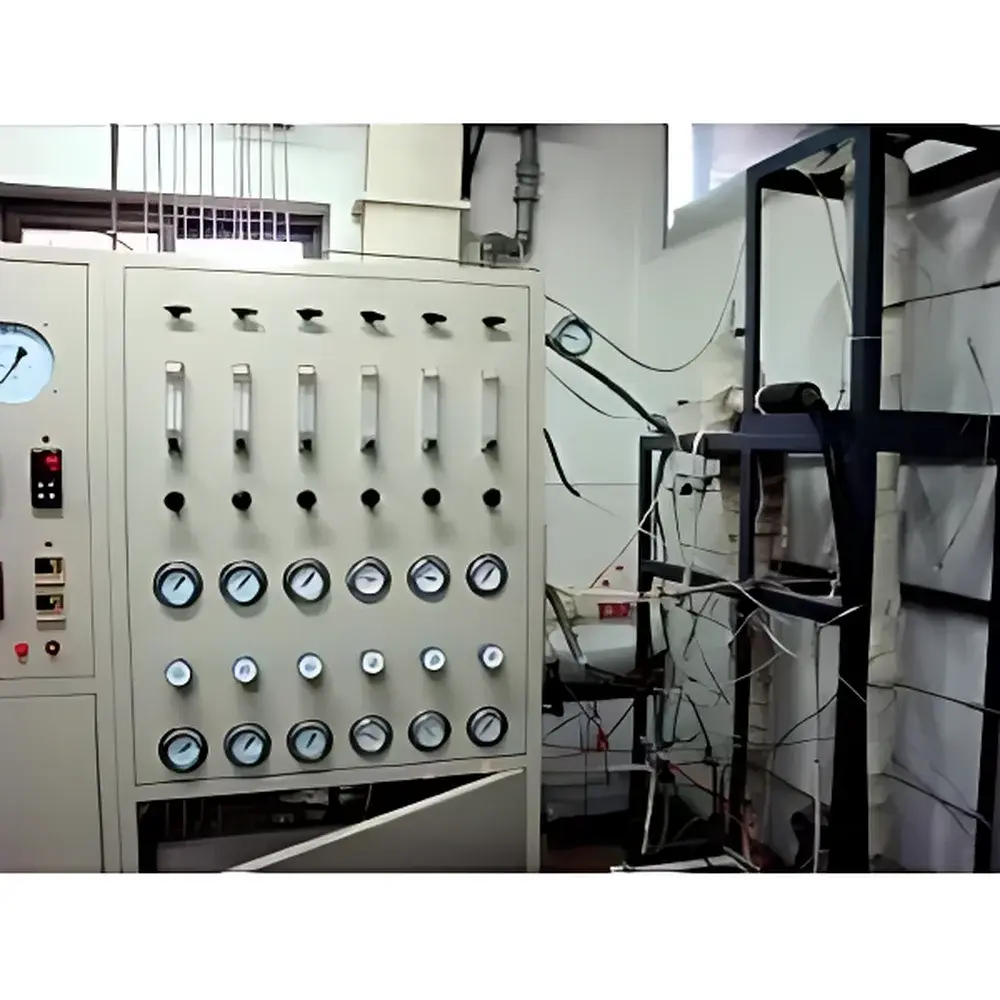
Henven HJCY 100mL Diesel Hydrogenation Catalyst Evaluation System
| Brand | Henven |
|---|---|
| Origin | Beijing, China |
| Manufacturer Type | Direct Manufacturer |
| Model | HJCY |
| Temperature Control | 6 independent linear ramp/hold segments up to 550 °C |
| Temperature Accuracy | ±0.1 °C |
| Pressure Rating | 10 MPa |
| Gas Flow Range | 0–20 L/min, Accuracy: ±0.1% FS |
| Liquid Flow Range | 0–20 mL/min, Accuracy: ±0.1 mL/min |
| Catalyst Loading Capacity | Up to 100 mL (customizable) |
| Control Interface | Integrated industrial-grade LCD touchscreen with仁迈 (Renmai) fluidized-bed control firmware |
| Structural Frame | Heavy-duty 316 stainless steel modular frame |
| Compliance | Designed for ISO/IEC 17025-compliant lab environments |
Overview
The Henven HJCY 100mL Diesel Hydrogenation Catalyst Evaluation System is a purpose-built parallel-reactor platform engineered for rigorous comparative assessment of hydroprocessing catalysts under controlled, reproducible conditions. It operates on the principle of simultaneous dual-reactor evaluation—where one reactor houses a reference (standard) catalyst and the other a candidate (test) catalyst—enabling direct, side-by-side performance benchmarking under identical thermal, pressure, and mass-flow profiles. This architecture eliminates inter-run variability inherent in sequential testing and satisfies the fundamental requirement of ASTM D3226 and ISO 10724-1 for catalyst activity and deactivation studies. The system integrates precision thermal management, high-fidelity fluid delivery, and real-time process monitoring to support kinetic modeling, stability screening, and sulfur/nitrogen removal efficiency quantification in diesel-range feedstocks.
Key Features
- Parallel dual-reactor configuration with fully independent yet synchronized temperature, pressure, and flow control—ensuring true experimental equivalence between reference and test catalysts.
- Six-segment programmable linear temperature ramping and extended-duration isothermal operation (up to 550 °C), with thermal uniformity maintained at ±0.1 °C across each reaction zone.
- High-integrity pressure containment rated to 10 MPa, validated per ASME BPVC Section VIII Division 1 design standards; includes redundant pressure transducers and fast-acting safety relief valves.
- Gas flow control via mass flow controllers (MFCs) calibrated to ±0.1% full scale; liquid feed delivered by precision syringe pumps with ±0.1 mL/min resolution and pulse-dampened output.
- Integrated Renmai fluidized-bed control firmware enabling automated response to sensor feedback—including dynamic adjustment of gas velocity, bed temperature gradients, and differential pressure compensation.
- Industrial-grade 10.1-inch capacitive touchscreen HMI with intuitive parameter mapping, recipe storage (≥500 protocols), and real-time trend visualization of all critical variables (T, P, Fgas, Fliquid, level).
- Dedicated fault detection subsystem continuously monitors 12+ critical points (e.g., heater zone overtemperature, pressure surge, flow deviation); triggers audible/visual alarms and initiates predefined safe-state transitions (e.g., gas shutoff, cooldown ramp).
Sample Compatibility & Compliance
The HJCY accommodates solid heterogeneous catalysts in granular, extrudate, or pellet form, with loading volumes adjustable from 0 to 100 mL per reactor—configurable for fixed-bed, trickle-bed, or expanded-bed operation. Compatible feedstocks include straight-run diesel, hydrotreated distillates, model compounds (e.g., dibenzothiophene, quinoline), and synthetic blends. All wetted parts are constructed from ASTM A240 316 stainless steel with electropolished internal surfaces (Ra ≤ 0.4 µm) to minimize catalytic memory and corrosion. The system meets mechanical and electrical safety requirements per IEC 61000-6-2/6-4 and is designed to operate within laboratories accredited to ISO/IEC 17025. Optional 21 CFR Part 11-compliant electronic record functionality—including user authentication, audit trail generation, and electronic signature support—is available via certified software add-on.
Software & Data Management
Control and data acquisition are managed through embedded Linux-based firmware with deterministic real-time scheduling. Raw sensor data (100 Hz sampling) is timestamped and stored locally on encrypted industrial SSDs with ≥1TB capacity. Export formats include CSV, HDF5, and XML—structured to align with LIMS integration protocols (e.g., ASTM E1578). The system supports OPC UA server deployment for seamless connectivity to enterprise SCADA or MES platforms. All calibration coefficients, maintenance logs, and operational history are retained with immutable metadata, satisfying GLP documentation requirements for regulatory submissions (e.g., EPA Method 3060A, EN 15936).
Applications
- Comparative activity evaluation of NiMo/Al2O3, CoMo/Al2O3, and novel sulfide or noble-metal catalysts for hydrodesulfurization (HDS) and hydrodenitrogenation (HDN).
- Long-term stability and coking resistance testing under accelerated aging conditions (e.g., 100–300 h time-on-stream at 340–380 °C, 5–8 MPa).
- Optimization of H2/oil ratio, LHSV, and temperature staging for maximum heteroatom removal while minimizing saturation and cracking.
- Validation of catalyst regeneration protocols using programmed oxidative treatments followed by in-situ sulfidation.
- Academic and industrial R&D for next-generation low-pressure, low-hydrogen-consumption diesel upgrading processes.
FAQ
Can the HJCY system be configured for single-reactor operation?
Yes—the dual-reactor manifold includes isolated isolation valves, allowing either reactor to operate independently while maintaining full control fidelity.
Is remote monitoring supported?
Standard Ethernet (RJ45) and optional 4G/LTE modules enable secure remote access via TLS-encrypted web interface or VNC client, with configurable role-based permissions.
What maintenance intervals are recommended for the fluid handling system?
Gas MFCs require annual NIST-traceable recalibration; liquid pump seals and check valves should be inspected every 500 operational hours or per feedstock corrosivity profile.
Does the system comply with explosion-proof requirements for hydrogen service?
The base configuration meets Class I, Division 2, Group B/C/D (NEC/CEC) requirements; ATEX Zone 1 or IECEx-certified variants are available upon request with intrinsically safe instrumentation.
Can catalyst beds be characterized in situ using online GC or MS?
Yes—the system provides standardized ¼” Swagelok ports with heated transfer lines (up to 250 °C) for integration with third-party analyzers; GC interface kits with split/splitless injectors and cold traps are offered as accessories.



