
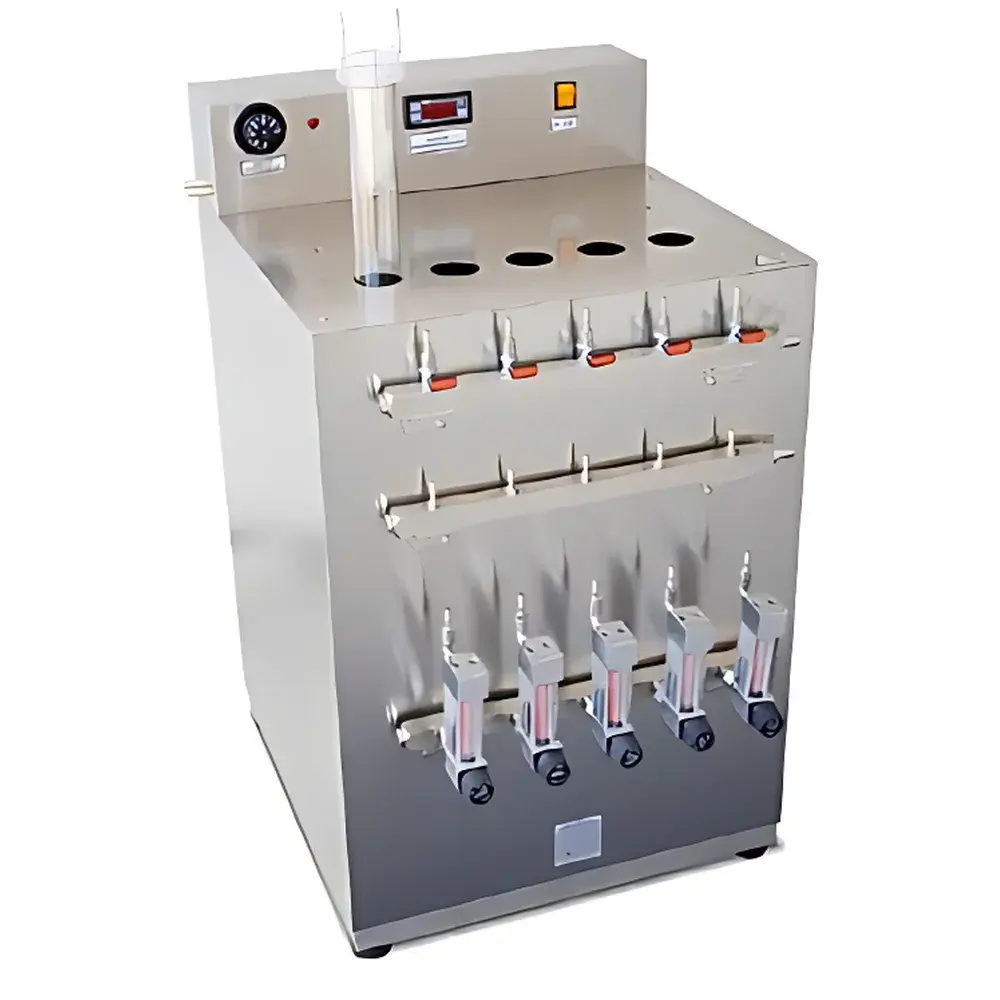
English Product Name
| Origin | Switzerland |
|---|---|
| Manufacturer Type | Authorized Distributor |
| Origin Category | Imported |
| Model | D2274 |
| Pricing | Available Upon Request |
Overview
The Swiss-made D2274 Distillate Fuel Oxidation Stability Tester is a precision-engineered benchtop instrument designed for accelerated oxidation testing of petroleum-based distillate fuels and inert mineral oils under strictly controlled thermal, oxidative, and catalytic conditions. It operates on the fundamental principle of forced-air oxidation—exposing samples to elevated temperature (95 °C for distillates per ASTM D2274/IP 388), continuous oxygen flow (50 mL/min per sample), and defined metal-catalyst exposure (copper and iron) to simulate long-term aging in service environments. The system enables quantitative assessment of inherent oxidative resistance by measuring insoluble sludge formation, acid number increase, and viscosity change following standardized exposure durations. Its architecture conforms to the thermodynamic and mass-transfer requirements of ASTM D2274 (distillate fuels), ASTM D943/DIN 51587/ISO 4263 (turbine and hydraulic oils), and ASTM D4310 (sludge and corrosion tendency evaluation), making it suitable for R&D laboratories, refinery QC departments, and third-party testing facilities requiring GLP-compliant reproducibility.
Key Features
- Stainless steel dual-walled insulated chamber with corrosion-resistant 316-grade construction, ensuring thermal uniformity and long-term chemical resistance to acidic oxidation byproducts.
- Five independent sample stations, each equipped with dedicated oxygen flow control via calibrated rotameters (50 mL/min ±2% accuracy), enabling parallel testing with statistical robustness.
- Integrated motor-driven stirrer assembly maintaining consistent laminar mixing across all samples—critical for replicating convective oxidation kinetics specified in ASTM protocols.
- Dual-layer sample support rack engineered for precise vertical alignment of oxidation tubes (e.g., LAB-101-921), minimizing thermal gradient effects between upper and lower sample zones.
- Dedicated water-cooled condensation system with inlet/outlet manifolds and flexible tubing, facilitating efficient vapor reflux management during extended 168-hour D2274 tests.
- Modular design supporting method-specific accessory integration—including optional heating units (LT/HD-1280/S6), analytical balances (LT/B-2470/BCA200), and drying ovens (LT/DO-24800/F/50S)—without hardware modification.
Sample Compatibility & Compliance
The D2274 tester accommodates a broad range of hydrocarbon-based fluids including middle-distillate fuels (diesel, jet fuel), steam turbine oils, anti-wear hydraulic fluids, and heat-transfer oils with specific gravity <1.0 and additive packages containing rust and oxidation inhibitors. All operational parameters—including temperature setpoint stability (±0.5 °C at 95 °C), oxygen flow consistency, and catalyst surface area exposure—are validated against ASTM D2274 Annex A1, IP 388 Clause 6.2, and ISO 4263:2017 Annex B. The system supports full traceability for regulatory submissions under FDA 21 CFR Part 11 when paired with compliant data acquisition software, and meets mechanical safety requirements per IEC 61010-1 for laboratory electrical equipment. Routine calibration verification follows ASTM D975 Appendix X1 guidelines for oxidation test apparatus.
Software & Data Management
While the base D2274 unit operates as a stand-alone hardware platform, it is fully compatible with optional PC-based data logging modules that record real-time temperature, oxygen flow rate, and test duration per channel. Raw data exports to CSV or Excel formats support post-test analysis per ASTM D2274 Section 11 calculation procedures—including sludge mass determination (via gravimetric filtration using LAB-102-174/A/B/C components), acid number titration (ASTM D974), and kinematic viscosity shift (ASTM D445). Audit trails, user access controls, and electronic signature capability are available through validated LIMS integrations, satisfying GLP and GMP documentation requirements for ISO/IEC 17025-accredited laboratories.
Applications
- Quality assurance of diesel and aviation turbine fuels prior to distribution, verifying compliance with EN 590, ASTM D975, and DEF STAN 91-91 specifications.
- Formulation development of antioxidant packages in industrial lubricants, quantifying synergistic effects of hindered phenols and amines under D943-type conditions.
- Failure analysis of in-service turbine oils exhibiting varnish deposition, correlating D4310 sludge yield with field-reported filter plugging incidents.
- Regulatory conformance testing for biodiesel blends (B5–B20), where oxidative instability remains a critical performance bottleneck per ASTM D7462.
- Accelerated aging studies supporting remaining useful life (RUL) modeling for power generation assets operating under high-temperature cyclic duty.
FAQ
Does the D2274 system include consumables such as oxidation tubes or silicone oil?
No—consumables including LAB-101-921 oxidation tubes, LAB-100-371/50 silicone oil (25 L), and LAB-101-441/P silicon carbide paper are supplied separately to accommodate lab-specific usage patterns and shelf-life management.
Can the instrument perform ASTM D943 and D4310 tests simultaneously with D2274?
Yes—the five-channel architecture allows concurrent execution of different methods across stations, provided appropriate accessories (e.g., copper catalyst strips for D943, iron chips for D4310) are installed and temperature/oxygen profiles are configured per standard requirements.
Is third-party calibration certification available?
Yes—certified calibration reports traceable to NIST standards are provided upon request, covering temperature sensors, flow meters, and timer modules in accordance with ISO/IEC 17025 Clause 6.5.
What maintenance intervals are recommended for the oxygen flow system?
Rotameter calibration and tubing inspection are recommended every 200 operational hours or semiannually, whichever occurs first, to maintain flow accuracy within ASTM D2274 tolerance limits.
How is thermal uniformity verified across the five sample positions?
Uniformity validation is performed using five calibrated PT100 probes placed at identical radial and axial coordinates; maximum deviation must not exceed ±0.5 °C at 95 °C per ASTM D2274 Section 7.2.







