
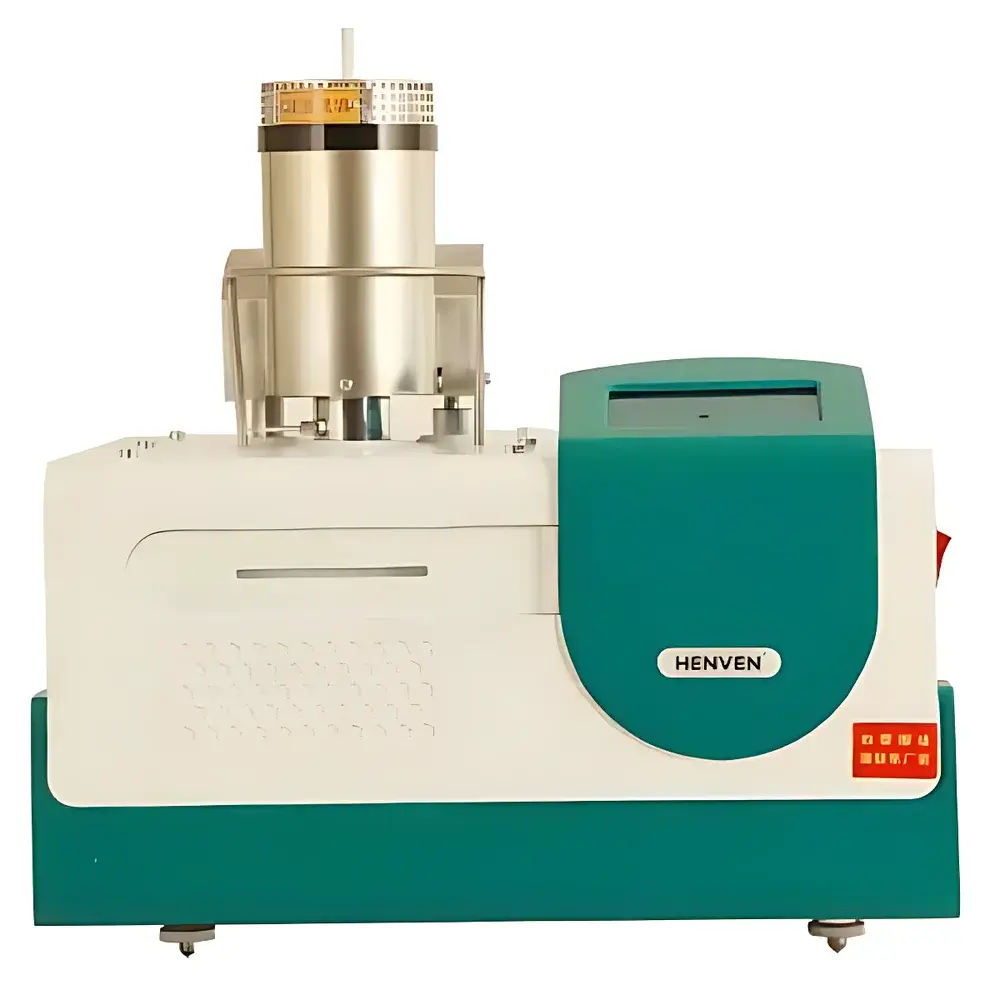
Henven HCT-1 Simultaneous Thermal Analyzer
| Brand | Henven |
|---|---|
| Origin | Beijing, China |
| Manufacturer Type | Direct Manufacturer |
| Model | HCT-1 |
| Price Range | USD 12,500 – 18,000 (FOB Beijing) |
| Temperature Range | Ambient to 1150 °C |
| Heating Rate | 0.1–100 °C/min (user-definable) |
| Temperature Stability | ±0.1 °C |
| Maximum Sample Mass | 5 g |
| Atmosphere Control | Dual-channel mass flow controller (MFC) |
Overview
The Henven HCT-1 Simultaneous Thermal Analyzer is an integrated thermogravimetric-differential thermal analysis (TG-DTA) instrument engineered for precision measurement of mass change and thermal effects occurring concurrently in a single sample under controlled temperature programs. Based on the principle of simultaneous detection—where a high-sensitivity microbalance and differential thermocouple array operate within a shared furnace environment—the HCT-1 delivers synchronized TG, DTA, and derivative (DTG) signals with high temporal and thermal resolution. Designed for laboratories requiring compliance-ready thermal characterization, it supports method development aligned with ASTM E1131, ISO 11358, and USP residual solvent protocols. Its dual-thermocouple architecture enables independent real-time monitoring of furnace temperature (always active) and sample temperature (during heating), ensuring traceable thermal calibration and robust baseline stability across extended runs up to 72 hours at isothermal conditions.
Key Features
- High-stability furnace with ±0.1 °C temperature control accuracy over ambient to 1150 °C, validated via NIST-traceable reference materials (e.g., Ni, Al, In, Zn)
- Dual-channel mass flow controller (MFC) for precise, automated switching between inert (N₂, Ar), oxidizing (air, O₂), or reactive atmospheres; optional chemically resistant MFC modules available for aggressive gases (HF, Cl₂, SO₂)
- Microbalance with 0.1 μg resolution and <0.1 μg RMS noise, supporting sample masses from 1 mg to 5 g via interchangeable support rods and crucible holders
- Thermocouple-based DTA sensor with 0.01 μV resolution and ±10 μV to ±2000 μV dynamic range—no auto-ranging required
- Integrated 7-inch LCD interface displaying real-time furnace temperature, sample temperature, mass, gas flow status, and alarm states
- Modular auxiliary interfaces: optional heated transfer line (up to 200 °C), GC/MS coupling port, and vacuum connection (base pressure 2.5×10⁻² Pa with external pump)
Sample Compatibility & Compliance
The HCT-1 accommodates a broad spectrum of solid and powder samples—including polymers, pharmaceuticals, catalysts, ceramics, battery electrode materials, and geological specimens—using standard alumina (0.06 mL or 0.12 mL), aluminum, quartz, graphite, or platinum crucibles. All crucible options are pre-characterized for thermal inertia and baseline reproducibility. The system supports GLP/GMP-aligned workflows: audit trail logging, user-access controls, electronic signatures (via optional software module), and full 21 CFR Part 11 compliance readiness. Calibration routines for temperature, mass, and energy are performed using certified standards (e.g., indium for melting point, calcium oxalate monohydrate for multi-step decomposition), with documented uncertainty budgets traceable to national metrology institutes.
Software & Data Management
The proprietary Henven TA-Studio software provides comprehensive data acquisition and post-processing capabilities. It supports real-time signal capture at up to 10 Hz sampling rate, automatic scaling, and on-the-fly baseline correction. Built-in algorithms enable quantitative analysis including: peak integration (DTA/DSC enthalpy), kinetic modeling (Ozawa-Flynn-Wall, Kissinger, Friedman), glass transition determination (Tg onset/midpoint), specific heat calculation (via comparative method), and oxidation induction time (OIT) per ASTM D3895. Users may define custom calculation formulas via embedded scripting; Henven’s engineering team provides validated software extensions upon request. All data files are stored in vendor-neutral ASCII format with metadata headers, ensuring long-term archival integrity and third-party interoperability.
Applications
- Thermal stability assessment of active pharmaceutical ingredients (APIs) and excipients under ICH Q1A(R2) stress conditions
- Decomposition kinetics of metal-organic frameworks (MOFs) and battery cathode materials (e.g., NMC, LFP)
- Quantification of filler content, moisture, and volatiles in polymer composites per ISO 3451
- Phase transition mapping in shape-memory alloys and ferroelectric ceramics
- Reaction calorimetry for catalytic coke formation studies in petrochemical feedstocks
- Residue analysis in food packaging films and environmental microplastic screening
FAQ
What calibration standards are recommended for routine verification?
NIST-traceable indium (156.6 °C), zinc (419.5 °C), and aluminum (660.3 °C) for temperature; calcium oxalate monohydrate for TG step calibration.
Can the HCT-1 be operated under vacuum without external pumping?
No—the base vacuum seal is passive; achieving 2.5×10⁻² Pa requires connection to an external two-stage rotary vane pump.
Is DSC mode supported natively?
The HCT-1 is configured as a TG-DTA platform; DSC functionality requires optional heat-flux sensor upgrade and corresponding software license.
How is atmosphere purity maintained during reactive gas experiments?
Dual MFC channels include inline particulate filters, stainless-steel wetted parts, and optional Hastelloy-C276 gas lines for halogenated or sulfur-bearing environments.
Does the system support automated sample changers?
Not standard; however, the mechanical design allows third-party autosampler integration via RS-485 and dry-contact I/O ports.



