
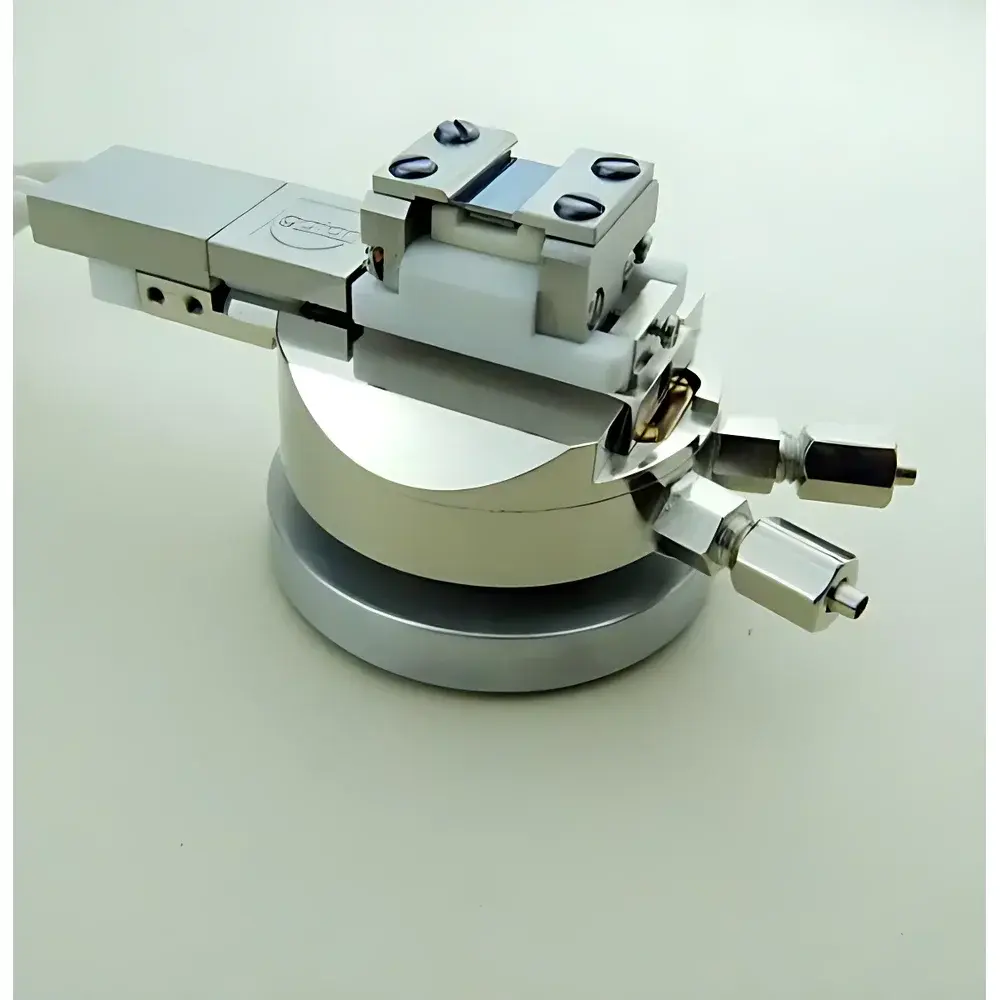
Gatan Murano 525 In-Situ Heating Stage
| Brand | Gatan |
|---|---|
| Origin | USA |
| Model | Murano 525 |
| Temperature Range | Ambient to 950 °C |
| Max Sample Size | 9 mm × 4.5 mm × 1.5 mm (with thermal shield) |
| Heating/Cooling Rate | >100 °C/min |
| Temperature Stability | ±0.5 °C |
| Temperature Control Accuracy | ±0.5 °C |
| Working Distance | 10 mm (with shield), 12.5 mm (without shield) |
Overview
The Gatan Murano 525 In-Situ Heating Stage is an engineered solution for high-precision, real-time structural and phase evolution studies inside scanning electron microscopes (SEM). Designed around the principles of controlled resistive heating and thermally isolated sample positioning, the Murano 525 enables dynamic observation of solid-state transformations—including phase transitions, recrystallization, grain growth, oxidation kinetics, and interfacial reactions—under vacuum-compatible conditions. Its integration into SEM workflows supports both secondary electron (SE) imaging and electron backscatter diffraction (EBSD), maintaining optimal geometry for high-resolution crystallographic mapping even at elevated temperatures. The stage operates from ambient up to 950 °C with sub-degree thermal stability, making it suitable for quantitative metallurgical analysis, catalytic surface science, and functional material degradation studies where temporal and spatial resolution are critical.
Key Features
- Compact, modular design compatible with standard SEM sample holders and multi-axis tilt stages—enabling seamless insertion and removal in under three minutes without tooling.
- Integrated water-cooled base and replaceable radiation shielding minimize heat transfer to the objective lens and chamber components, preserving SEM optical performance and detector sensitivity during prolonged high-temperature operation.
- Dual-mode temperature control (PID auto-tuning and manual setpoint override) via a dedicated PC-based software interface; all heating profiles—including ramp rates, dwell times, and cooling sequences—are programmable and timestamped.
- Gas injection capability through an optional side-mounted capillary port, allowing localized reactive environments (e.g., H₂, O₂, CO, or inert mixtures) for in-situ catalysis, reduction, or oxidation experiments.
- Electron-optical optimization: integrated bias circuitry discriminates thermally emitted electrons from secondary electrons, significantly enhancing signal-to-noise ratio and contrast fidelity above 600 °C.
- EBSD-ready geometry: maintains ≥70° tilt angle and stable working distance (10 mm with shield, 12.5 mm without) to ensure consistent pattern quality and indexing reliability across the full temperature range.
Sample Compatibility & Compliance
The Murano 525 accommodates flat, conductive, or coated specimens up to 9 mm × 4.5 mm × 1.5 mm (with thermal shield) or 3 mm thick (without shield). It supports standard SEM stub mounting (e.g., aluminum or copper pin stubs) and is compatible with carbon tape, silver paint, and conductive epoxy fixation methods. The stage meets ISO 14644-1 Class 5 cleanroom handling requirements for installation and maintenance. All firmware and control software comply with IEC 62304 for medical device software lifecycle management and support audit trails required under GLP and GMP environments. Temperature logging adheres to FDA 21 CFR Part 11 electronic record integrity standards when used with validated acquisition systems (e.g., Oxford Instruments AZtec or EDAX TEAM™).
Software & Data Management
The Murano 525 is operated via Gatan’s proprietary Murano Control Software, a Windows-based application that provides synchronized temperature logging at 100 Hz resolution. The software exports calibrated time–temperature datasets in CSV and HDF5 formats, enabling direct import into MATLAB, Python (NumPy/Pandas), or Thermo-Calc for kinetic modeling. Real-time temperature overlays can be embedded into EBSD map metadata using vendor-neutral .ctf or .ang file headers. Optional API integration allows third-party scripting (Python, LabVIEW) for automated experiment sequencing—such as triggering EBSD acquisition at predefined isothermal holds or initiating cooling ramps upon phase boundary detection.
Applications
- Metallurgy & Alloy Development: In-situ tracking of austenite–ferrite transformation kinetics, precipitate coarsening, and creep-induced dislocation dynamics in steels, Ni-based superalloys, and Ti-aluminides.
- Geosciences & Petrology: Observation of fluid inclusion homogenization, mineral dehydration reactions, and melt–solid interface migration in silicate systems under controlled thermal gradients.
- Semiconductor & Device Physics: Thermal stability assessment of gate oxides, intermetallic formation at Cu/Al interfaces, and dopant diffusion front propagation in SiC and GaN heterostructures.
- Energy Materials: Solid–electrolyte interphase (SEI) evolution in Li-ion battery cathodes, oxygen vacancy migration in SOFC electrolytes, and thermal runaway initiation pathways in layered oxide cathodes.
- Soft Matter & Polymers: Crystallinity development in block copolymers, liquid crystal director reorientation, and glass transition mapping via thermal strain-induced contrast modulation.
FAQ
Is the Murano 525 compatible with field-emission SEMs (FE-SEM)?
Yes—the stage is fully compatible with FE-SEM platforms operating at accelerating voltages from 1 kV to 30 kV, provided the chamber pressure remains ≤1×10⁻⁴ Pa during heating.
Can temperature data be synchronized with EBSD acquisition in real time?
Yes—via the Murano Control Software’s trigger output and TTL handshake protocol, temperature setpoints and actual readings are embedded into each EBSD map’s metadata header.
What is the maximum allowable thermal drift during EBSD mapping at 800 °C?
Drift is typically <0.5 µm/min under optimized vacuum and shielding conditions; this is within acceptable limits for high-fidelity grain boundary reconstruction and misorientation analysis.
Does the system support vacuum-compatible gas dosing for in-situ reaction studies?
Yes—an optional stainless-steel capillary assembly enables precise, localized gas delivery (<1 sccm resolution) adjacent to the sample surface, with flow regulated via UHV-rated needle valves mounted directly on the stage flange.
How is calibration traceability maintained for temperature measurements?
Each Murano 525 unit ships with NIST-traceable calibration certificates for its integrated Pt100 sensor and associated electronics, verified at five points between 100 °C and 950 °C using a primary-standard blackbody furnace.



