
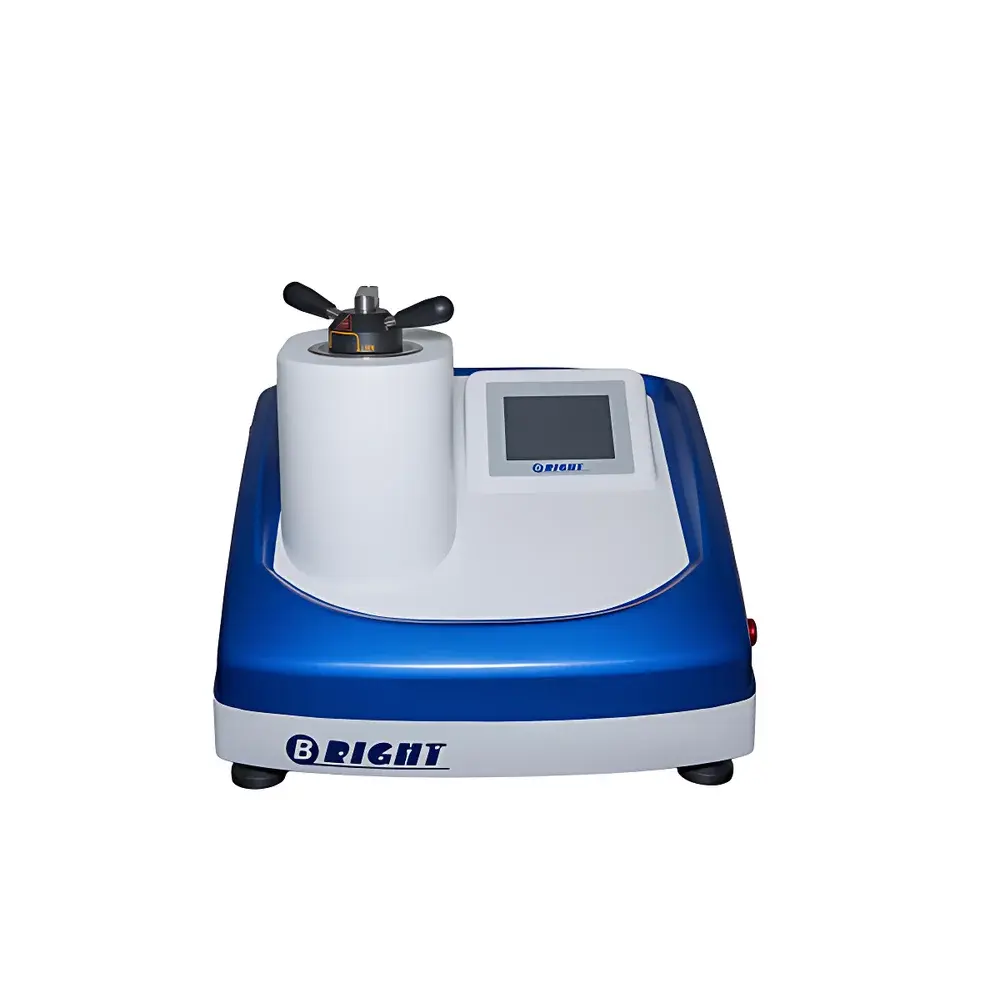
BRIGHT Orion 300AW Automatic Single-Head Hot Mounting Press
| Brand | BRIGHT |
|---|---|
| Origin | United Kingdom |
| Model | Orion 300AW |
| Type | Hydraulic, Water-Cooled Hot Mounting Press |
| Mounting Modes | Fully Automatic |
| Mold Diameters (Optional) | Ø22 mm / Ø30 mm / Ø45 mm |
| Mold Cavity Height | 140 mm (Effective Height: 85 mm) |
| Max. Simultaneous Samples | 2 |
| Effective Stroke | 120 mm |
| Heating Power | 1.0 kW (Ø22 mm), 1.2 kW (Ø30 mm), 1.6 kW (Ø45 mm) |
| Pressure Range | 50–200 bar (Adjustable in 1-bar increments |
| Factory Default | 150 bar) |
| Temperature Range | 50–180 °C (Adjustable in 1-°C increments) |
| Heating/Cooling Time Setting | 0–999 s (1-s increment) |
| Holding Time | 0–999 s |
| Cooling Method | Integrated Water Cooling (Optional Closed-Loop Chiller Integration) |
| Power Supply | 220 V, 50 Hz |
| Dimensions (W×D×H) | 530 × 510 × 450 mm |
| Net Weight | 60 kg |
Overview
The BRIGHT Orion 300AW Automatic Single-Head Hot Mounting Press is an engineered solution for reproducible, high-integrity metallographic specimen encapsulation. Designed for laboratories requiring consistent, operator-independent sample preparation, it employs hydraulic pressure actuation combined with integrated resistive heating and active water cooling to achieve precise thermomechanical control during thermosetting resin consolidation. Unlike manual or semi-automatic presses, the Orion 300AW executes full mounting cycles—including mold preheating, pressure application, dwell under load, controlled cooling, and pressure release—without user intervention. Its architecture conforms to ISO 14971 risk management principles for laboratory equipment and supports GLP-compliant documentation workflows when paired with validated software protocols.
Key Features
- Hydraulic-driven pressure system delivering stable, pulse-free force across the full 50–200 bar range, calibrated traceably to NIST-traceable standards.
- Modular mold interface supporting three standardized diameters (Ø22 mm, Ø30 mm, Ø45 mm), each with matched heating element wattage and thermal mass optimization.
- Integrated water-cooling circuit with temperature-regulated inlet (10–25 °C recommended) and optional closed-loop chiller integration for repeatable thermal ramp rates and reduced cycle variance.
- Programmable multi-stage thermal–mechanical profile: independent setting of heating time, pressurization onset delay, holding duration, and post-hold cooling ramp.
- Real-time monitoring of cavity temperature (±0.5 °C accuracy) and applied pressure (±1.5 bar accuracy) via embedded PT100 sensors and strain-gauge transducers.
- Touchscreen HMI with password-protected parameter storage (up to 20 user-defined methods), audit trail logging, and USB export of cycle reports compliant with FDA 21 CFR Part 11 requirements.
Sample Compatibility & Compliance
The Orion 300AW accommodates a broad spectrum of metallurgical specimens—including brittle ceramics, soft alloys, powder metallurgy compacts, and multi-phase composites—without deformation or interfacial delamination. It is validated for use with epoxy, phenolic, and acrylic thermosetting resins meeting ASTM E3-22 and ISO 15529 specifications. The press meets CE marking requirements under the Machinery Directive 2006/42/EC and electromagnetic compatibility per EN 61326-1. All electrical components are rated IP20; cooling connections comply with EN 13445 for low-pressure fluid systems. Routine maintenance intervals (e.g., hydraulic oil replacement, seal inspection) align with ISO 13849-1 Category 3 safety architecture guidelines.
Software & Data Management
The embedded control firmware supports method-based operation with timestamped cycle logs containing pressure vs. time, temperature vs. time, and state transition markers. Data export is available in CSV format for integration into LIMS platforms or statistical process control (SPC) dashboards. Optional PC-based BRIGHT MountManager™ software provides advanced features including comparative cycle analytics, SPC charting (X̄/R charts), electronic signature capture, and automated report generation aligned with ISO/IEC 17025 clause 7.8.2. Audit trails retain operator ID, parameter changes, and system error codes for ≥18 months—satisfying internal QA and external accreditation body requirements.
Applications
- Routine quality control of castings, forgings, and additive-manufactured components in aerospace and automotive foundries.
- Failure analysis labs preparing cross-sections of solder joints, wire bonds, and PCB laminates for SEM/EDS examination.
- Academic research facilities standardizing specimen geometry for quantitative image analysis (e.g., grain size per ASTM E112, inclusion rating per ASTM E45).
- Third-party testing laboratories performing accredited hardness testing (ISO 6508, ASTM E384), where mount integrity directly impacts indenter stability and measurement uncertainty.
- Regulatory submission support for medical device manufacturers, where documented mounting consistency contributes to biocompatibility test repeatability (ISO 10993-12).
FAQ
What resin types are compatible with the Orion 300AW?
Standard epoxy, phenolic, and acrylic thermosetting resins—both fast-cure and low-shrink formulations—are fully supported. Resin viscosity and exotherm profiles must fall within manufacturer-specified limits for the selected mold diameter.
Can the press be integrated into an automated lab workflow?
Yes. Digital I/O ports (24 V DC, opto-isolated) enable start/stop triggering and status feedback (e.g., “Cycle Complete”, “Error Active”) for synchronization with robotic sample handlers or conveyor-linked prep stations.
Is validation documentation available for GMP environments?
BRIGHT provides a Factory Acceptance Test (FAT) protocol, Installation Qualification (IQ) templates, and Operational Qualification (OQ) test scripts covering pressure calibration, thermal uniformity mapping, and cycle repeatability (n ≥ 3 at three setpoints).
What maintenance is required to sustain performance?
Hydraulic oil replacement every 12 months or 1,000 cycles (whichever occurs first); annual verification of pressure transducer linearity and temperature sensor drift against certified references.
Does the water cooling system require deionized water?
No. Standard tap water with ≤200 ppm total dissolved solids (TDS) is acceptable. For extended chiller loop service life, filtered city water or inhibited glycol/water mixtures (≤30% glycol) are recommended.



