
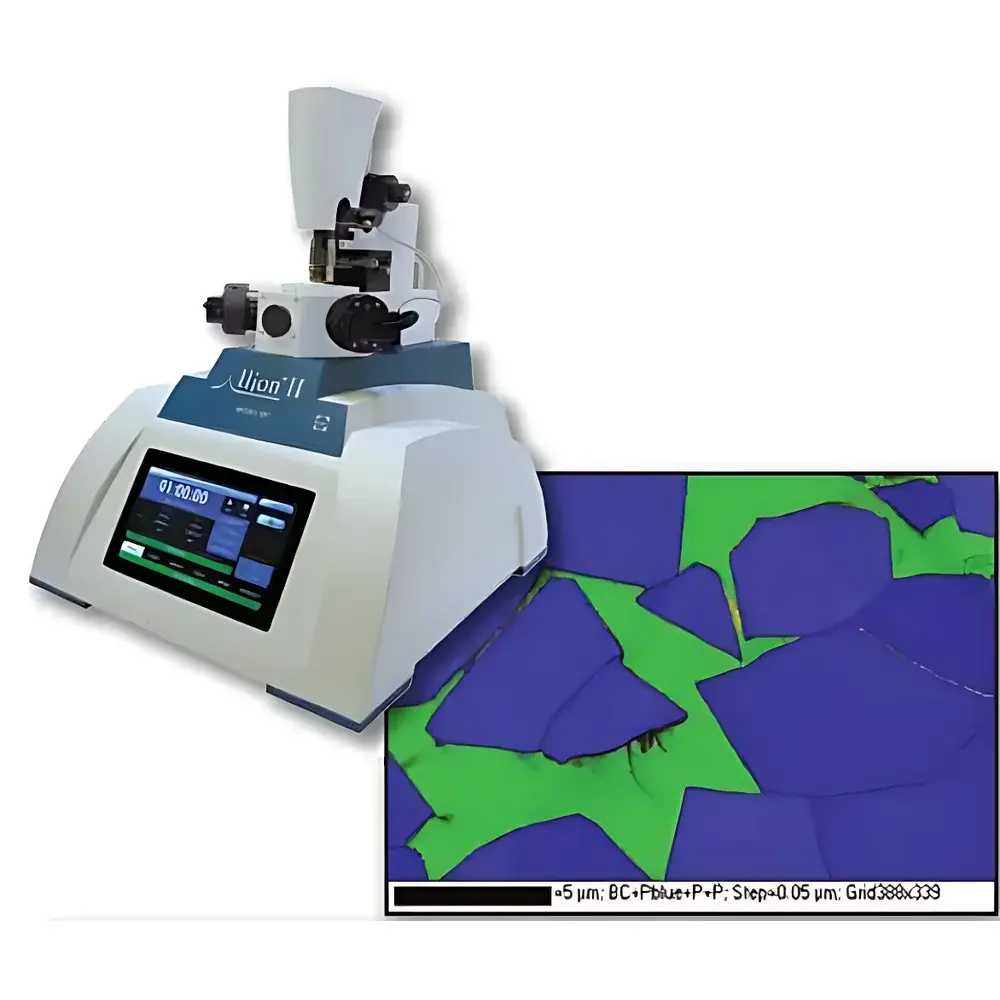
Gatan 697 Ilion II Broad-Beam Argon Ion Polishing System
| Brand | Gatan |
|---|---|
| Origin | USA |
| Model | 697 Ilion II |
| Ion Gun Type | Dual Penning-type with Triode (Cathode/Anode/Focusing Electrode) Construction |
| Beam Energy Range | 100 eV – 8 keV |
| Beam Current Control | 0–100 mA per gun via Mass Flow Controller |
| Beam Angle Adjustment | ±10° per gun, 0.1° incremental resolution |
| 扇形抛光角 | ��Sector Polish Angle): Programmable 10°–90° |
| Polishing Rate | Up to 300 µm/h (on Si at 8 keV) |
| Vacuum Base Pressure | 5×10⁻⁶ Torr |
| Operating Pressure | 8.5×10⁻⁵ Torr |
| Pumping System | 80 L/s Turbo-Molecular Pump + Dual-Stage Diaphragm Pump |
| Sample Stage Rotation | 0.5–6 rpm, continuously adjustable |
| Cryogenic Stage | Liquid Nitrogen-cooled, down to −120 °C |
| Integrated Imaging | Digital Zoom Microscope (300×–2200×), real-time acquisition via Gatan DigitalMicrograph® software |
| Sample Exchange Time | < 60 s via WhisperLock™ pneumatic airlock |
| Ion Source Lifetime | > 30,000 hours, maintenance-free operation |
Overview
The Gatan 697 Ilion II Broad-Beam Argon Ion Polishing System is an advanced, benchtop sample preparation instrument engineered for high-fidelity cross-sectional and planar polishing of diverse solid-state materials prior to electron microscopy analysis. It operates on the principle of physical sputtering: accelerated argon ions impinge upon a solid sample surface at controlled energy and incidence angle, removing material through momentum transfer without inducing thermal or chemical alteration. Unlike focused ion beam (FIB) systems, the Ilion II employs two independently steerable, low-energy, broad-beam Penning ion sources—enabling uniform, artifact-minimized removal over mm-scale areas. This makes it particularly suited for preparing large-area, damage-sensitive specimens required for scanning electron microscopy (SEM), electron backscatter diffraction (EBSD), and energy-dispersive X-ray spectroscopy (EDS) applications. Its design emphasizes reproducibility, vacuum integrity, and operator efficiency—critical attributes in regulated research environments where sample-to-sample consistency and traceability are essential.
Key Features
- Dual triode-configuration Penning ion guns with rare-earth permanent magnets, delivering stable, low-divergence beams across the full 100 eV–8 keV energy range.
- Independent, motorized beam alignment per gun with ±10° angular adjustment (0.1° resolution), enabling precise control of incidence geometry for optimal surface finish and subsurface damage reduction.
- Programmable sector polishing mode: fan-shaped beam profile with user-defined angular width (10°–90°), facilitating selective exposure of interfaces, grain boundaries, or layered structures.
- Gatan-patented WhisperLock™ pneumatic airlock system allows full sample exchange in under 60 seconds without venting the main chamber—preserving ultra-high vacuum (UHV) conditions and minimizing contamination risk.
- Integrated 10-inch color touchscreen interface running embedded control firmware; supports full parameter programming, real-time process monitoring, and recipe-based operation with audit-trail-capable parameter logging.
- Liquid nitrogen cryostage capable of stabilizing samples at temperatures as low as −120 °C, significantly suppressing ion-induced amorphization, preferential sputtering, and thermal diffusion in beam-sensitive materials (e.g., polymers, battery cathodes, biological composites).
- Vacuum architecture combining an 80 L/s turbo-molecular pump and dual-stage diaphragm pump achieves a base pressure of 5×10⁻⁶ Torr and operational stability at 8.5×10⁻⁵ Torr—ensuring minimal hydrocarbon adsorption and consistent sputter yield.
- Digital zoom optical microscope (300×–2200× magnification) with real-time image capture and annotation via Gatan DigitalMicrograph® software, enabling in situ assessment of polishing progress and endpoint detection.
Sample Compatibility & Compliance
The Ilion II accommodates a broad spectrum of inorganic and organic materials—including multiphase alloys, ceramic composites, geological specimens, semiconductor heterostructures, thin-film stacks, polymer blends, and metallized textiles—without requiring conductive coating or embedding. Its gentle, low-energy ion beam minimizes curtaining, edge rounding, and preferential sputtering in heterogeneous samples. The system complies with internationally recognized laboratory infrastructure standards: vacuum components meet ISO 10100 (vacuum technology — terminology); electrical safety conforms to UL 61010-1 and IEC 61010-1; and its recipe-driven operation supports GLP/GMP-aligned workflows. While not inherently 21 CFR Part 11-compliant out-of-the-box, the DigitalMicrograph® software platform offers optional electronic signature and audit trail modules suitable for regulated quality control laboratories conducting SEM/EBSD validation per ASTM E112, ISO 13067, or USP .
Software & Data Management
Control and data acquisition are unified within Gatan’s DigitalMicrograph® environment—a mature, C++-based platform widely deployed in academic and industrial electron microscopy labs. The Ilion II’s embedded controller communicates bidirectionally with the host PC, enabling synchronized image capture, parameter logging, and time-stamped metadata tagging (e.g., beam energy, current, angle, duration, stage position). All recipes—including beam configuration, gas flow profiles, rotation speed, and cooling setpoints—are stored as encrypted XML files with version history and user attribution. Raw micrographs and polishing logs can be exported in TIFF, DM3, or HDF5 formats for downstream analysis in MATLAB, Python (via hyperspy), or commercial EBSD indexing suites (e.g., Oxford AZtec, EDAX TEAM™). Optional integration with laboratory information management systems (LIMS) is available via TCP/IP API.
Applications
The Ilion II serves as a cornerstone tool in materials characterization pipelines across multiple sectors. In metallurgy and failure analysis, it prepares weld interfaces, coated substrates, and fatigue fracture surfaces for high-resolution EBSD phase mapping and strain quantification. In geoscience, it reveals unaltered mineral textures and fluid inclusion geometries in shale, basalt, or meteoritic sections. Semiconductor R&D leverages its sector-polish capability to expose interconnect vias, gate oxides, and 3D NAND stack interfaces with nanoscale lateral uniformity. Battery researchers use cryo-polishing to preserve solid-electrolyte interphase (SEI) morphology in Li-ion electrode cross-sections. Photovoltaic labs apply it to cleave CIGS and perovskite thin films without delamination. Additionally, it supports forensic materials analysis, additive manufacturing QA (powder bed fusion interface inspection), and catalysis studies involving supported nanoparticle distributions.
FAQ
What vacuum level is required for stable ion beam operation?
The Ilion II achieves optimal beam stability and sputter yield consistency at a working pressure of 8.5×10⁻⁵ Torr, maintained by its integrated 80 L/s turbo-molecular pump and dual-stage diaphragm backing pump.
Can the system prepare EBSD-ready surfaces from brittle ceramics?
Yes—by combining low-energy beam settings (≤1 keV), cryogenic cooling (−120 °C), and shallow incidence angles (≤5°), the Ilion II produces deformation-free, Kikuchi-pattern-friendly surfaces in alumina, silicon carbide, and yttria-stabilized zirconia.
Is routine maintenance required for the ion sources?
No. The triode Penning guns are sealed, consumable-free units rated for >30,000 hours of continuous operation; no filament replacement, anode cleaning, or internal recalibration is necessary during normal use.
How does sector polishing differ from conventional broad-beam polishing?
Sector polishing restricts ion flux to a defined angular segment (10°–90°) while rotating the sample, enabling controlled, directional exposure of specific features—such as grain boundary networks or multilayer interfaces—without over-polishing adjacent regions.
Does the system support automated endpoint detection?
While not equipped with in-beam spectroscopic sensors, the integrated digital microscope enables visual endpoint identification via real-time contrast changes; users may define custom stopping criteria (e.g., layer visibility threshold) within DigitalMicrograph® scripting routines.




