
Opton AMICS Automated Mineralogical Quantitative Analysis System
| Brand | Opton |
|---|---|
| Origin | Germany |
| Distributor Type | Authorized Distributor |
| Import Status | Imported |
| Model | AMICS |
| Electron Gun | Tungsten Filament |
| Secondary Electron Resolution | 3.0 nm @ 30 kV (SE, W) |
| Magnification Range | 5× – 1,000,000× |
| Accelerating Voltage | 0.2–30 kV |
| Backscattered Electron Resolution | 4.0 nm @ 30 kV (VP with BSD) |
| Minimum Detectable Mineral Grain Size | 1 µm |
| Typical Measurement Time (30 mm diameter sample) | 15 min |
| Mineral Database | >2,000 reference minerals |
| Stage | High-precision 5-axis motorized 9-pin stage |
| EDS Detector Compatibility | Silicon Drift Detector (SDD), liquid-nitrogen-free cryogenic cooling, ultra-fast pulse processing (e.g., Bruker QUANTAX) |
Overview
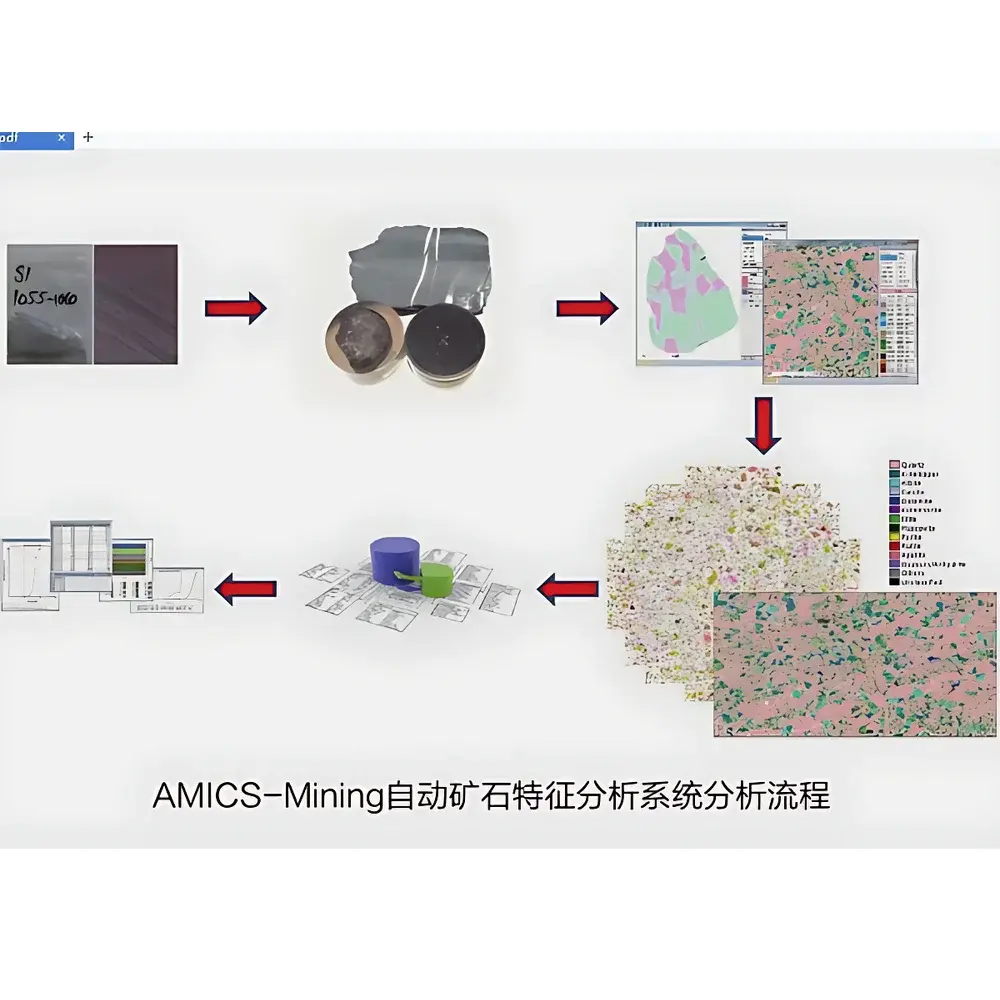
The Opton AMICS Automated Mineralogical Quantitative Analysis System is a fully integrated, SEM-based platform engineered for high-throughput, statistically robust mineralogical characterization of geological and industrial materials. Built upon scanning electron microscopy coupled with energy-dispersive X-ray spectroscopy (SEM-EDS), AMICS implements automated particle-based mineral identification using backscattered electron (BSE) imaging, X-ray spectral acquisition, and multivariate statistical classification. Its core measurement principle relies on pixel-by-pixel elemental quantification followed by phase assignment against a rigorously curated, thermodynamically consistent mineral database — enabling quantitative determination of mineral modal abundance, grain size distribution, liberation degree, association relationships, and textural parameters. Designed specifically for process mineralogy, AMICS delivers traceable, repeatable, and audit-ready data compliant with ISO 14687 (geological materials), ASTM D7695 (mineralogical analysis of ores), and GLP-aligned workflows in resource evaluation, beneficiation engineering, and reservoir characterization.
Key Features
- Third-generation autonomous mineral identification engine eliminating manual library curation or operator-dependent thresholding
- Real-time mineral classification during acquisition — immediate preview of modal composition and particle count
- Advanced image segmentation using adaptive morphological filtering and boundary-aware region growing, optimized for complex intergrowths and fine-grained matrices
- Comprehensive texture analysis suite: liberation index, degree of association, inclusion mapping, porosity-per-mineral, and grain boundary network topology
- Dual-domain reporting: pixel-level phase maps and particle-based statistics with configurable size/shape/chemistry filters
- Built-in support for multi-instrument calibration transfer — seamless integration with field-emission and tungsten-filament SEMs
- Fully bilingual interface (English/Chinese) with role-based access control and audit-trail logging per ASTM E2500 and FDA 21 CFR Part 11 requirements
Sample Compatibility & Compliance
AMICS supports polished sections, grain mounts, thin sections, rock chips, drill cuttings, coal ash residues, tailings, and environmental particulates (e.g., airborne dust, sediment cores). All sample preparation follows ISO 12743 (polished section standards) and ASTM D5777 (rock sample preparation). The system complies with IEC 61000-6-3 (EMC), CE marking for laboratory instrumentation, and meets essential health and safety requirements under Directive 2014/30/EU. Data integrity safeguards include electronic signatures, time-stamped metadata embedding, and immutable result archiving — fulfilling GLP/GMP documentation expectations for regulatory submissions in mining permitting, environmental impact assessments, and reserve estimation reports.
Software & Data Management
The AMICS software architecture employs a modular client-server design with PostgreSQL backend for scalable storage of raw spectra, BSE images, classified particles, and derived metrics. All analytical sessions are version-controlled; every report includes embedded instrument configuration logs, detector performance diagnostics, and uncertainty propagation estimates per ISO/IEC Guide 98-3. Export formats include CSV, HDF5, GeoJSON (for GIS integration), and PDF/A-2b-compliant technical reports. Custom scripting via Python API enables batch reprocessing, machine learning model training on local mineral libraries, and integration with digital twin platforms for mine planning and reservoir simulation workflows.
Applications
- Mining: Ore grade estimation, grind size optimization, flotation circuit modeling, tailings mineralogy for acid rock drainage prediction
- Coal: Ash-forming mineral quantification, maceral-mineral associations, combustion behavior forecasting
- Oil & Gas: Core and cuttings mineralogy for brittleness index, pore-throat geometry correlation, hydraulic fracturing target selection
- Environmental Geoscience: Heavy metal host-phase identification in soils/sediments, asbestos fiber typing, landfill leachate source tracing
- Materials Recycling: Slag phase analysis, battery cathode material recovery assessment, critical raw material sourcing verification
- Academic Research: Petrographic quantification, metamorphic reaction pathway validation, experimental petrology dataset generation
FAQ
What SEM models are compatible with AMICS?
AMICS supports all major tungsten-filament and field-emission SEM platforms with standard EDS interfaces (Bruker, Thermo Fisher, JEOL, Hitachi) and digital BSE output. Integration requires vendor-specific SDK licensing and hardware synchronization modules.
Can AMICS quantify amorphous phases or solid solutions?
AMICS classifies only crystalline reference minerals defined in its database. Amorphous components (e.g., volcanic glass, gels) are reported as “unidentified” or assigned to nearest compositional analogs; quantitative treatment requires complementary XRD or TEM validation.
How is measurement uncertainty reported?
Uncertainty budgets include counting statistics (Poisson), detector dead-time correction, matrix effects (ZAF), and phase identification confidence scores derived from spectral match quality (χ² residuals and peak overlap indices). Full uncertainty propagation is available in advanced reporting mode.
Is cloud-based deployment supported?
On-premise installation is standard. Private-cloud deployment (AWS/Azure VPC) is available under enterprise licensing, subject to data residency and encryption compliance review.
Does AMICS support real-time monitoring of plant feed streams?
While not designed for inline process control, AMICS can be deployed in mobile labs or near-mine facilities with automated sample changers and scheduled acquisition protocols — enabling daily or shift-based mineralogical trending per ISO 17025 QA/QC frameworks.





