
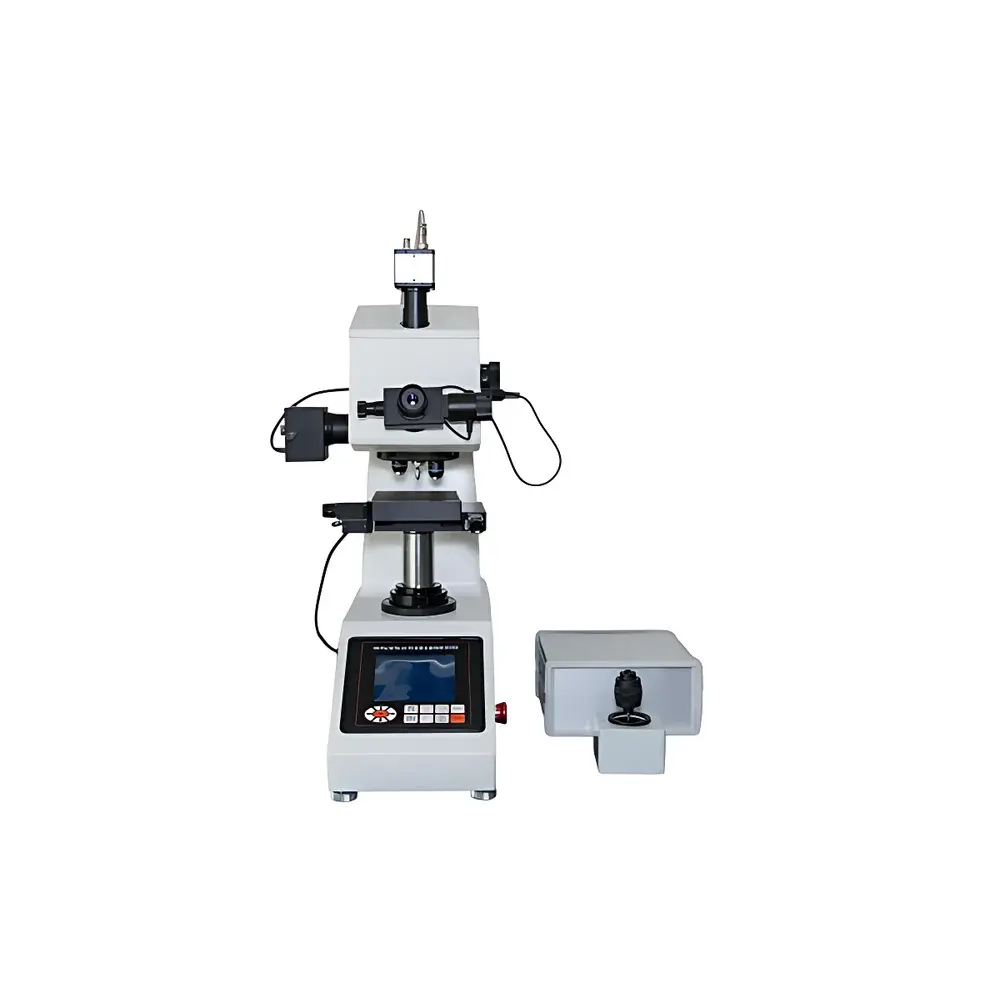
BRIGHT Cratos W50 Fully Automated Digital Microhardness Tester
| Brand | BRIGHT |
|---|---|
| Origin | United Kingdom |
| Manufacturer Type | Authorized Distributor |
| Product Category | Imported Instrument |
| Model | Cratos W50 |
| Instrument Type | Microhardness Tester |
| Test Force Range | 10–1000 gf (0.098–9.80 N) |
| Hardness Range | 1–2967 HV |
| Measurement Mode | HV/HK |
| Loading Method | Closed-Loop Sensor-Controlled Auto-Loading/Holding/Unloading |
| Indentation Imaging | Integrated 1.3 MP CCD Camera with Real-Time Dynamic View |
| X-Y Motorized Stage | 120 × 120 mm Platform, 25 × 25 mm Travel, 0.003 mm Step Accuracy |
| Resolution | 0.025 µm |
| Dwell Time | 0–60 s |
| Standards Compliance | ISO 6507, ASTM E384, JIS Z2244, GB/T 4340.2 |
Overview
The BRIGHT Cratos W50 Fully Automated Digital Microhardness Tester is an advanced metrology instrument engineered for high-precision micro-scale hardness evaluation using the Vickers and Knoop indentation principles. It operates under controlled low-load conditions—ranging from 10 gf to 1000 gf—to generate reproducible indentations on delicate or surface-treated materials without compromising structural integrity or functional performance. The system employs a closed-loop force sensor feedback mechanism to ensure accurate, repeatable load application, dwell, and unloading—eliminating mechanical hysteresis and drift common in traditional electromagnetic or spring-based actuators. Its integrated optical path features a halogen-illuminated metallurgical microscope with automatic turret switching between objective lenses and diamond pyramidal indenters (Vickers and Knoop), enabling rapid transition between observation and testing modes. Designed for laboratories requiring traceable, auditable, and standards-compliant hardness data, the Cratos W50 meets the metrological requirements of ISO/IEC 17025-accredited facilities and supports GLP/GMP-aligned workflows.
Key Features
- Fully automated indentation cycle—including auto-focusing, auto-positioning, auto-loading, dwell control, and auto-unloading—executed via embedded industrial PC running real-time control firmware.
- Motorized X-Y precision stage (120 × 120 mm platform; 25 × 25 mm travel range) with 0.003 mm step resolution and programmable coordinate mapping for multi-point hardness profiling.
- Integrated 1.3 MP CCD imaging system with real-time dynamic indentation visualization on a dedicated tablet interface; automatic indentation detection and measurement using edge-enhanced grayscale thresholding algorithms.
- High-resolution depth-sensing capability enabled by 0.025 µm Z-axis encoder resolution and synchronized image capture during loading/unloading phases for depth-of-indentation correlation studies.
- Comprehensive hardness scale conversion engine compliant with ASTM E140 and ISO 18265, supporting direct output in HV, HK, HBW, HRA–HRK, HR15N–HR45T, HR15T–HR45T, and HS scales.
- Onboard Intel Core i5 CPU, 2 GB RAM, and 64 GB SSD ensure responsive operation of the proprietary hardness analysis software without external computing dependencies.
Sample Compatibility & Compliance
The Cratos W50 accommodates specimens up to 185 mm in height and 130 mm from indenter center to column wall—suitable for cross-sectioned metallographic mounts, thin-film coated wafers, case-hardened gear teeth, nitrided bearing surfaces, layered composites, and microelectromechanical systems (MEMS) components. Its test force range (0.098–9.80 N) aligns with ISO 6507-1 for microhardness testing of metallic and ceramic materials, while the Knoop mode satisfies ASTM E384 requirements for brittle or anisotropic phases. All measurement routines are timestamped, user-logged, and stored with full audit trail metadata—including operator ID, environmental temperature/humidity tags (when interfaced with optional sensors), and raw pixel-coordinate data—ensuring compliance with FDA 21 CFR Part 11 for electronic records and signatures. Calibration verification follows ISO 6507-3 and is supported by NIST-traceable reference blocks supplied with each instrument shipment.
Software & Data Management
The Cratos W50 runs BRIGHT’s proprietary HardnessStudio™ software, a Windows-based application designed for laboratory informatics integration. It enables creation of customizable test templates—including multi-load series, grid-based mapping, and gradient profiling—with configurable dwell times (0–60 s), load ramps, and repeatability settings. Measured values are automatically compiled into structured datasets, exportable as .xlsx or .docx reports containing statistical summaries (mean, SD, CV%), annotated micrographs, and interactive hardness–depth curves. Raw image archives (TIFF format) and coordinate logs are retained locally with SHA-256 checksum validation. Optional OPC UA or REST API modules allow bidirectional data exchange with LIMS (e.g., LabWare, STARLIMS) and MES platforms, supporting Industry 4.0-ready quality documentation frameworks.
Applications
- Case depth analysis of carburized, nitrided, or induction-hardened steel components per ISO 2639 and ASTM E1077.
- Coating adhesion and interfacial hardness profiling across PVD/CVD layers, thermal spray deposits, and electroplated finishes.
- Quality assurance of micro-sized medical device components (e.g., stent struts, orthodontic wires, surgical pins) where conventional macro-hardness methods are destructive or nonrepresentative.
- Phase-specific hardness quantification in multiphase alloys (e.g., austenite/ferrite in duplex stainless steels, α/β in titanium grades) using automated grain boundary recognition tools.
- Research-grade indentation size effect (ISE) studies in nanocrystalline metals and thin-film systems, leveraging sub-micron positioning repeatability and calibrated low-force stability.
FAQ
Does the Cratos W50 support remote calibration verification?
Yes—via integrated pattern recognition algorithms that compare real-time indentation geometry against certified reference block images; results are logged with uncertainty budgets per ISO/IEC 17025 Annex A.3.
Can hardness mapping data be exported to third-party statistical analysis tools?
Absolutely—CSV and XML exports include Cartesian coordinates, hardness values, standard deviation per site, and metadata tags for seamless import into MATLAB, Python (pandas), JMP, or Minitab.
Is the halogen illumination system adjustable for Köhler alignment?
Yes—the condenser and field diaphragm are manually adjustable to meet ISO 6507-2 optical setup requirements for optimal contrast and depth of field during indentation assessment.
What maintenance intervals are recommended for long-term accuracy?
Annual verification of force transducer linearity, indenter geometry (via SEM inspection), and stage encoder calibration is advised; BRIGHT provides certified service kits and remote diagnostic support through authorized service centers in EMEA and APAC regions.



