
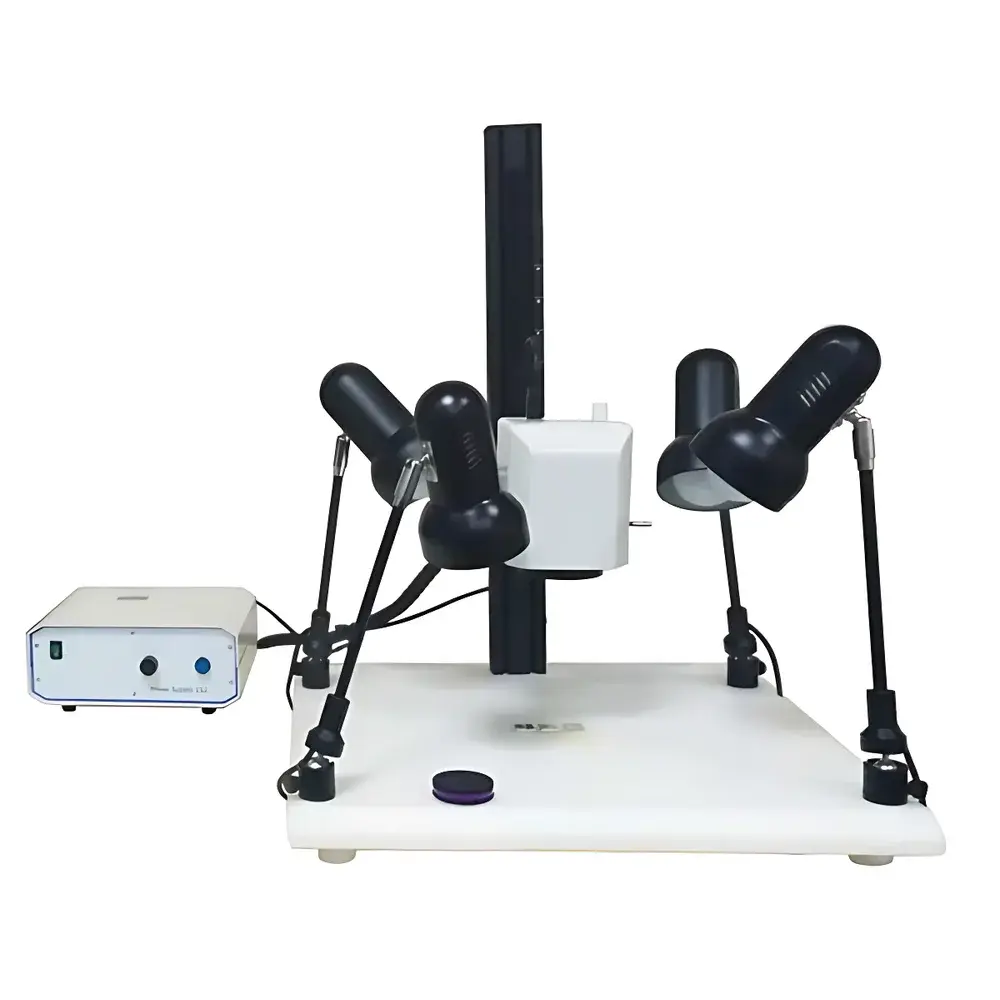
BRIGHT MAS600 Macro Imaging System
| Brand | BRIGHT |
|---|---|
| Origin | United Kingdom |
| Manufacturer Type | Authorized Distributor |
| Origin Category | Imported Instrument |
| Model | MAS600 |
| Total Magnification | 1× (Macro-scale imaging, non-magnifying optical path) |
| Zoom Ratio | None (Fixed-optic macro imaging system) |
| Field Diameter | 20–500 mm |
| Working Distance | 15–500 mm |
| Objective Type | N/A (Integrated telecentric macro optics) |
| Illumination Type | Adjustable LED Ring Light |
| Depth of Field | 10 mm |
| Numerical Aperture | 0.005 |
| Image Sensor | 5.0 MP Color sCMOS |
| Max Display Resolution | 2560 × 1920 (5.0 MP) |
| Zoom Range | 22× digital pan-zoom (software-based, non-optical) |
| Minimum Field of View | 1.5 mm × 1.0 mm |
| Maximum Field of View | 330 mm × 240 mm |
| Output Interface | USB 3.0 |
| Power Input | 24 V DC |
| Column Height | 600 mm |
Overview
The BRIGHT MAS600 Macro Imaging System is a high-precision, large-field-of-view industrial macro imaging platform engineered for non-contact, distortion-minimized surface documentation and failure analysis at millimeter-to-decimeter scales. Unlike conventional stereo microscopes relying on optical magnification, the MAS600 employs a fixed-focal-length telecentric optical architecture coupled with a 5.0 MP color sCMOS sensor to deliver true 1:1 scale imaging across its entire working distance range (15–500 mm). Its design prioritizes geometric fidelity, depth-consistent illumination, and real-time digital image synthesis—making it ideal for metrology-grade visual inspection where spatial accuracy, color fidelity, and repeatability are critical. The system operates on a coaxial LED ring light source, eliminating shadow artifacts and ensuring uniform illumination across complex topographies. Its mechanical structure supports ±90° tilting and handheld operation, enabling versatile positioning for large or immobile specimens encountered in heavy industry.
Key Features
- Telecentric macro-optics with NA 0.005, optimized for minimal perspective distortion and consistent magnification across variable working distances
- 5.0 MP color sCMOS sensor delivering 2560 × 1920 resolution output via USB 3.0 interface with low-noise, high-dynamic-range performance
- Adjustable 24 V DC-powered LED ring illumination—cold white light (6000 K), >50,000-hour lifetime, zero IR/UV emission to prevent thermal degradation of sensitive samples
- Real-time image processing engine supporting RGB channel-level adjustment (gain, gamma, contrast, brightness), geometric rotation, region-of-interest zoom, and multi-frame pixel alignment
- Motorized focus drive with tactile handwheel control, enabling precise Z-axis positioning and programmable focus stacking sequences
- Modular mechanical column (600 mm height) with dual-axis tilt mechanism (±90°) and detachable articulating arm for off-axis or handheld acquisition
- Software-enabled 22× digital pan-zoom with sub-pixel interpolation—preserving contextual field integrity while allowing localized feature interrogation
Sample Compatibility & Compliance
The MAS600 accommodates specimens ranging from small precision components (≥1.5 mm × 1.0 mm FoV) to oversized industrial assemblies (up to 330 mm × 240 mm FoV), including castings, machined housings, PCBs, turbine blades, composite laminates, and power transmission elements. Its 10 mm depth of field and long working distance eliminate the need for sample sectioning or stage repositioning during full-part documentation. The system conforms to ISO 10934-1 (optical measurement terminology), ASTM E284 (standard terminology for microscopy), and supports GLP/GMP-compliant workflows through audit-trail-enabled software logging (user actions, timestamped image metadata, parameter settings). While not a regulated medical device, its imaging traceability aligns with ISO 13485 documentation requirements for quality records in manufacturing QA/QC environments.
Software & Data Management
The MAS600 is operated via dedicated Windows-based imaging software featuring a modular GUI with live preview, annotation tools, measurement overlays (calibrated length/area), and batch export in TIFF, PNG, and JPEG2000 formats. All images embed EXIF metadata—including sensor exposure time, illumination intensity, focus position, and calibration ID. Software supports FDA 21 CFR Part 11-compliant user authentication, electronic signatures, and immutable audit logs when deployed with networked license management. Image databases support SQL-backed storage, version-controlled annotations, and integration with LIMS or MES platforms via RESTful API endpoints. No cloud upload occurs by default; all data remains on-premise unless explicitly configured.
Applications
- Root cause analysis of mechanical failure modes—crack propagation mapping, wear pattern quantification, corrosion extent assessment
- Pre- and post-process visual verification in automotive casting, aerospace structural assembly, and bearing manufacturing
- Non-destructive documentation of electrical insulation breakdown, busbar oxidation, or transformer winding deformation
- Quality gate inspection for additive-manufactured parts—surface roughness trend mapping, support structure residue identification
- Forensic engineering reporting—evidence capture compliant with EN 15038 translation and documentation standards
- Technical illustration generation for service manuals and ISO-compliant maintenance procedures
FAQ
Does the MAS600 provide optical magnification?
No—the MAS600 is a macro imaging system with a fixed 1× optical path; magnification is achieved digitally via software pan-zoom (up to 22×) without altering optical geometry.
Is calibration required before use?
Yes—system calibration (pixel-to-mm mapping, illumination uniformity correction, and focus plane registration) must be performed using the included NIST-traceable calibration target prior to quantitative measurement tasks.
Can the MAS600 integrate with existing laboratory IT infrastructure?
Yes—it supports domain authentication, TLS-encrypted data export, and metadata tagging compatible with enterprise DAM and QMS systems.
What is the recommended maintenance interval?
Annual verification of illumination stability, sensor dark-frame drift, and mechanical tilt axis repeatability is advised per ISO/IEC 17025 guidelines for accredited testing laboratories.




