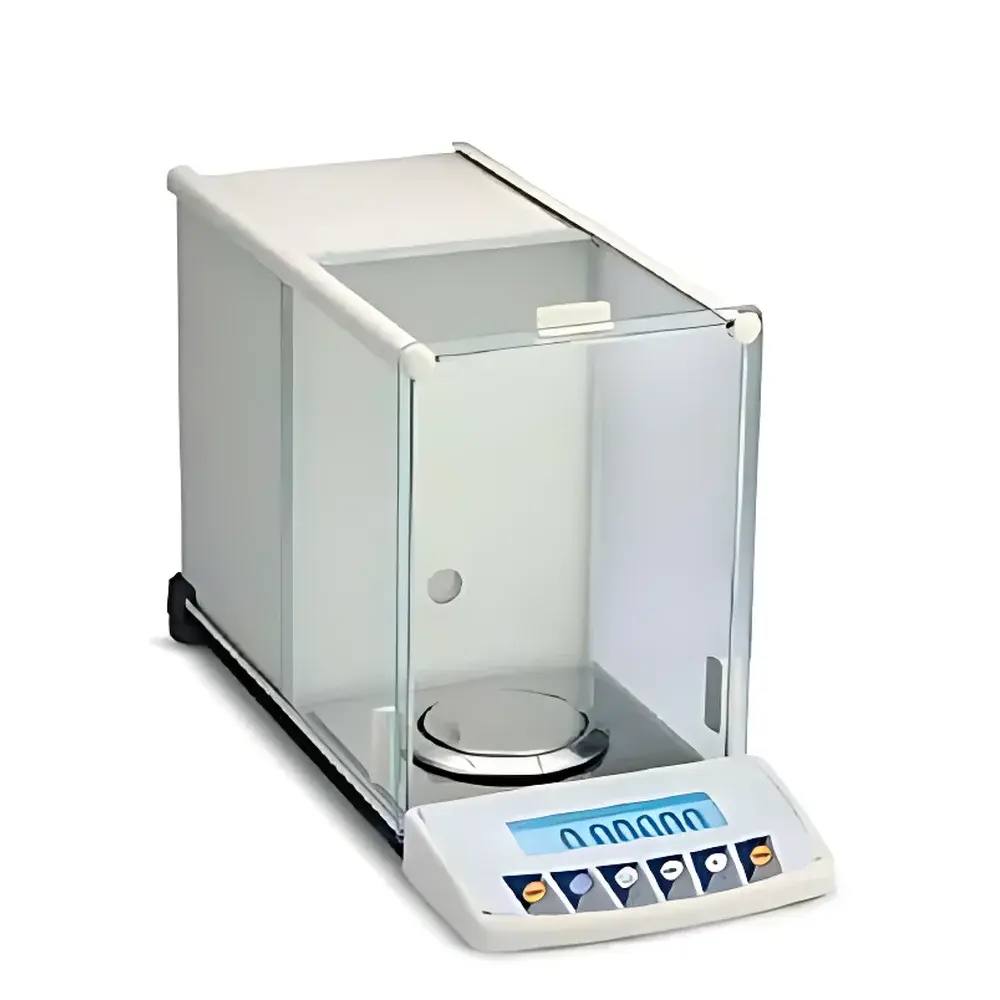
Ohaus CX265 Semi-Micro Balance
| [Origin | USA |
|---|---|
| Type | Analytical Balance |
| Capacity | 210 g |
| Readability | 0.01 mg / 0.1 mg (dual-range) |
| Repeatability | ±0.01 mg / ±0.1 mg |
| Linearity | ±0.04 mg / ±0.2 mg |
| Pan Diameter | 80 mm |
| Stabilization Time | 8 s |
| Internal Calibration | Yes, auto-compensated for temperature drift |
| Operating Temperature | 15–35 °C |
| Dimensions (W×D×H) | 185 × 470 × 280 mm |
| Weight | 9.3 kg |
| Compliance | GLP/GMP, ISO 9001] |
Overview
The Ohaus CX265 Semi-Micro Balance is an engineered precision instrument designed for laboratories requiring high-resolution mass measurement in the 100–210 g capacity range. Utilizing electromagnetic force restoration (EMFR) technology, it delivers dual-range readability—0.01 mg for ultra-fine weighing tasks and 0.1 mg for higher-capacity operations—without mechanical compromise. Its semi-micro architecture bridges the functional gap between analytical and micro balances, making it ideal for quantitative sample preparation, reference standard handling, catalyst dosing, and pharmaceutical active ingredient (API) formulation where sub-100 µg resolution is critical. The balance operates within a rigorously controlled thermal envelope (15–35 °C), with built-in temperature compensation algorithms that dynamically adjust calibration parameters to maintain metrological integrity across ambient fluctuations.
Key Features
- Advanced Eye Protection (AEP) LCD display with high-contrast backlighting and adjustable viewing angle for extended operator comfort during prolonged use.
- Dual-range readability: 0.01 mg (up to 100 g) and 0.1 mg (up to 210 g), enabling seamless transition between trace-level and routine analytical tasks.
- Internal motorized calibration system with automatic temperature-triggered recalibration and user-scheduled calibration intervals (e.g., at startup, hourly, or on-demand).
- Integrated draft shield compatibility (standard 185 × 470 × 280 mm chamber dimensions) supporting ISO/IEC 17025-compliant weighing environments.
- Aluminum-painted housing with reinforced base structure, minimizing vibration transmission and ensuring long-term mechanical stability under continuous laboratory use.
- Multi-function operation modes: percentage weighing, piece counting, checkweighing, statistical analysis (mean, SD, CV%), and accumulation mode for sequential additions.
- Configurable filtering and stability thresholds—allowing users to prioritize speed or resolution based on sample volatility or environmental conditions.
- Full tare range (–210 g to +210 g) and seven selectable units: g, mg, ct, oz, dwt, mom, GN—facilitating cross-disciplinary workflows including gemology, metallurgy, and pharmacopeial testing.
Sample Compatibility & Compliance
The CX265 accommodates samples up to 210 g with a 80 mm diameter weighing pan, optimized for crucibles, vials, filtration assemblies, and small-volume reaction vessels. Its internal draft shield interface ensures compatibility with Ohaus-certified acrylic and glass enclosures (sold separately), meeting ISO 17025 clause 5.5.2 requirements for environmental control during critical mass determinations. The balance conforms to international regulatory frameworks including GLP (Good Laboratory Practice), GMP (Good Manufacturing Practice), and ISO 9001:2015 quality management standards. All calibration events—including automatic temperature-driven corrections—are timestamped and logged with operator ID support, satisfying FDA 21 CFR Part 11 audit trail requirements when integrated with compliant data management software.
Software & Data Management
Data export is supported via standard RS-232 serial interface (no USB or Bluetooth), enabling direct integration with LIMS, ELN, or custom acquisition platforms using ASCII-based command protocols (e.g., Ohaus Standard Protocol). Each weighing event includes metadata: date/time stamp, net/gross/tare values, unit identifier, stability flag, and calibration status. Optional Ohaus Acquire™ software provides real-time graphing, batch reporting, and CSV export with configurable field mapping—fully compatible with electronic signature workflows required under 21 CFR Part 11 when deployed on validated systems. All internal memory retains ≥1,000 records with cyclic overwrite protection and manual backup capability.
Applications
- Pharmaceutical QC/QA: USP and compliant weighing of cytotoxic agents and sterile preparations.
- Materials science: Precise dosing of nanomaterials, catalysts, and thin-film precursors where mass variability must remain below ±0.02 mg.
- Environmental testing labs: Gravimetric analysis of PM2.5 filters per EPA Method 201A and ISO 12103-1.
- Academic research: Isotope-labeled compound quantification, polymer molecular weight determination via end-group titration, and enzymatic assay substrate preparation.
- Reference material certification: NIST-traceable mass assignments for CRM production under ISO Guide 34 and ILAC-G13.
FAQ
What does “dual-range readability” mean for the CX265?
It indicates two distinct resolution modes: 0.01 mg for loads ≤100 g and 0.1 mg for loads up to 210 g—automatically selected based on applied mass to optimize signal-to-noise ratio without manual mode switching.
Is external calibration required?
No. The CX265 features fully automated internal calibration with temperature-compensated reference weights; external calibration is only necessary for periodic verification or after physical relocation.
Can the CX265 be used in a fume hood?
Yes—provided the hood’s air velocity remains below 0.5 m/s at the balance location and the unit is mounted on a vibration-isolated surface; draft shield use is mandatory in such environments.
Does it support ISO/IEC 17025-compliant uncertainty budgets?
Yes—the balance’s documented repeatability (±0.01 mg), linearity (±0.04 mg), and temperature coefficient (≤1 ppm/°C) are published in its Type Evaluation Report and can be directly incorporated into laboratory-specific uncertainty calculations.
How is compliance with 21 CFR Part 11 enforced?
Through secure user authentication, electronic audit trails (including calibration history and weighing logs), and role-based access control when paired with validated Ohaus Acquire™ software on a locked-down Windows OS platform.