
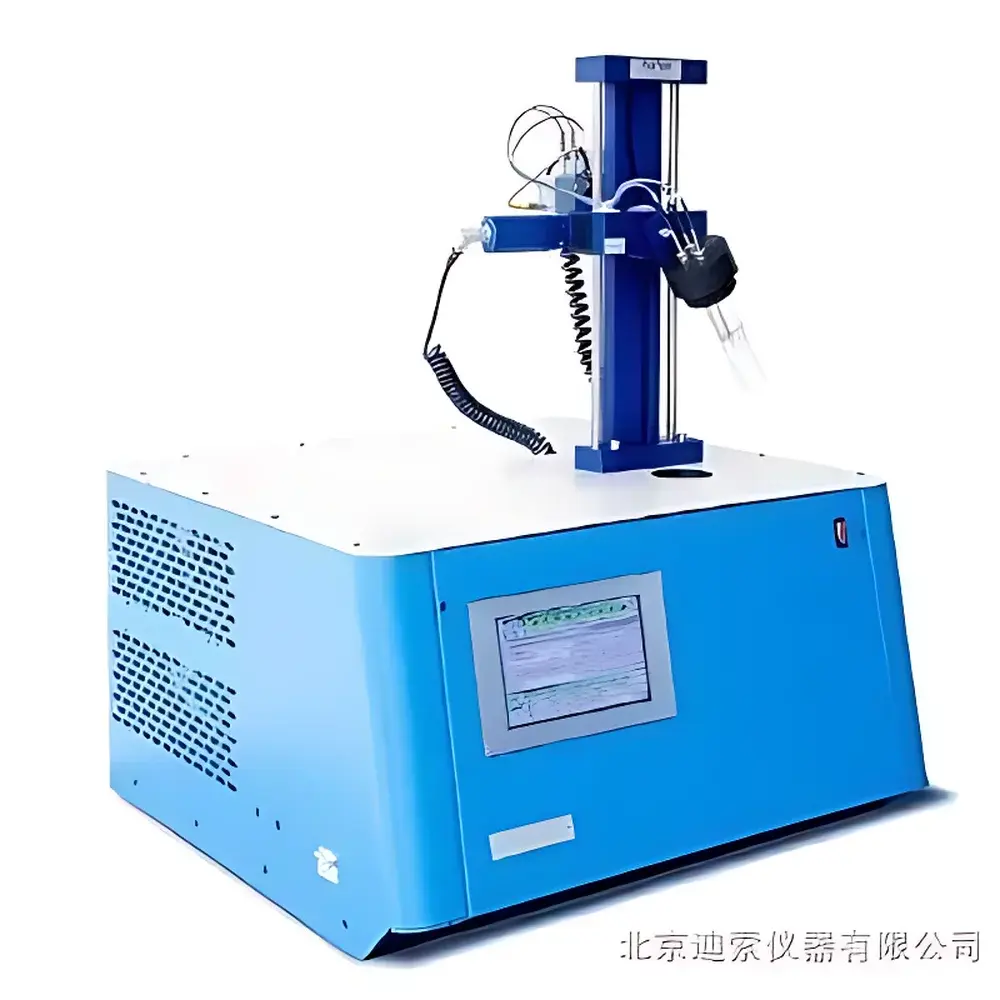
Linetechnic NewLab 300 Automated Pour Point Analyzer
| Brand | Linetechnic |
|---|---|
| Origin | Switzerland |
| Model | NewLab 300 |
| Temperature Range | +80 °C to –80 °C |
| Temperature Resolution | 0.06 °C |
| Temperature Accuracy | ±0.1 °C |
| Compliance | ASTM D97, D5950, D5853 |
| Detection Method | Dual PT100 surface probes with motorized sample tube tilting |
| Cooling System | Single-stage or dual-stage compressor options |
| Test Heads | 1 or 2 independent stations |
Overview
The Linetechnic NewLab 300 Automated Pour Point Analyzer is an engineered solution for precise, repeatable determination of the pour point of petroleum-based liquids in accordance with internationally recognized standard test methods. Based on the fundamental principle of controlled cooling and mechanical observation of flow cessation—defined as the lowest temperature at which a sample remains mobile under specified conditions—the instrument implements a thermally regulated bath coupled with real-time surface temperature monitoring and automated sample tube manipulation. Unlike manual or semi-automated alternatives, the NewLab 300 eliminates operator subjectivity by replacing visual inspection with objective thermal threshold detection and programmable tilt sequencing. Its architecture integrates a high-stability refrigeration system, dual-sensor surface temperature measurement, and microprocessor-controlled timing logic to ensure strict adherence to ASTM D97 (Standard Test Method for Pour Point of Petroleum Products), ASTM D5950 (Standard Test Method for Pour Point of Petroleum Products—Automatic Pressure Pulsing Method), ASTM D5853 (Standard Test Method for Pour Point of Crude Oils), IP 15 and IP 441 (Institute of Petroleum standards), and ISO 3016 (Petroleum products — Determination of pour point). Designed for laboratories requiring regulatory traceability and audit-ready operation, the system supports GLP-compliant workflows through integrated calibration logging and user-accessible diagnostic routines.
Key Features
- Automated pour point determination across a wide thermal range: +80 °C to –80 °C, selectable via compressor configuration (single-stage for –40 °C operation; dual-stage for full –80 °C capability)
- Dual PT100 resistance temperature detectors positioned at the sample surface to monitor thermal gradient and detect solidification onset with 0.06 °C resolution and ±0.1 °C accuracy
- Motor-driven mechanical arm that precisely tilts the sample tube to horizontal orientation at defined intervals during cooling, enabling unambiguous detection of flow arrest
- Modular test head design: available in single-head (NewLab 300/1 or /2) or dual-head (NewLab 300/300/1 or /300/2) configurations for parallel analysis or method validation
- Thermally insulated bath with active temperature stabilization, minimizing ambient influence and ensuring reproducible ramp rates per ASTM requirements
- Embedded firmware with built-in compliance checks—verifies cooling rate, hold time, tilt sequence timing, and temperature stability before final result assignment
Sample Compatibility & Compliance
The NewLab 300 accommodates a broad spectrum of hydrocarbon-based fluids, including crude oil, distillate fuels (diesel, jet fuel), engine oils, transmission fluids, lubricants, biodiesel blends (B5–B100), fuel additives, and refinery intermediates. Sample volume requirement is standardized at 40 mL per test, compatible with ASTM D97-compliant cylindrical glass tubes (16 mm × 125 mm). All operational parameters—including cooling ramp profiles, dwell times, tilt angles, and detection thresholds—are preconfigured to satisfy the procedural rigor of ASTM D97, D5950, D5853, IP 15, IP 441, and ISO 3016. The system supports full documentation of instrument qualification (IQ/OQ), including temperature mapping reports, probe calibration certificates (traceable to NIST or equivalent national metrology institutes), and electronic audit trails required under FDA 21 CFR Part 11 for regulated environments.
Software & Data Management
The NewLab 300 operates via an embedded Linux-based control interface with three dedicated functional menus: Analysis (for method selection, sample ID entry, and run initiation), Diagnostics (for real-time sensor status, refrigeration performance monitoring, and mechanical actuator self-test), and Calibration (for two-point PT100 verification and thermal offset adjustment). All raw temperature vs. time data, tilt events, and final pour point assignments are timestamped and stored in CSV format for external import into LIMS or statistical process control platforms. Data integrity is maintained through user-level access controls, password-protected method editing, and immutable run logs with digital signatures. Optional software modules support automated report generation compliant with ISO/IEC 17025 reporting requirements, including uncertainty estimation per GUM guidelines.
Applications
- Quality control of finished lubricants and base oils in manufacturing facilities
- Crude assay laboratories assessing low-temperature handling risks prior to transportation or storage
- Fuel formulation R&D, particularly for arctic-grade diesel and aviation turbine fuels
- Regulatory submission testing for EPA, EN, or regional specifications requiring pour point certification
- Third-party contract testing labs serving upstream, midstream, and downstream petroleum sectors
- Academic and government research institutions studying wax crystallization kinetics and flow assurance phenomena
FAQ
What standards does the NewLab 300 validate against?
ASTM D97, D5950, D5853; IP 15, IP 441; and ISO 3016—all implemented with hardware-enforced procedural constraints.
Can the instrument be used for biodiesel testing?
Yes—validated for B5 through B100 blends, including FAME and HVO-derived fuels, with optimized cooling profiles to prevent supercooling artifacts.
Is dual-head operation truly independent?
Yes—each test station has dedicated temperature sensors, tilt actuators, and refrigeration control loops, enabling concurrent but non-interfering analyses.
How is calibration traceability maintained?
PT100 probes are supplied with individual calibration certificates traceable to national standards; field recalibration uses certified reference thermometers and documented SOPs.
Does the system support remote monitoring or integration with lab networks?
Via optional Ethernet interface and Modbus TCP protocol, enabling integration with SCADA systems, centralized instrument management platforms, or custom MES interfaces.







