
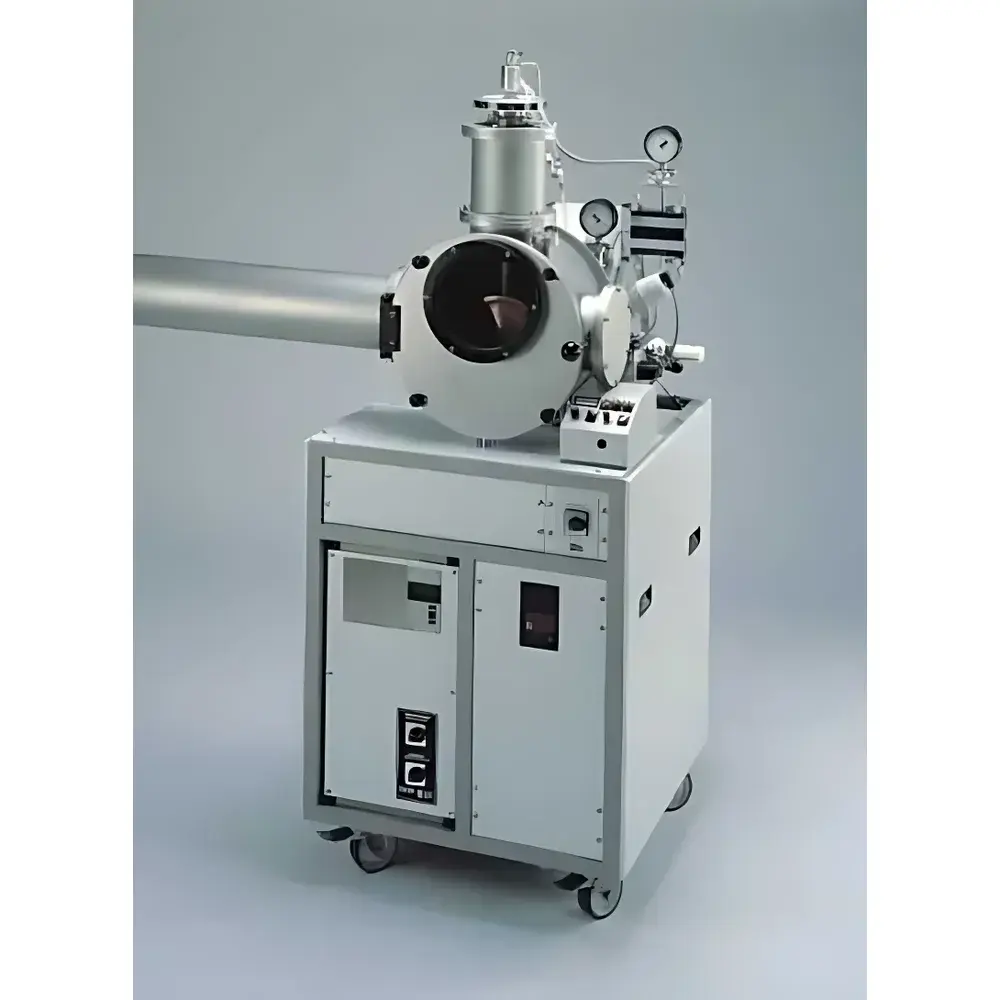
SC-Type Ultra-Rapid Cooling Melt Spinning Furnace
| Origin | Imported |
|---|---|
| Manufacturer Type | Authorized Distributor |
| Model | SC-Type |
| Pricing | Available Upon Request |
Overview
The SC-Type Ultra-Rapid Cooling Melt Spinning Furnace is a precision-engineered laboratory-scale thermal processing system designed for the controlled melting and ultra-fast solidification of metallic alloys under high-vacuum or inert gas (e.g., argon) atmospheres. It operates on the principle of melt spinning—a rapid quenching technique in which molten metal is ejected under controlled pressure onto a rotating, water-cooled copper wheel, enabling solidification rates exceeding 10⁶ K/s. This extreme cooling rate suppresses atomic diffusion and kinetically traps metastable phases—including amorphous (glassy) and nanocrystalline structures—that are inaccessible via conventional casting or annealing methods. The furnace supports fundamental research into non-equilibrium metallurgy, magnetic soft-phase development, and advanced functional alloy design, particularly for applications requiring exceptional coercivity, low core loss, or enhanced corrosion resistance.
Key Features
- Maximum operating temperature of 2500 °C, achieved via high-purity graphite or molybdenum heating elements with dual-zone thermal profiling for precise melt homogenization.
- Water-cooled, magnetically coupled copper spin wheel (Ø200 mm), engineered for surface velocities up to 60 m/s and compatible with optional alternative wheel materials (e.g., Ni-based alloys) upon request.
- Adjustable, water-cooled crucible holder accommodating boron nitride (BN) or fused quartz crucibles—ensuring chemical inertness and thermal shock resistance during repeated cycling.
- Integrated vacuum chamber rated to ≤5 × 10⁻⁵ mbar, equipped with turbo-molecular pumping and residual gas analysis (RGA) port for process atmosphere validation.
- Programmable inert gas purging system with mass flow controllers for argon or nitrogen, supporting both static and dynamic purge modes with O₂/H₂O impurity monitoring.
- Compact, fully sealed mechanical drive architecture with ceramic bearings and double-lip shaft seals, minimizing maintenance and ensuring long-term rotational stability under thermal load.
Sample Compatibility & Compliance
The SC-Type furnace accommodates sample charges up to 10 g per run, optimized for Fe-, Co-, Ni-, and Zr-based metallic systems—including Fe-Nd-B, Co-Fe-Si-B, and Pd-Cu-Ni-P compositions. Thin ribbon production yields uniform thicknesses between 20–60 µm and widths adjustable from 1–25 mm. All internal wetted surfaces comply with ASTM F86 (standard practice for surface preparation of titanium and titanium alloys) and ISO 10993-1 (biocompatibility evaluation framework), facilitating downstream characterization (XRD, TEM, DSC, VSM) without cross-contamination. The system meets GLP-compliant documentation requirements for traceable parameter logging and is compatible with FDA 21 CFR Part 11–enabled data acquisition when integrated with validated third-party control software.
Software & Data Management
The furnace interfaces with a modular PC-based control suite supporting real-time monitoring of melt temperature (via dual-wavelength pyrometer), wheel speed (optical encoder feedback), vacuum level (capacitance manometer), and gas partial pressures. All operational parameters—including ramp rates, hold times, quench initiation timing, and purge cycles—are programmable and stored with timestamped audit trails. Export formats include CSV and HDF5, enabling direct import into MATLAB, Python (Pandas/NumPy), or Thermo-Calc for kinetic modeling. Optional firmware upgrade enables automated batch sequencing with inter-run cooldown verification and alarm-triggered emergency venting per IEC 61508 SIL-2 functional safety guidelines.
Applications
- Synthesis of amorphous and nanostructured metallic ribbons for soft magnetic cores in high-frequency power electronics (e.g., EV inverters, wireless charging coils).
- Fundamental studies of glass-forming ability (GFA), crystallization kinetics, and thermodynamic metastability in bulk metallic glasses (BMGs).
- Development of corrosion-resistant coatings and catalytic substrates via rapid solidification of Al-, Mg-, or Ti-based multicomponent alloys.
- Preparation of precursor ribbons for subsequent devitrification, hot-pressing, or spark plasma sintering (SPS) into bulk nanocrystalline magnets.
- Materials qualification for aerospace and medical device applications where phase purity, oxide content, and grain boundary segregation must be rigorously controlled.
FAQ
What maximum cooling rate can this system achieve, and how is it measured?
The system achieves solidification rates up to 10⁶ K/s, determined indirectly via inverse heat conduction modeling using measured wheel surface temperature gradients, melt ejection velocity, and ribbon thickness—validated against synchrotron X-ray diffraction time-resolved solidification studies.
Is the furnace compatible with reactive metals such as titanium or zirconium?
Yes—operation under high vacuum (<5 × 10⁻⁵ mbar) or high-purity argon (<1 ppm O₂) prevents oxidation; BN crucibles and graphite insulation provide necessary chemical stability for reactive melts.
Can ribbon width be adjusted without hardware modification?
Yes—width is controlled by precision-machined nozzle inserts installed upstream of the melt delivery orifice; standard kits support 1, 5, 10, and 25 mm configurations with sub-10 µm edge definition.
Does the system support automated data archiving compliant with regulatory audits?
When configured with optional validation package, all critical process parameters are logged with electronic signatures, change history, and tamper-proof timestamps meeting ALCOA+ (Attributable, Legible, Contemporaneous, Original, Accurate, Complete, Consistent, Enduring, Available) principles.
What maintenance intervals are recommended for the spin wheel and crucible assembly?
Copper wheel surface inspection and cleaning every 50 runs; BN crucibles replaced after 10–15 melts depending on alloy aggressiveness; full vacuum seal integrity test required quarterly per ISO 27427.



