
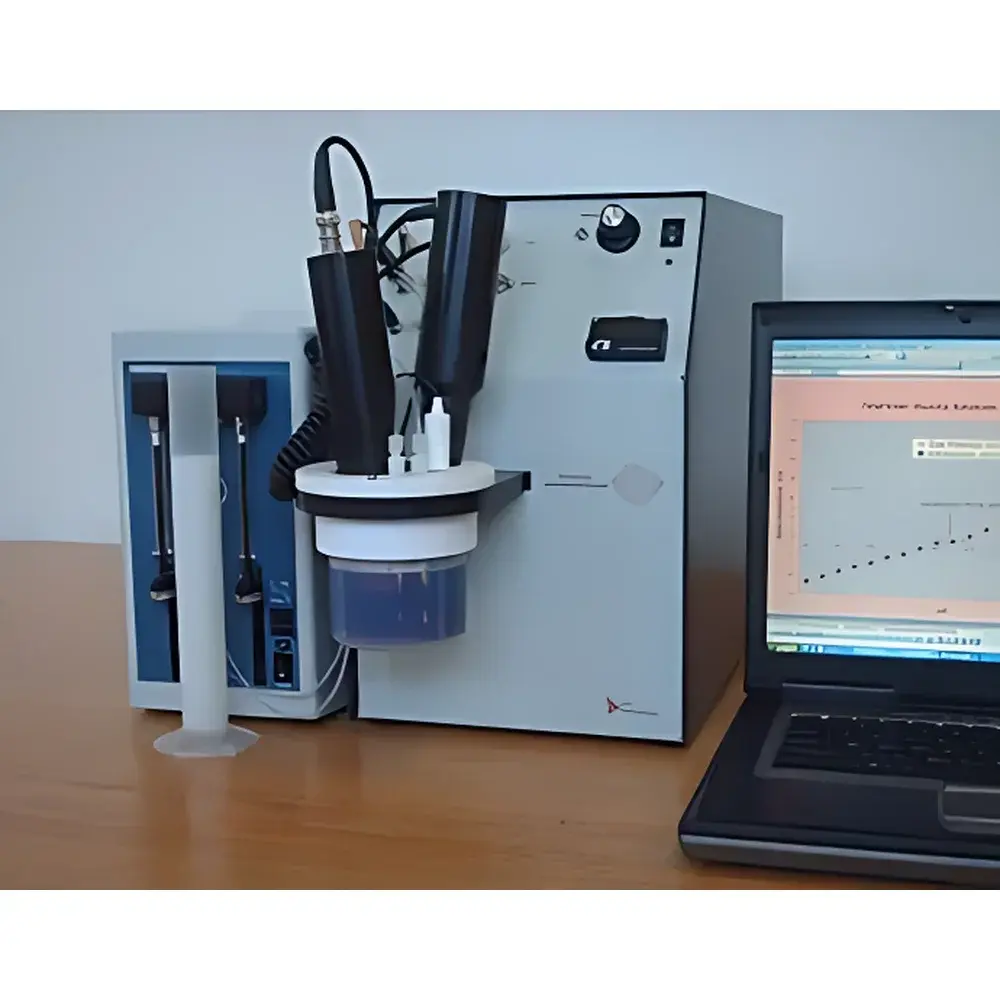
ZetaFinder Zeta Potential Analyzer by Dispersion Technology, Inc.
| Origin | USA |
|---|---|
| Manufacturer Type | Authorized Distributor |
| Origin Category | Imported |
| Model | ZetaFinder |
| Pricing | Available Upon Request |
Overview
The ZetaFinder Zeta Potential Analyzer is an advanced electroacoustic instrument engineered for direct, in-situ measurement of zeta potential and electrophoretic mobility in concentrated, opaque, and highly viscous colloidal dispersions—without dilution, optical alignment, or sample preparation. Unlike conventional laser Doppler electrophoresis or phase-analysis light scattering (PALS) systems, the ZetaFinder operates on the principle of electroacoustics: a high-frequency alternating electric field induces oscillatory motion of charged particles within the dispersion medium; this motion generates detectable colloid vibration current (CVI) or electrokinetic sonic amplitude (ESA), which is quantitatively correlated to particle surface charge and zeta potential via well-established theoretical models (e.g., O’Brien–Hunter equation). This non-optical, field-based methodology eliminates critical limitations inherent to optical techniques—including sensitivity loss in turbid or highly absorbing media, artifacts from sedimentation or aggregation during static cell measurement, and pH drift induced by DC fields. As a result, the ZetaFinder delivers representative, process-relevant data from real-world formulations—whether polymer lattices, ceramic slurries, pharmaceutical suspensions, or battery electrode dispersions—at their native concentration and rheological state.
Key Features
- Electroacoustic measurement platform enabling direct zeta potential analysis in undiluted dispersions (0.5–50 vol% solids)
- Simultaneous real-time acquisition of zeta potential, electrophoretic mobility, pH, conductivity, temperature, and ESA signal amplitude
- Robust stainless-steel and gold-plated probe design for chemical resistance, mechanical stability, and measurement reproducibility
- No optical alignment required—eliminates dependency on particle transparency, size distribution, or refractive index contrast
- Minimal sample volume: 10 mL (no upper volume limit; compatible with flow-through or batch configurations)
- Integrated Teflon-coated titration cell for automated acid/base titrations during zeta potential vs. pH profiling
- DSP-based hardware architecture supporting high-speed signal processing, noise rejection, and dynamic range optimization
- Microsoft Windows-compatible software with audit-trail logging, user-level access control, and export compliance with ASTM E2917 and ISO 13099-3
- Operational flexibility: supports measurements in static, stirred, or continuously flowing dispersions
- Validated for use in GMP/GLP environments; software features 21 CFR Part 11-compliant electronic signatures and data integrity safeguards
Sample Compatibility & Compliance
The ZetaFinder accommodates a broad spectrum of industrial and academic sample types—including aqueous and non-aqueous colloids (e.g., alcohols, esters, hydrocarbons), high-viscosity polymer emulsions (>10,000 cP), nanoparticle suspensions, pigment pastes, and biopolymer gels. It reliably characterizes particles up to 30 µm in diameter and molecular species such as proteins or dendrimers. Its electroacoustic method complies with ISO 13099-3 (Colloidal systems — Methods for zeta-potential determination — Part 3: Acoustic and electroacoustic methods) and aligns with ASTM D7826 (Standard Guide for Zeta Potential Measurement of Nanoparticles in Aqueous Media). The system meets functional requirements for quality control laboratories operating under ICH Q5C, USP , and FDA guidance on nanomaterial characterization.
Software & Data Management
The ZetaFinder Control Software provides intuitive, wizard-driven workflows for calibration, titration, time-series monitoring, and multi-parameter correlation analysis. All raw and processed data are stored in encrypted, timestamped project files with full metadata capture (operator ID, instrument serial number, environmental conditions, calibration history). Built-in reporting tools generate PDF/CSV outputs compliant with internal SOPs and external regulatory submissions. Audit trails record every parameter change, measurement initiation, and data export event—fully traceable for inspection readiness. Remote diagnostics and firmware updates are supported via secure HTTPS channels.
Applications
- Stability assessment of drug delivery nanoparticles and protein therapeutics
- Optimization of dispersant dosage in ceramic, inkjet, and coating formulations
- Zeta-pH titration for isoelectric point (IEP) determination in biologics and vaccine adjuvants
- In-process monitoring of slurry stability in lithium-ion battery electrode manufacturing
- Quality-by-Design (QbD) development of colloidal self-assembly processes
- Regulatory submission support for FDA, EMA, and PMDA filings requiring zeta potential as a critical quality attribute (CQA)
FAQ
Does the ZetaFinder require sample dilution?
No. It measures zeta potential directly in undiluted, concentrated dispersions—eliminating dilution-induced artifacts and preserving native interfacial chemistry.
Can it measure samples with high optical opacity or color?
Yes. Because it relies on acoustic detection rather than light scattering, turbidity, absorbance, or fluorescence do not affect measurement accuracy.
What is the minimum particle size detectable?
The instrument detects electrophoretic response across the colloidal regime (sub-nanometer to ~30 µm); sensitivity depends on particle charge density and medium conductivity—not size alone.
Is the system suitable for Good Manufacturing Practice (GMP) environments?
Yes. With 21 CFR Part 11-compliant software, electronic signature capability, and full audit-trail functionality, it supports validated QC workflows.
How is calibration performed?
Calibration uses certified reference materials (CRM) traceable to NIST standards; probe sensitivity is verified via known conductivity and mobility standards prior to each analytical session.



