
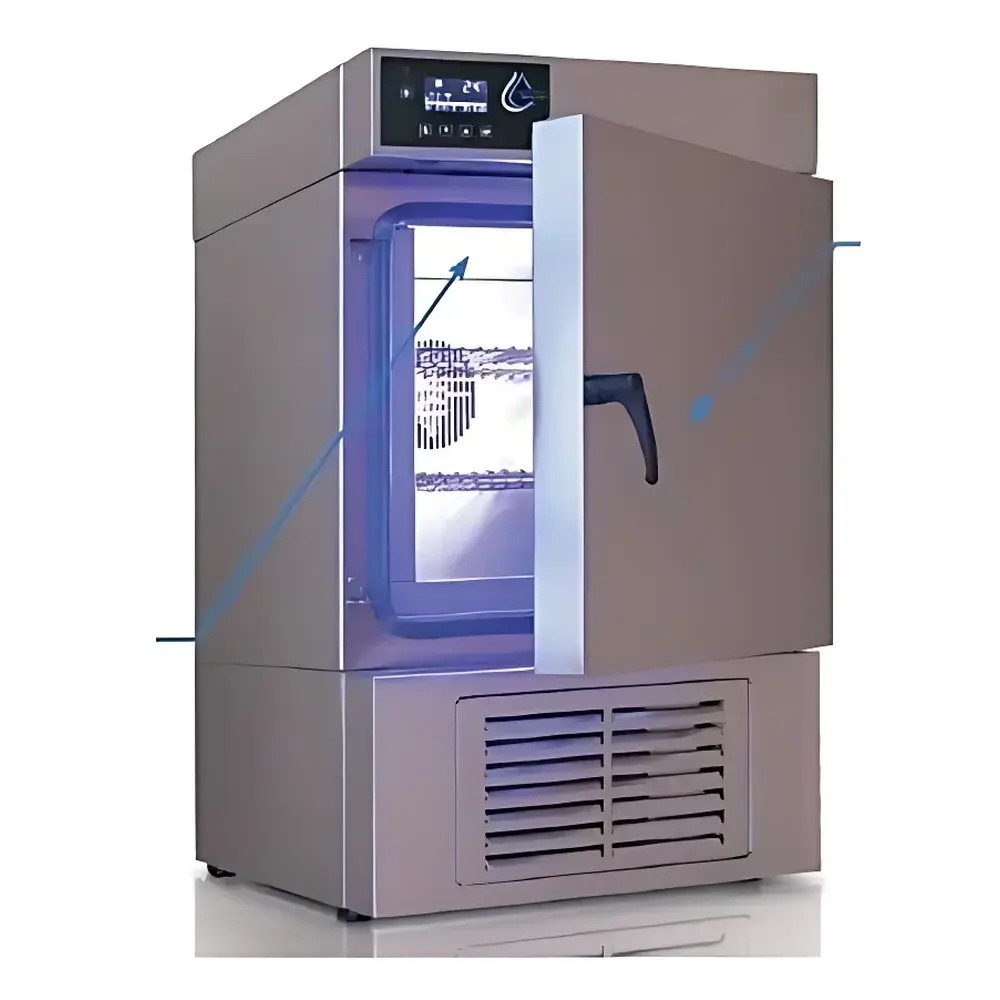
KK Series Temperature and Humidity Controlled Incubator (Poland-Made)
| Origin | Poland |
|---|---|
| Manufacturer Type | Authorized Distributor |
| Origin Category | Imported |
| Model | KK Series |
| Price Range | USD 6,800 – 13,600 (FOB) |
| Temperature Range (with Humidification) | −10 °C to +60 °C |
| Temperature Uniformity | ±0.75 °C |
| Humidity Range | 30–90 %RH |
| Internal Volume | ≥115 L |
| Temperature Stability | ±0.3 °C |
| Humidity Accuracy | ±2 %RH |
| Cooling Rate | 70 °C → 0 °C in ≤60 min |
| Heating Rate | −10 °C → 70 °C in ≤45 min |
| Power Consumption | 1000–2300 W |
| Net Weight | 90–185 kg |
Overview
The KK Series Temperature and Humidity Controlled Incubator is a precision-engineered environmental chamber designed for reproducible, long-term biological and pharmaceutical sample conditioning under tightly regulated thermal and hygroscopic conditions. Developed in Poland and distributed globally under strict quality assurance protocols, this incubator employs dual-loop PID control architecture—separate feedback circuits for temperature and humidity—to maintain stable setpoints across the full operational range (−10 °C to +60 °C; 30–90 %RH). Its thermoelectric cooling system, combined with high-efficiency PTC heating elements and a dedicated steam-based humidification module, enables rapid thermal response and low-drift operation. The chamber’s structural integrity is reinforced by 75 mm thick polyurethane insulation in the door and walls, minimizing thermal bridging and ensuring compliance with ISO 14644-1 Class 8 cleanroom-compatible air handling standards. All models meet IEC 61000-4 electromagnetic compatibility requirements and are certified to EN 61010-1 for laboratory safety.
Key Features
- Dual independent microprocessor-based control system with real-time digital display of temperature and relative humidity
- 9-step programmable cycle function supporting up to 999 repetitions, with user-defined ramp/soak profiles
- Self-diagnostic monitoring with audible/visual alarms for out-of-limit conditions, door-open detection, sensor failure, and power interruption
- Non-volatile memory retains all setpoints and program sequences during unexpected power loss
- Vertical airflow design with adjustable stainless-steel shelves and optimized fan placement ensures uniform air distribution and minimal turbulence across the entire chamber volume
- Heated, double-glazed observation window with anti-fog coating preserves internal climate stability while enabling continuous visual monitoring
- Automatic defrost cycle prevents ice accumulation on evaporator coils without manual intervention or chamber downtime
- RS232C serial interface supports external data logging and integration with LIMS or SCADA systems (optional RS485 or Ethernet modules available)
- Corrosion-resistant powder-coated exterior with rounded edges and polished 304 stainless-steel interior for ease of cleaning and compliance with GLP documentation practices
Sample Compatibility & Compliance
The KK Series accommodates a broad spectrum of life science applications—including cell culture, microbial growth studies, stability testing per ICH Q1A(R2), seed germination assays, and enzyme activity profiling—across three standard internal volumes (115 L, 245 L, and 424 L). Each configuration maintains temperature uniformity within ±0.75 °C and humidity accuracy within ±2 %RH at steady state, validated per ASTM E2875-22 Annex A1 (Standard Practice for Performance Verification of Environmental Chambers). The unit complies with EU Directive 2014/30/EU (EMC), 2014/35/EU (LVD), and carries CE marking. Optional IQ/OQ documentation packages are available to support FDA 21 CFR Part 11-compliant validation workflows, including audit trails for parameter changes, alarm logs, and calibration history.
Software & Data Management
The embedded controller supports local parameter configuration via intuitive keypad navigation and provides timestamped event logging (e.g., door openings, alarm triggers, setpoint modifications) stored in non-volatile memory for ≥30 days. When connected via RS232C, third-party software such as LabVIEW, MATLAB, or custom Python scripts can poll live sensor data at 1-second intervals. Optional PC-based software (KK-LogSuite v3.2) enables remote monitoring, automated report generation in PDF/CSV formats, and trend analysis aligned with ISO/IEC 17025 clause 7.7 (result reporting). All electronic records include digital signatures, version control, and immutable timestamps—fully traceable for GMP/GLP audits.
Applications
- Accelerated stability testing of pharmaceuticals and biologics under ICH Q5C and Q1E guidelines
- Long-term storage and propagation of mammalian, insect, and plant cell lines requiring precise RH modulation
- Environmental simulation for material degradation studies (e.g., polymer hydrolysis, packaging barrier performance)
- Microbiological incubation for QC/QA labs performing USP / microbial enumeration and identification
- Development and qualification of diagnostic reagents sensitive to moisture-induced denaturation
- Educational use in university laboratories for teaching environmental physiology and experimental design principles
FAQ
What is the maximum allowable load mass before airflow uniformity degrades?
Airflow uniformity remains within specification (±0.75 °C) when ≤70 % of internal volume is occupied by samples or accessories.
Is the humidity sensor recalibratable in-house?
Yes—the capacitive RH sensor supports two-point calibration using NIST-traceable saturated salt solutions (e.g., LiCl, MgCl₂) via service menu access.
Does the unit comply with FDA 21 CFR Part 11 for electronic records?
Out-of-the-box functionality meets baseline requirements; full Part 11 compliance requires optional KK-LogSuite v3.2 with enabled audit trail, electronic signature, and role-based access control.
Can the incubator operate continuously at −10 °C with 90 %RH?
No—simultaneous extreme low temperature and high humidity exceeds condensation management capacity; consult the operating envelope chart in Section 4.2 of the Technical Manual.
What maintenance intervals are recommended for optimal performance?
Humidifier tank cleaning every 72 hours during active use; annual verification of temperature/humidity sensors by accredited metrology lab; quarterly inspection of door gasket integrity.





