
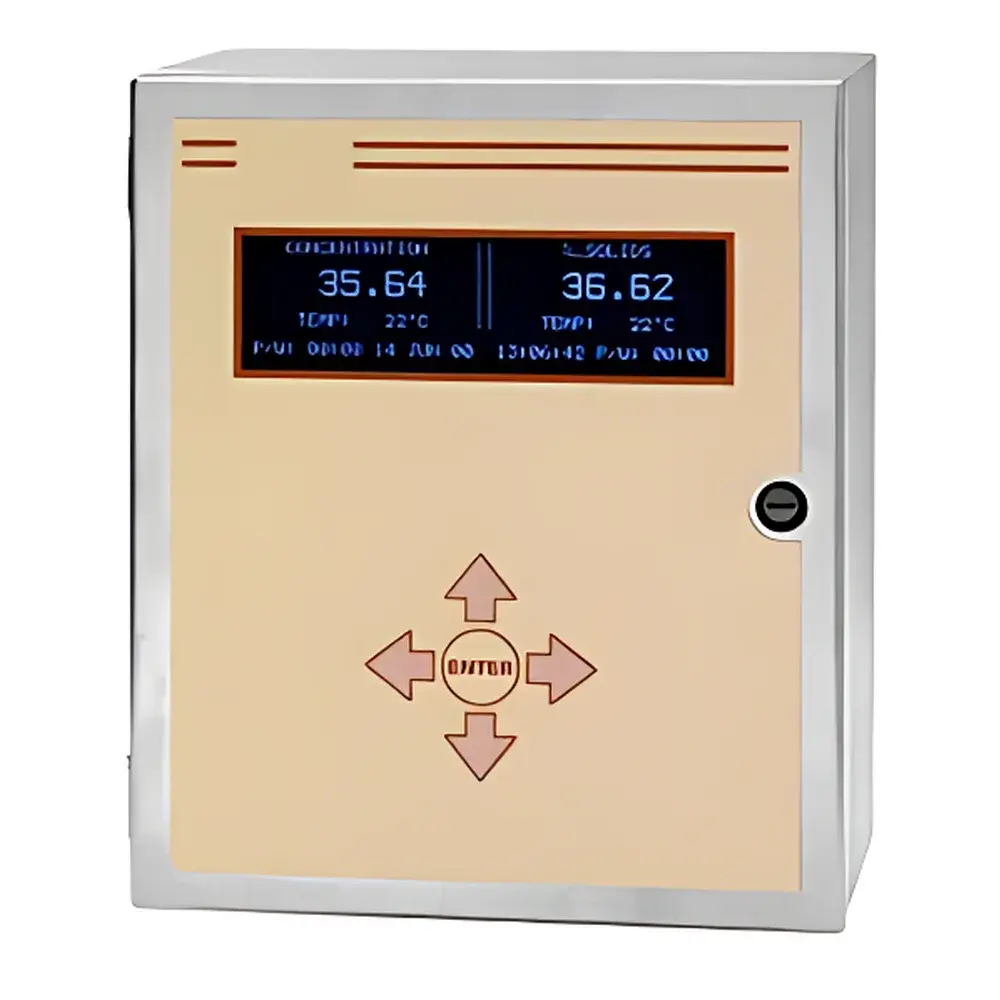
American-made 614 Series In-Line Refractometer
| Origin | USA |
|---|---|
| Type | In-line refractometer |
| Model | 614 |
| Measurement Range | 1.3000–1.6000 RIU (Refractive Index Units) |
| Accuracy | ±0.5% of full scale |
| Temperature Compensation | Automatic, -25°C to +150°C |
| Process Pressure Rating | Up to 1000 PSIG (68 bar) |
| Prism Material | Sapphire |
| Output Signals | 4–20 mA, 0–10 VDC (refractive index and temperature) |
| Communication Interfaces | RS-232, dual RS-485 (up to 3 km remote operation) |
| Cable Length | Up to 500 m |
| Display | Backlit LCD with 5-touch-button interface |
| Alarm Functions | Two independent alarms (out-of-range and system fault) |
| Power Supply | 230 VAC, 50 Hz, <25 W |
Overview
The American-made 614 Series In-Line Refractometer is an industrial-grade process analytical instrument engineered for continuous, real-time measurement of refractive index in flowing liquid streams. It operates on the principle of critical angle refractometry—a well-established optical technique that quantifies the refractive index (RI) by detecting the angle at which light undergoes total internal reflection at the interface between a sapphire prism and the process fluid. Unlike traditional benchtop or handheld refractometers, the 614 Series is designed for permanent installation in pressurized pipelines or open-channel applications, delivering stable, drift-free measurements without dependence on sample clarity, color, turbidity, suspended solids, or viscosity. Its robust sapphire prism—chemically inert and abrasion-resistant—ensures long-term reliability in aggressive chemical, high-temperature, and high-pressure environments common in pulp & paper, sugar refining, dairy processing, beverage production, and fine chemical synthesis.
Key Features
- True in-line measurement with direct prism-to-process contact—no sampling loops, no delays, no maintenance-intensive flow cells.
- Critical angle detection using infrared LED illumination, minimizing thermal drift and eliminating sensitivity to ambient light interference.
- Integrated Pt100 RTD temperature sensor with automatic temperature compensation across -25°C to +150°C, ensuring RI accuracy per ISO 21748 and ASTM D1218 standards.
- Dual-mode configuration support: single-sensor mode for standard concentration monitoring; dual-sensor mode for redundancy or differential measurement in parallel lines.
- Sapphire prism (Mohs hardness 9) resistant to corrosion, erosion, and thermal shock—validated for use with caustic soda, sulfuric acid, sucrose syrups, whey, and ethanol-water mixtures.
- Two independent analog outputs (4–20 mA and 0–10 VDC) for refractive index and process temperature—fully scalable and compatible with DCS, PLC, and SCADA systems.
- Self-diagnostic firmware with two configurable alarms: one for out-of-range RI values, another for hardware or communication failure—supporting IEC 61508 functional safety awareness.
Sample Compatibility & Compliance
The 614 Series accommodates opaque, colored, viscous, or particulate-laden process streams—including black liquor, molasses, fruit purees, milk concentrates, and polymer emulsions—without signal attenuation or calibration drift. Its optical design is insensitive to air entrainment, crystallization, or phase separation at the prism surface, enabling reliable operation in non-ideal process conditions. The instrument complies with NEMA 4X/IP66 enclosure ratings for wet and dusty industrial environments. Electrical interfaces meet CE, UL 61010-1, and ATEX/IECEx Zone 1 (optional) certification requirements. Data integrity features—including timestamped measurement logs and user-accessible calibration history—align with FDA 21 CFR Part 11 expectations for audit-ready process records in GMP-regulated food, pharmaceutical, and biotech manufacturing.
Software & Data Management
The embedded control system provides a menu-driven interface via a high-contrast LCD display and five tactile touch keys—enabling zero-point calibration, span adjustment, temperature offset tuning, and diagnostic self-tests without external software. All parameters—including current RI value, compensated Brix equivalent (0–100%), % total solids, process temperature, and alarm status—are displayed simultaneously. Remote operation is supported via dual RS-485 ports, allowing control boxes to be installed up to 3 km from the sensor head while maintaining full bidirectional communication. Optional data logging supports soft-disk archival (via built-in floppy drive interface) or integration with third-party historian platforms via RS-232. Firmware supports configurable data output intervals (1–60 sec), linearization tables for non-linear solute responses, and password-protected parameter access levels for QA/QC oversight.
Applications
This refractometer is routinely deployed in continuous concentration monitoring applications where real-time compositional feedback is critical to process efficiency and product consistency. Key use cases include: real-time control of evaporator feed and condensate in sugar beet and cane refineries; monitoring dissolved solids in black liquor during kraft pulping; inline Brix verification in juice concentration and wine must handling; fat/protein ratio estimation in raw milk pre-separation; glycol concentration tracking in heat transfer fluids; and solvent recovery loop control in pharmaceutical API synthesis. Its wide RI range (1.3000–1.6000) covers aqueous solutions, organic solvents, and multi-component mixtures—making it suitable for R&D pilot plants as well as 24/7 production lines.
FAQ
Does the 614 Series require periodic recalibration under continuous operation?
No—its critical angle measurement principle and sapphire prism construction eliminate mechanical hysteresis and thermal drift. Calibration is required only after sensor replacement, major process chemistry changes, or as part of scheduled QA verification (e.g., quarterly).
Can it measure in high-viscosity or fouling-prone streams?
Yes—the sapphire prism’s surface energy and geometry minimize adhesion of sticky or scaling materials. Optional ultrasonic cleaning modules (not included) can be integrated for extended maintenance intervals.
Is temperature compensation algorithm compliant with international standards?
Yes—the embedded polynomial correction follows the methodology defined in ISO 21748 Annex C and is traceable to NIST-certified reference liquids across the full operating temperature range.
What are the maximum cable run limitations for analog and digital signals?
Analog outputs (4–20 mA) support runs up to 500 m with standard shielded twisted pair. RS-485 communication maintains integrity up to 3 km using appropriate termination and grounding practices.
How is compliance with GLP/GMP data integrity requirements addressed?
All measurement events are timestamped and stored in non-volatile memory. Calibration actions are logged with operator ID, date/time, and before/after values—enabling full audit trail reconstruction per ALCOA+ principles.




