
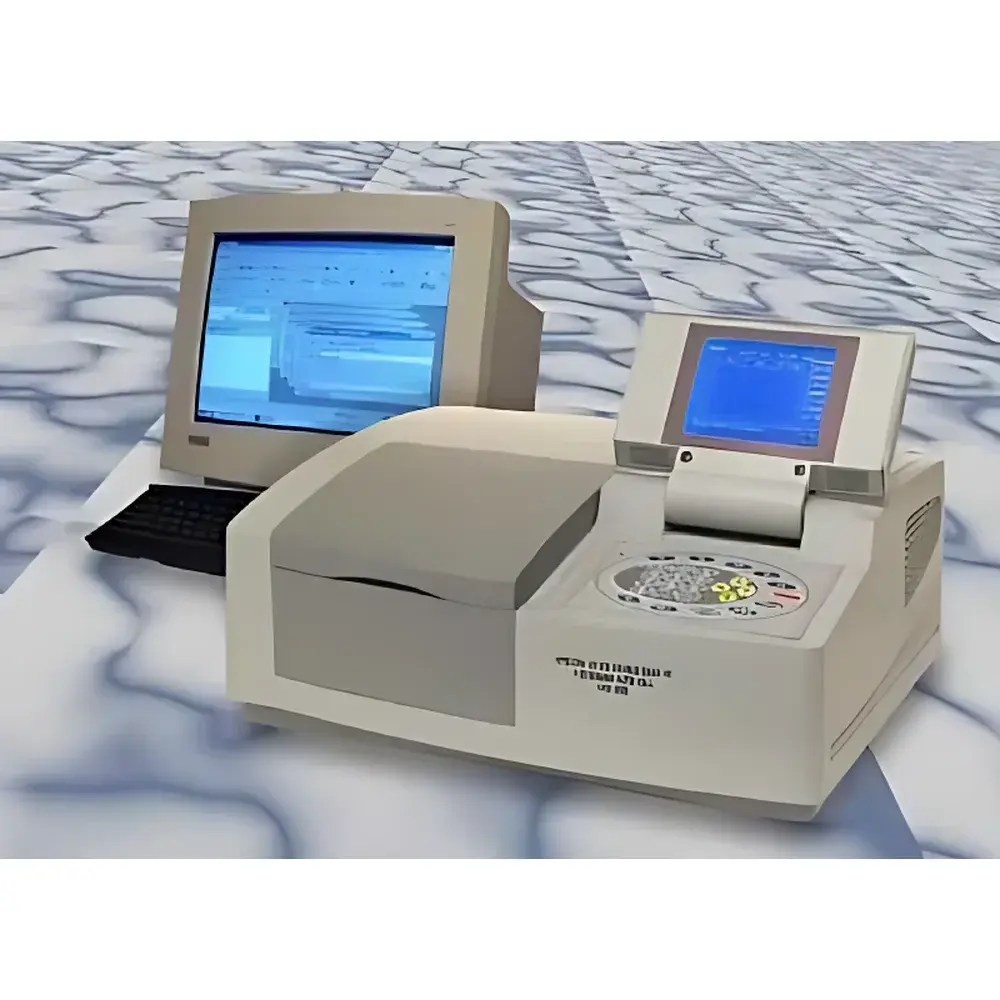
UV-Vis Spectrophotometer Model 2950 Dual-Wavelength
| Origin | USA |
|---|---|
| Manufacturer Type | Authorized Distributor |
| Origin Category | Imported Instrument |
| Model | 2950 |
| Pricing | Available Upon Request |
Overview
The UV-Vis Spectrophotometer Model 2950 Dual-Wavelength is a precision optical absorption measurement system engineered for quantitative and qualitative analysis in research laboratories, quality control environments, and regulatory-compliant testing facilities. Operating on the principle of Beer–Lambert law-based absorbance spectroscopy, the instrument employs a dual-beam optical architecture with dynamic ratio feedback to minimize baseline drift and enhance photometric stability across the full spectral range. Its dual-wavelength capability enables simultaneous or alternating measurements at two user-selectable wavelengths—critical for kinetic assays, differential analysis, and background subtraction in complex matrices. Designed and assembled in the United States, the Model 2950 integrates high-fidelity optical components—including holographic gratings, low-noise silicon photodiodes, and OEM-sourced deuterium and tungsten-halogen lamps—to ensure long-term photometric integrity and spectral fidelity.
Key Features
- Dual-wavelength dynamic ratio feedback system for real-time baseline stabilization and drift compensation
- High-energy optical path with large-aperture optics to maximize signal-to-noise ratio and improve spectral resolution
- Dual-cell holder accommodating both reference and sample cuvettes simultaneously—enabling rapid, reproducible comparative measurements
- Modular lamp bay with standardized sockets for quick, tool-free replacement of deuterium (190–350 nm) and tungsten-halogen (320–1100 nm) sources
- Integrated 320 × 240 pixel LCD display with capacitive touch keypad for standalone operation and parameter navigation
- RS-232 serial interface compliant with ANSI/EIA-232 standards for bidirectional communication with Windows-based host systems
- Robust mechanical architecture: aluminum alloy chassis, precision-machined optical bench, and thermally stable monochromator housing
Sample Compatibility & Compliance
The Model 2950 supports standard 10 mm pathlength quartz and optical glass cuvettes (included), as well as extended-pathlength cells (20–50 mm) via optional multi-position holders. It accommodates flow-through configurations using the optional peristaltic pump and flow cell module—ideal for continuous monitoring applications such as enzymatic kinetics or column eluent detection. All optical components meet ISO 9022-3 (optical instruments — environmental testing) specifications for thermal and mechanical stability. The instrument’s photometric accuracy and wavelength calibration traceability align with ASTM E275, ISO 6059, and USP guidelines for spectrophotometric performance verification. Data acquisition workflows support GLP/GMP audit trails when used with validated software versions compliant with FDA 21 CFR Part 11 requirements.
Software & Data Management
The included Windows-compatible application software (compatible with Windows 98 through Windows 10 x64) provides comprehensive instrument control, spectral scanning, kinetic profiling, multi-point calibration, and quantitative analysis routines—including linear, quadratic, and polynomial regression models. Raw absorbance, transmittance, and concentration data are exportable in CSV, TXT, and XML formats for integration with LIMS or statistical analysis platforms (e.g., JMP, MATLAB, R). Software features include automatic wavelength calibration using optional Nd/Pr oxide and holmium oxide filters, baseline correction algorithms (Savitzky–Golay smoothing), and time-resolved data logging with timestamped metadata. Audit logs record user actions, method parameters, and calibration events—supporting laboratory documentation requirements under ISO/IEC 17025.
Applications
- Pharmaceutical assay development and release testing (e.g., content uniformity, dissolution profile analysis)
- Environmental water quality monitoring (nitrate, phosphate, COD, heavy metal chelates)
- Food and beverage quality assurance (colorimetric quantification of antioxidants, pigments, preservatives)
- Academic and industrial materials science (bandgap determination of semiconductors, nanoparticle extinction coefficient analysis)
- Clinical biochemistry (enzyme activity assays, protein quantification via Bradford/Lowry methods)
- Method validation studies requiring dual-wavelength correction for turbidity or matrix interference
FAQ
What wavelength accuracy does the Model 2950 achieve after auto-calibration?
±0.5 nm across 190–1100 nm, verified using traceable holmium oxide and didymium filters per ISO 6059.
Is the instrument compatible with modern operating systems beyond Windows XP?
Yes—driver and software packages are validated for Windows 7, 8.1, and 10 (64-bit); virtual machine deployment is supported for legacy method continuity.
Can the Model 2950 perform kinetic scans at dual wavelengths simultaneously?
It supports alternating-wavelength kinetic mode with user-defined dwell times; true simultaneous dual-wavelength detection requires external beam-splitting accessories.
What is the recommended maintenance interval for lamp replacement?
Deuterium lamps: 1,000–1,500 hours; tungsten-halogen lamps: 2,000–3,000 hours—both monitored via built-in usage counters and lamp health diagnostics.
Does the system support electronic signatures and audit trail functionality per 21 CFR Part 11?
When deployed with validated software version 3.2 or later and configured with network-authenticated user accounts, full Part 11 compliance—including electronic signatures, role-based access, and immutable audit logs—is achievable.
Related Products




